
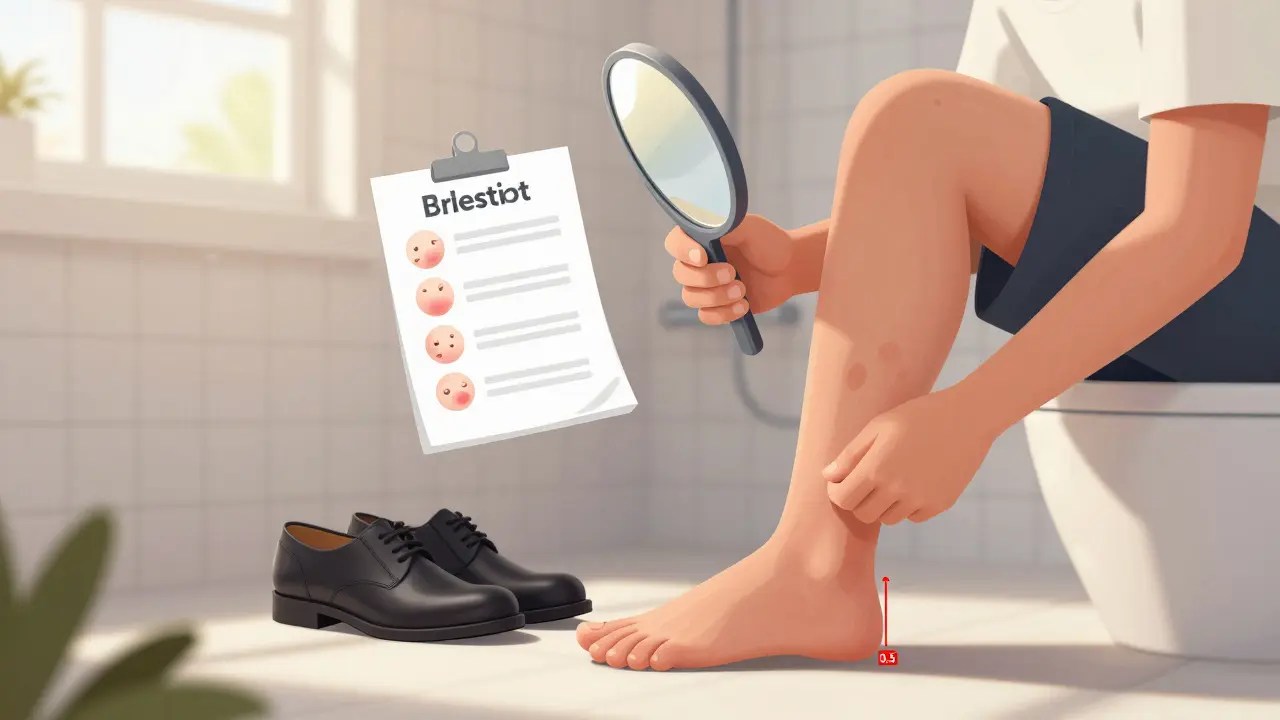
Every year, over 82,000 people in the U.S. lose a foot or leg because of diabetes. Most of these amputations don’t have to happen. They start with a small cut, blister, or sore that goes unnoticed - often because nerve damage hides the pain. The good news? You can stop this before it starts. With a daily inspection routine and the right habits, you can keep your feet healthy and avoid ulcers entirely.
Why Foot Care Matters More Than You Think
If you have diabetes, your feet are at risk. High blood sugar damages nerves over time, making it harder to feel heat, cold, or pain. This is called diabetic neuropathy. At the same time, poor circulation slows healing. A tiny blister from a tight shoe can turn into a deep ulcer in days. And once an ulcer forms, infection can spread fast - sometimes leading to amputation. The International Working Group on the Diabetic Foot (IWGDF) says 15% to 25% of people with diabetes will develop a foot ulcer in their lifetime. That’s more than one in five. But here’s the key: 80% of these ulcers are preventable. The problem isn’t lack of knowledge. It’s consistency. Most people know they should check their feet. But only 42% actually do it every day.The Five Essentials of Ulcer Prevention
The latest guidelines from the IWGDF (2023) break down prevention into five non-negotiable steps:- Know your risk level
- Inspect your feet every single day
- Wear the right shoes - no exceptions
- Learn what to look for
- Manage what you can control
Your Daily Foot Inspection Checklist
This isn’t optional. It’s your first line of defense. Do this every morning or evening - same time, same light. Natural daylight between 10 a.m. and 2 p.m. is best. Body temperature changes during the day can hide early signs of swelling or infection.- Wash your feet in lukewarm water - between 90°F and 95°F. Test the temperature with your elbow or a thermometer. Hot water burns skin that can’t feel it.
- Dry completely, especially between the toes. Moisture invites fungus and cracks.
- Inspect every surface. Use a mirror to see the bottom of your feet. If you can’t bend over, ask a family member or use a handheld mirror. Look for:
- Blisters larger than 3mm
- Cuts or scrapes deeper than 1mm
- Redness bigger than a quarter (1 inch)
- Swelling that makes your shoe feel tighter
- Warm spots - if one foot feels hotter than the other
- Ingrown toenails or yellow, thick nails (signs of fungus)
- Dry, cracked skin - especially around the heel
Pay extra attention to the balls of your feet - the area under your metatarsal bones. That’s where 92% of ulcers start because of pressure from walking.
- Moisturize dry skin with unscented lotion. Never put lotion between your toes - that traps moisture and causes infections.
- Trim your nails straight across. Don’t cut them too short. Leave 1-2mm of nail beyond the tip of your toe. File sharp edges smooth. If your vision is poor or your hands shake, get a podiatrist to do it.
Footwear: The Most Overlooked Factor
Shoes are your second skin. Wearing the wrong ones is the #1 cause of foot ulcers in people with neuropathy. The IWGDF says 87% of forefoot ulcers come from pressure points in ill-fitting shoes. You don’t need expensive “therapeutic” shoes unless you’re at moderate or high risk. But you do need shoes that fit right:- There should be 0.5 inches (12.7mm) of space between your longest toe and the end of the shoe.
- Your toes should have room to spread - about 15mm of width beyond your widest toe.
- The heel counter (back of the shoe) should be firm, not floppy. A good test: pinch the heel. If it collapses easily, it’s too soft.
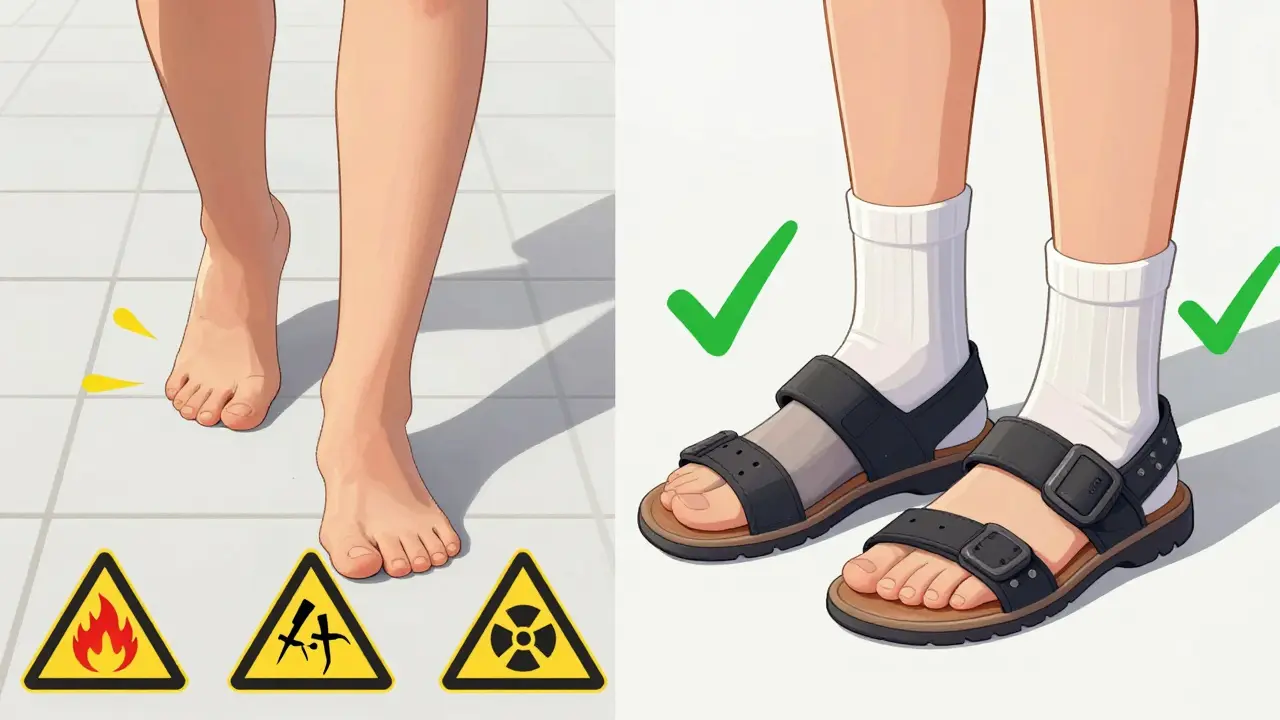
Never walk barefoot - not even indoors. The CDC found people who walk barefoot for just 5 minutes a day are 11 times more likely to get an ulcer. Flip-flops and sandals? Avoid them. Studies show they increase ulcer risk by 4.3 times because they offer no support or protection.
Even in summer, when it’s 89°F, people swap their shoes for sandals. That’s when ulcers spike. Wear breathable, closed-toe shoes with moisture-wicking socks. Change socks daily. Cotton or wool blends are best.
What Not to Do
Some common habits are dangerous - even if they seem harmless:- Don’t use heating pads or hot water bottles on your feet. You can’t feel burns until it’s too late.
- Don’t try to cut corns or calluses yourself. Use a pumice stone gently after bathing, or see a podiatrist.
- Don’t ignore redness or warmth. If a spot stays red for more than 24 hours, or feels warmer than the rest of your foot, call your doctor. That’s an early sign of infection.
- Don’t use antibiotics without a diagnosis. The IDSA says giving antibiotics to uninfected ulcers increases drug resistance without helping healing.
- Don’t do unsupervised foot exercises. Some ankle stretches can increase pressure on weak spots. Only do them if your doctor or podiatrist approves them.
When to Call Your Doctor
You don’t need to panic over every little bump. But these signs mean act now:- Redness spreading beyond 1 inch
- Swelling that makes your shoe feel tight
- Drainage - yellow, green, or bloody fluid
- Foul odor from your foot
- Black or dark tissue - that’s dead skin (necrosis)
- Fever or chills
If you see any of these, call your doctor the same day. Don’t wait. Ulcers heal faster when caught early. The longer you wait, the higher the chance of infection spreading to bone.
Barriers to Care - And How to Beat Them
Many people want to do the right thing but can’t. Vision problems make it hard to see small cuts. Arthritis makes it painful to bend down. Low income means expensive shoes or sensors are out of reach. Here’s what works:- If you can’t see your feet, use a handheld mirror or ask a family member to help. Set a daily alarm as a reminder.
- If you can’t reach your feet, try a long-handled shoe horn or a foot inspection tool with a mirror on a stick. Some are sold at medical supply stores.
- If shoes are too expensive, ask your doctor for a referral to a podiatry clinic. Many offer free or low-cost shoes through grants or insurance programs.
- If you’re on Medicaid, know this: as of January 2024, 47 states require annual foot exams for Medicaid patients. Ask your provider to schedule yours.
Technology can help - but it’s not a must. Wireless insoles that track foot temperature can warn you of an ulcer 4-7 days before it appears. But they cost $299 upfront plus $99 a month. That’s too much for many. Smartphone apps that analyze photos of your feet show 89% accuracy in detecting ulcers. But they need good internet - a problem in rural areas. Use them if you can afford them, but don’t wait for tech to start checking your feet manually.
Integrated Care Works
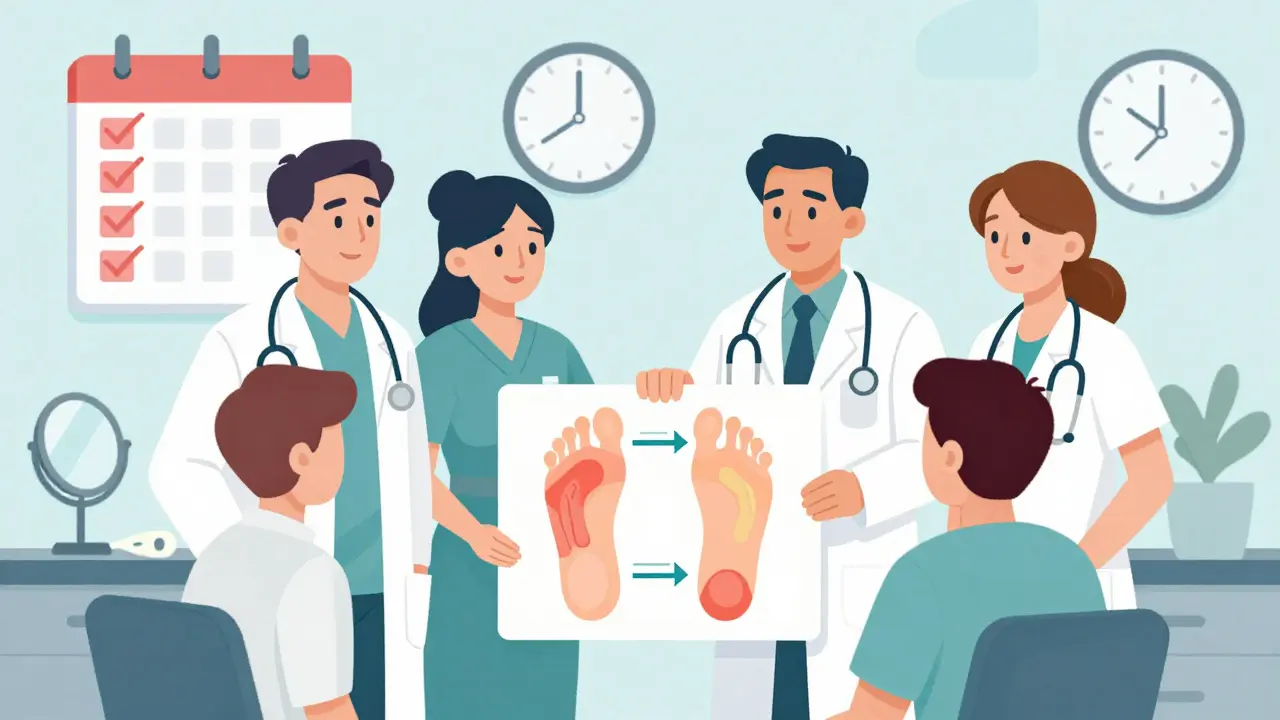
The best outcomes happen when care is coordinated. That means your primary care doctor, podiatrist, diabetes educator, and sometimes a vascular specialist all work together. If you’re at moderate or high risk, ask for an integrated foot care plan. Studies show these programs cut ulcers by 36% and amputations by 42%.You don’t need to do this alone. Ask your doctor for a referral to a certified diabetes care and education specialist (CDCES). They can teach you how to inspect your feet, choose shoes, and manage your blood sugar - all in one place.
What’s New in 2026
The biggest change? No more nerve decompression surgery for prevention. Once common, new data shows it doesn’t reduce ulcers. It’s no longer recommended. Also, the CDC’s 2024 goal is to cut diabetes-related amputations by 25% by 2030. That’s possible - but only if more people check their feet every day.It’s not about perfection. It’s about showing up. Miss one day? Don’t give up. Just start again tomorrow. Your feet can stay healthy - if you give them the attention they need.
Can I use a mirror to check my feet if I have trouble bending over?
Yes. A handheld mirror or a long-handled foot inspection tool works well. Place the mirror on the floor and angle it to see the bottom of your feet. You can also ask a family member or caregiver to help. The goal is to see every part of your foot - so use whatever tool makes it possible.
Is it safe to soak my feet in Epsom salt or herbal solutions?
No. Soaking your feet for long periods can dry out your skin and cause cracks. Epsom salt or herbal mixtures don’t offer proven benefits and may irritate sensitive skin. Stick to plain lukewarm water and mild soap. Dry thoroughly after washing.
Do I need special socks for diabetic foot care?
Yes - but not because they’re magic. Diabetic socks are seamless, non-binding, and made from moisture-wicking materials like cotton or wool blends. They reduce friction and prevent swelling. Avoid socks with elastic tops or seams that dig into your skin. Change them daily.
Can I still exercise if I have diabetes?
Yes - but choose wisely. Walking, swimming, and cycling are safe. Avoid high-impact activities like running or jumping if you have nerve damage or foot deformities. Always wear proper shoes. If you’re unsure, ask your doctor for a gait analysis before starting a new routine.
How often should I see a podiatrist?
If you’re at low risk (Risk 0 or 1), once a year is enough. If you’re at moderate or high risk (Risk 2 or 3), see a podiatrist every 2 to 3 months. They can trim nails safely, remove calluses, check for pressure points, and adjust your footwear. Don’t wait for a problem to arise.
What if I can’t afford therapeutic shoes?
Many insurance plans, including Medicaid in 47 states, cover one pair of therapeutic shoes per year. Ask your doctor for a prescription and referral to a certified pedorthist. Some nonprofit organizations and clinics offer free or discounted shoes. Never skip shoes because of cost - the cost of an ulcer is far higher.
Can I use over-the-counter corn removers or wart treatments?
No. These products contain acids that can burn your skin. If you have a corn or wart, see a podiatrist. Self-treatment can turn a small issue into a deep ulcer. Your feet are too sensitive to risk chemical treatments.
Why does my foot feel warmer than the other?
A temperature difference of more than 4°F between feet can signal early inflammation - often before a sore appears. This is why some people use smart insoles that track temperature. But even without tech, you can feel it. If one foot feels noticeably warmer, check for redness, swelling, or pain. Call your doctor. It could be the start of an ulcer.

This changed my life. I check my feet every night now. No more ignoring the little red spot.
They say 80% of ulcers are preventable. That’s not a statistic - that’s a slap in the face to everyone who thought ‘it won’t happen to me.’
Turns out, the only thing more dangerous than diabetes? Complacency.
Let’s be real - this isn’t about medical advice. It’s about dignity.
When you lose a foot to something you could’ve prevented, you’re not just losing tissue - you’re losing autonomy.
Every morning you skip the mirror check, you’re choosing to let your body become a casualty of neglect.
And no, ‘I’m too tired’ doesn’t cut it. You brush your teeth. You shower. Why not your feet?
This isn’t a chore. It’s a rebellion against the slow, quiet violence of chronic disease.
My grandfather lost both legs because he thought ‘it’s just a blister.’ He didn’t die from diabetes. He died from not being heard.
Don’t be him. Don’t be any of us who put it off until tomorrow.
Tomorrow never comes. But your feet? They remember every single day you ignored them.
The IWGDF 2023 guidelines are unequivocal: diabetic neuropathy-driven biomechanical stressors, compounded by suboptimal footwear biomechanics and impaired microcirculatory perfusion, are the primary etiological triad underlying preventable ulcerogenesis.
Empirical data from the CDC’s 2024 surveillance cohort corroborates that 87% of forefoot ulcers derive from localized pressure differentials exceeding 200 kPa - thresholds routinely breached by conventional footwear lacking offloading architecture.
Furthermore, thermal asymmetry >4°F between bilateral plantar surfaces exhibits 91% sensitivity for subclinical inflammation, preceding macroscopic tissue breakdown by 4–7 days.
Yet, adherence remains abysmal due to cognitive dissonance between risk perception and behavioral execution - a phenomenon well-documented in health psychology literature as the ‘paradox of preventive compliance.’
Interventions must transcend education and target executive function deficits via implementation intentions and environmental cueing.
Mobile photo-based screening tools demonstrate 89% diagnostic concordance with clinical assessment - yet their utility is nullified by digital inequity in rural and low-SES populations.
Therapeutic footwear reimbursement policies remain fragmented; 47 states mandate Medicaid coverage, yet provider awareness is <15%.
Until we institutionalize foot inspection as a vital sign - alongside BP and glucose - we’re treating symptoms, not the disease of systemic neglect.
Why are we spending billions on this when the real problem is people who won’t stop eating sugar?
My cousin’s uncle got his foot cut off - and he still eats donuts every morning.
It’s not the shoes. It’s the laziness.
Fix the people, not the socks.
Ugh. I just don’t understand how people can be so careless with their bodies.
You know what? I’ve been checking my feet since I was 25. I don’t even have diabetes. I just believe in self-respect.
And if you’re too lazy to look at your own feet? That’s not a medical issue - that’s a moral failure. 😔
Also, I started meditating every morning and now my blood sugar is perfect. Coincidence? I think not.
I’ve been reading through this checklist and I’m struck by how much of this is about consistency rather than complexity.
The science is clear - daily inspection, proper footwear, avoiding heat, not cutting corns yourself - these aren’t new ideas.
So why do so many people fail?
Is it the cost? The lack of access? Or is it something deeper - like the way we’ve been taught to ignore our bodies until they scream?
I think about my dad, who had type 2 for 20 years and never checked his feet once.
He’d say, ‘I feel fine.’ But feeling fine doesn’t mean you’re safe.
Maybe the real barrier isn’t knowledge - it’s the quiet, daily surrender to the belief that ‘it won’t happen today.’
And that’s the hardest thing to fix.
Not the shoes. Not the mirrors. Not even the money.
Just the habit of showing up - even when you’re tired, even when it’s boring, even when you don’t feel like it.
Who says you need a mirror? Just feel your feet with your hands
Also why are we paying for fancy socks when socks are socks
And who told you to use a thermometer? Your elbow works fine
Also why are we still talking about this like it’s new? My grandma did this in 1972
And stop with the ‘risk levels’ - you’re either paying attention or you’re not
It’s not rocket science
Stop overcomplicating it
Let me guess - this post was written by someone who’s never had to choose between insulin and shoes.
You think I’m gonna check my feet when I’m working two jobs and my Medicaid won’t cover a $200 pair of ‘therapeutic’ shoes?
And don’t give me that ‘it’s 80% preventable’ crap.
That’s just guilt-tripping people who are already drowning.
Fix the system. Not the patient.
I used to skip foot checks. Then I got a blister from my flip-flop and it turned into a whole thing.
Had to go to the ER. Cost me $12k.
Now I check every night. No excuses.
And no, I don’t use a mirror - I just ask my dog. He’s a good listener.
And he doesn’t judge.
Respected Sir, I am deeply moved by the comprehensive guidelines provided in this post. As a diabetic patient from India, I have been practicing daily foot inspection since 2019, and I wish to humbly suggest that the Indian Ministry of Health should consider distributing free foot inspection mirrors in primary health centers. The cost of a simple handheld mirror is negligible, yet its impact is profound. May I also recommend the inclusion of multilingual pictorial guides in regional languages to enhance accessibility for the elderly and visually impaired? Thank you for your tireless efforts in saving lives.
With profound respect,
Rakesh Kakkad