
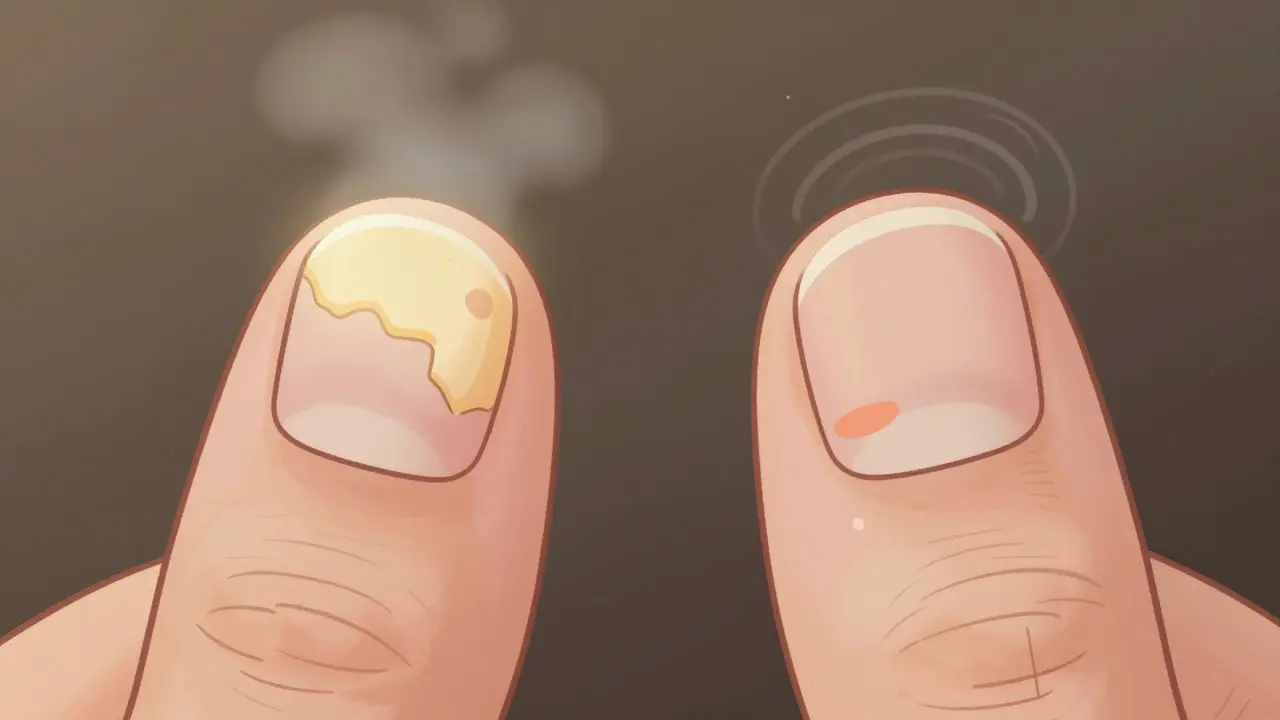
What’s Really Going On With Your Nails?
If your nails are thick, discolored, or peeling, it’s easy to assume it’s a fungal infection. But what if it’s not? Nail psoriasis and fungal nail infections look almost identical-yellow, crumbly, lifted nails-and both are common. Yet they need completely different treatments. Misdiagnosing one for the other doesn’t just waste time-it can make things worse.
Up to 10% of people worldwide deal with one or both of these conditions. And here’s the kicker: nearly 40% of cases get mixed up. That means hundreds of thousands of people are using antifungal creams when they need immune-modulating drugs-or taking steroids when they need oral antifungals. The result? Months of frustration, worsening nails, and unnecessary costs.
Fungal Nails: The Slow Burn
Fungal nail infections, or onychomycosis, start small. Usually, you’ll notice a tiny white or yellow spot under the tip of the nail. Over months, it creeps toward the cuticle. The nail gets thicker, often to 3-5 mm, and turns brown or black. The edges curl. Sometimes, it smells-like old socks left in a gym bag. That odor? A red flag. It’s rare in psoriasis, common in fungal cases.
The usual culprit? Trichophyton rubrum. This fungus loves warm, damp places. Walk barefoot in public showers? Wear tight shoes for hours? You’re inviting it in. It doesn’t care if you’re healthy or have psoriasis-it just wants a place to grow. That’s why older adults, especially those over 60, are more likely to get it. Nails grow slower with age, giving fungi more time to take hold.
Treatment? It’s slow. Topical antifungals need 9-12 months to clear a toenail because nails grow just 0.1 mm per day. Oral meds like terbinafine work faster-78% of patients clear the infection after 12 weeks, confirmed by lab tests. But they come with risks: liver checks are required. And if you don’t finish the full course? The fungus comes back.
Nail Psoriasis: It’s Not Just a Nail Problem
Nail psoriasis isn’t an infection. It’s your immune system attacking your nail matrix-the living tissue under the cuticle that makes the nail. In psoriasis, skin cells turn over every 3-4 days instead of 28-30. That chaos spills over into your nails.
Look for nail pitting: tiny dents like a pinpricked surface. It’s the #1 sign-present in 70% of cases. Then there’s salmon patches: translucent orange-red spots under the nail. Oil-drop lesions look like a drop of oil trapped under the nail plate. And onycholysis? That’s the nail lifting from the bed, often without pain. Unlike fungal infections, psoriasis doesn’t usually cause odor.
Here’s what makes it tricky: 80-90% of people with nail psoriasis already have skin psoriasis. But sometimes, nails are the first sign. And it hits fingernails harder than toenails-75% of cases start there. Nail thickness? Moderate-usually 2-3 mm. Not as thick as fungal nails, but still noticeable.
Treatment is different, too. Topical steroids or steroid injections under the nail can help. For severe cases, biologics like secukinumab (Cosentyx) show results in 24 weeks-65% of patients see improvement. But these are injectables, expensive, and require a specialist. You can’t just buy them over the counter.
How to Tell Them Apart: The Real Differences
Doctors don’t guess. They look for clues.
- Pitting: Present in 78% of psoriasis cases, almost never in fungal infections.
- Foul odor: Found in 40% of fungal cases, 0% in psoriasis.
- Onset: Fungal infections creep in slowly. Psoriasis can flare suddenly, often affecting multiple nails at once.
- Location: Fungal starts at the tip or sides. Psoriasis often starts near the cuticle or lunula.
- History: Do you have psoriasis on your elbows, knees, or scalp? That’s a huge clue.
And here’s something most people don’t know: psoriasis can make you more vulnerable to fungal infections. About 5-30% of people with nail psoriasis develop a secondary fungal infection. That’s called a superinfection. It’s why some patients get worse on antifungals-they’re treating the wrong problem.
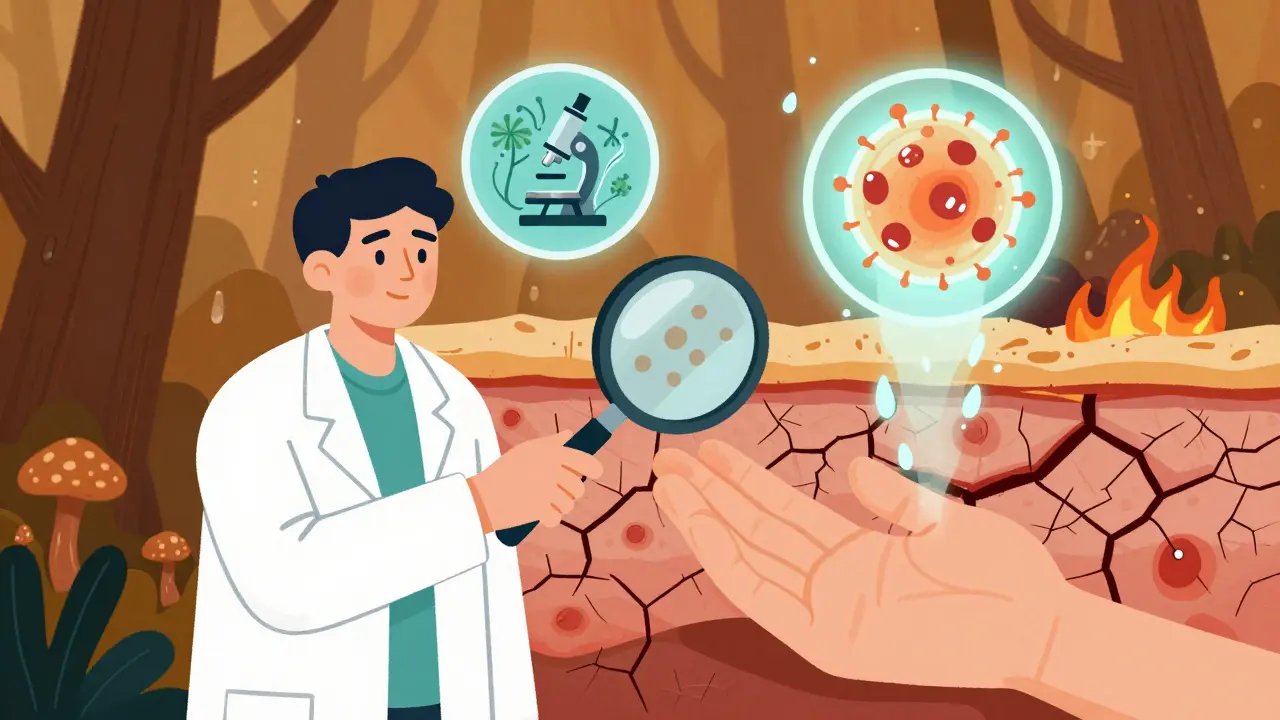
What Doctors Actually Do to Diagnose
Visual exam alone? Only 52% accurate for primary care doctors. Dermatologists? 85%. So if you’re unsure, see a skin specialist.
Here’s the standard diagnostic path:
- Clinical check: Look for pitting, oil spots, salmon patches-signs of psoriasis.
- KOH test: A scraping of the nail is mixed with potassium hydroxide and looked at under a microscope. It finds fungus 70-80% of the time.
- Fungal culture: If KOH is negative but suspicion remains, they grow the sample in a lab. Takes weeks, but 95% specific.
- PAS staining: A special dye that highlights fungal elements in nail tissue. Used when culture is inconclusive.
Some clinics now use reflectance confocal microscopy-a non-invasive imaging tool that shows nail structure in real time. In a 2023 Mayo Clinic study, it correctly identified the condition in 92% of cases.
Don’t be fooled by at-home test kits. They’re unreliable. And don’t assume your nail looks “classic.” Psoriasis can mimic fungus so well that even experienced doctors get it wrong.
What Happens If You Get It Wrong?
Using antifungals for psoriasis? You’ll waste months. The nail won’t improve. You might even get more inflammation.
Using steroids for a fungal infection? Even worse. Steroids suppress your immune system. That lets the fungus spread faster. Patients report nails becoming brittle, crumbling, and more painful.
One Reddit user wrote: “After 8 months of antifungals, my nails got worse. I ended up with painful separation.” That’s not uncommon. A Healthline survey found 78% of psoriasis patients waited over six months for the right diagnosis. Each visit cost money. Each wrong treatment cost hope.
On the flip side, a fungal infection misdiagnosed as psoriasis gets ignored. The fungus keeps growing. It can spread to other nails-or even your skin. In diabetics or people with poor circulation, that’s a serious risk.
What You Can Do at Home
While you wait for a diagnosis, here’s what helps:
- For suspected fungal infection: Keep nails dry. Use moisture-wicking socks. Avoid tight shoes. Dry between toes after showers. Humidity above 40% feeds fungi.
- For suspected psoriasis: Avoid trauma. Don’t pick at your nails. Use thick emollients like petroleum jelly on the cuticles to prevent separation. Moisturize daily.
- Both: Take photos monthly. Use the same lighting and angle. Track changes. This helps your doctor see progression.
Don’t try bleach soaks, vinegar baths, or tea tree oil as a cure. They’re not proven. And they can irritate already sensitive skin.
Costs, Trends, and What’s Coming
The global market for nail disorder treatments hit $2.8 billion in 2023. Antifungals like Jublia cost hundreds per bottle. Biologics like Cosentyx run over $40,000 a year. That’s why misdiagnosis isn’t just a medical error-it’s a financial one. In the U.S. alone, wrong treatments cost $850 million annually.
Research is moving fast. Scientists are now analyzing the nail microbiome. Early studies show psoriasis nails have more Staphylococcus, less Cutibacterium. Fungal nails have high levels of Trichophyton DNA. In the next few years, a simple swab might tell you exactly what you’re dealing with.
AI tools are being trained to analyze nail photos. The Global Psoriasis Atlas predicts a 22% drop in misdiagnosis by 2027. Climate change is also a factor-warmer, wetter weather expands fungal habitats. We’ll likely see more cases in the coming decade.
When to See a Doctor
If your nails have changed in the last 3-6 months, especially if:
- You have pitting or oil-drop spots
- Multiple nails are affected at once
- You have psoriasis elsewhere on your body
- Antifungals didn’t work after 3 months
- Your nail is lifting, painful, or smells
Don’t wait. A dermatologist can run the right tests. And if you’re unsure where to start, ask for a NAPSI score-a standardized system that measures nail damage in four zones. It’s not just for diagnosis. It tracks progress.
Bottom Line
Fungal nails and nail psoriasis are not the same. They look alike. They feel alike. But their causes, treatments, and long-term outcomes are worlds apart. The key isn’t just treating the nail-it’s understanding what’s driving the problem.
Don’t guess. Don’t self-treat. Don’t rely on internet advice. Get the right test. See a specialist. Your nails will thank you.
Can nail psoriasis be cured?
Nail psoriasis can’t be permanently cured, but it can be well-controlled. Biologic drugs like secukinumab and ustekinumab significantly reduce symptoms in most patients, with up to 65% showing major improvement after 6 months. Topical treatments and steroid injections help manage flare-ups. Consistent care keeps nails looking normal for long periods.
Is a fungal nail infection contagious?
Yes. Fungal nail infections spread through direct contact with infected surfaces-like showers, locker rooms, or shared towels. They can also spread from one nail to another on the same person. It’s not airborne, but sharing shoes or nail clippers increases risk. Keep personal items separate and disinfect tools after use.
Why do antifungals sometimes make nail psoriasis worse?
Antifungals don’t treat psoriasis-they target fungi. If you have psoriasis, using antifungals does nothing for the immune-driven inflammation. Meanwhile, the nail continues to separate and thicken. Some patients also develop secondary infections from irritation caused by harsh topical treatments. The result? More damage and delayed diagnosis.
Can I test for fungal infection at home?
Home test kits are unreliable. They often give false negatives or positives. The only accurate way is through a lab test: KOH prep, fungal culture, or PAS staining-all done by a dermatologist. Don’t waste money on kits. A $20 test at a clinic is far more trustworthy.
How long does it take for a nail to grow back normally?
Fingernails grow about 3 mm per month and take 4-6 months to fully replace. Toenails grow slower-about 1 mm per month-and can take 12-18 months to grow out completely. Even after successful treatment, you’ll need patience. The new nail must grow in healthy before you see full improvement.
Does stress make nail psoriasis worse?
Yes. Stress is a known trigger for psoriasis flares, including nail changes. Emotional stress, injury to the nail (like biting or manicures), and even cold weather can worsen symptoms. Managing stress through sleep, exercise, or mindfulness can help reduce flare frequency.
Can I still get a manicure or pedicure with nail psoriasis or fungus?
Yes-but with caution. Avoid aggressive filing, cuticle pushing, or soaking. Use your own tools, or bring sterilized ones. Tell the technician about your condition. Salons that reuse tools can spread fungus. For psoriasis, avoid polish with formaldehyde or acetone-it dries out nails and worsens separation.
Are there natural remedies that work?
No proven natural cures exist. Tea tree oil, vinegar, or coconut oil may have mild antifungal properties, but studies show they’re far less effective than prescription treatments. For psoriasis, moisturizers help with dryness but don’t stop immune activity. Relying on unproven remedies delays proper care and risks permanent damage.

Okay, I’ve been dealing with this for years, and honestly? This post saved my sanity. I thought I had fungus-bought every antifungal cream known to man. Turns out, it was psoriasis. My dermatologist finally did a KOH test and PAS staining. No fungus. Just my immune system being dramatic. Started on secukinumab. Six months later, my nails look like normal human nails again. Don’t self-diagnose. Get the tests.
OMG I KNEW IT. Everyone else is just too lazy to admit they don’t know what they’re doing. I told my cousin she had psoriasis and she went and bought antifungal cream for 6 months. Her nails looked like burnt toast. Now she’s in therapy for the emotional trauma. This is why we need more doctors who actually read medical journals. Not just ‘Google it and hope’ practitioners.
My mom had this for like 15 years and no one figured it out until she saw a dermatologist who actually listened. She said the oil-drop spots were the giveaway. Now she uses petroleum jelly daily and gets steroid injections every 3 months. It’s not a cure, but it’s manageable. Also-don’t use nail polish with formaldehyde. It’s like pouring acid on your cuticles.
Antifungals for psoriasis? That’s like giving insulin to a diabetic with Type 1. Basic biology. Why do people think medicine is a guessing game? The fact that 40% of cases are misdiagnosed is a national disgrace. And don’t even get me started on those ‘natural remedies’ TikTok influencers. They’re not healers. They’re predators.
My nails have been weird since college. Always thought it was fungus. Turned out it was psoriasis. I had zero skin symptoms. No one told me nails could be the first sign. Learned the hard way. Now I take photos every month. It’s the only way to track progress.
It’s fascinating how much we assume about our bodies based on appearances. Two things look the same, so we treat them the same. But biology doesn’t care about appearances. It cares about mechanisms. Fungal infection is an invader. Psoriasis is a betrayal from within. One needs to be killed. The other needs to be understood. Maybe that’s the real lesson here.
Big shoutout to dermatologists 🙌. Seriously, if you’ve got weird nails, don’t wait. Go see one. I had a 3-month wait but it was worth it. My nail tech noticed the pitting first-she’s been doing nails for 20 years. She said, ‘Girl, that’s not fungus.’ I cried. Then I went to the doc. Biologics changed my life. 🌱
They don’t want you to know this but the pharmaceutical companies are making billions off this confusion. Antifungals are cheap to make. Biologics? Pricey. Who benefits when you waste 8 months on the wrong treatment? Hint: not you. And no, your ‘natural’ vinegar soak isn’t going to fix it. It’s just a distraction while they sell you more pills.
i read this and i think maybe the whole thing is a scam. why do we even have 3 different tests for something that should be obvious? maybe the doctors are just confused. maybe the whole nail thing is just a distraction from real health problems. i dont trust medicine anymore. i eat garlic and i dont wear shoes indoors. my nails are fine now. also why is this article so long? i got bored
so like... what if the fungus is actually the immune system trying to clean up the psoriasis? what if we're just fighting the messenger? like maybe the body's trying to heal and we're just throwing chemicals at it? i'm not saying i'm right... but... what if?
Let me tell you something-this isn’t just about nails. It’s about how we treat our bodies like machines instead of living, breathing, emotional systems. I had nail psoriasis after my divorce. The stress triggered it. The doctors treated the nail. No one asked me how I was sleeping. No one asked if I was eating. No one asked if I still felt like I mattered. I got better when I started meditating, walking in nature, and stopped letting people drain my energy. The biologics helped-but the healing? That came from within. Your nails reflect your soul. Don’t ignore that.
so i tried tea tree oil for 3 months. it smelled like a forest fire. my nails looked the same. my cat started avoiding me. i finally went to the doc and they were like ‘uh yeah that’s psoriasis.’ i’m mad. but also… kinda proud i didn’t buy into the ‘vinegar soak for 2 hours daily’ cult. also-why do people think ‘natural’ means ‘better’? my phone is natural too. doesn’t mean i trust it to run my life.
Why are we letting foreigners and overpriced biologics control our health? In America, we used to fix things ourselves. Back in my day, you’d just cut the nail off and move on. Now we’re doing DNA tests on our toenails? This is why we’re broke. Get a real doctor. Not some guy with a microscope in a lab coat.