
Trimethoprim Hyperkalemia Risk Calculator
Your Risk Factors
Results
Your risk score: 0
When you take an antibiotic like Bactrim or Septra for a urinary tract infection, you’re probably not thinking about your potassium levels. But here’s the thing: trimethoprim, one of the two active ingredients in these drugs, can quietly spike your potassium to dangerous levels - sometimes in just 2 or 3 days. And if you’re over 65, have kidney issues, or take blood pressure meds like lisinopril or losartan, this isn’t just a theoretical risk. It’s a real, life-threatening one.
How Trimethoprim Messes With Your Kidneys
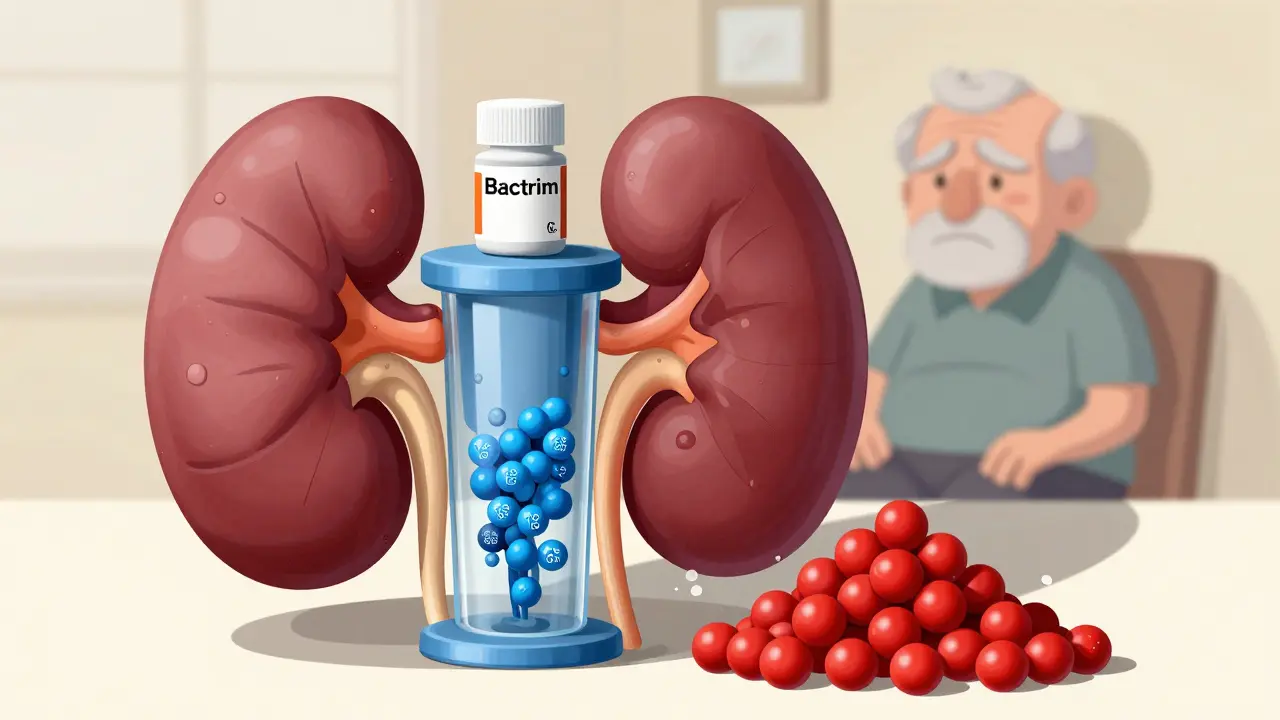
Trimethoprim doesn’t work like most antibiotics when it comes to potassium. It doesn’t cause diarrhea or vomiting that might lower your levels. Instead, it acts like a hidden diuretic - but not the kind that makes you pee more. It’s the opposite: a potassium-sparing diuretic, similar to the drug amiloride. This means it blocks sodium channels in your kidneys, which indirectly stops potassium from being flushed out in your urine.
Think of your kidneys like a filter. Normally, sodium gets reabsorbed, and potassium gets pushed out into the urine. Trimethoprim jams that system. Sodium stays in, potassium stays in. And over time, that builds up. Studies show serum potassium can rise by 0.5 to 1.5 mmol/L within 48 to 72 hours of starting the drug. That might not sound like much - but normal potassium is 3.5 to 5.0 mmol/L. Go above 5.5, and your heart rhythm can start to wobble. Above 6.5? You’re at risk of cardiac arrest.
Who’s Most at Risk?
This isn’t a problem for everyone. But certain people are sitting on a ticking clock when they take trimethoprim:
- People over 65 - age slows kidney function, even if blood tests look fine
- Those with chronic kidney disease (eGFR under 60)
- Anyone taking ACE inhibitors (like enalapril) or ARBs (like valsartan)
- Patients already on potassium-sparing diuretics like spironolactone
- People with diabetes - it often comes with kidney changes you might not know about
A 2014 study in JAMA Internal Medicine found that older adults on ACEIs or ARBs who took trimethoprim had a 6.7-fold higher risk of being hospitalized for high potassium than those who took amoxicillin. That’s not a small bump. That’s a massive jump.
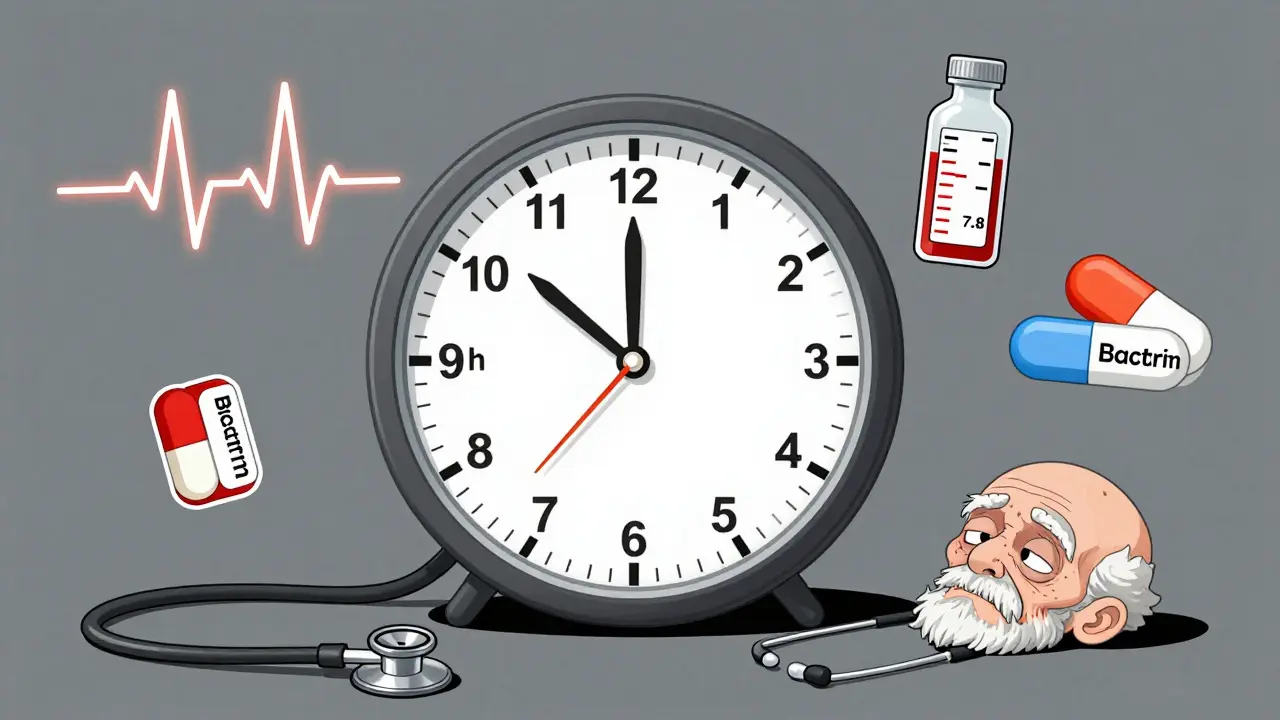
And here’s the scary part: you don’t need to have bad kidneys to be at risk. A 2023 case report described an 80-year-old woman with normal creatinine levels (0.7 mg/dL) who developed a potassium level of 7.8 mmol/L - just 72 hours after starting a low-dose Bactrim pill for pneumonia prevention. She had no history of kidney disease. No warning signs. Just a single pill, and her heart nearly stopped.
How Often Does This Actually Happen?
It’s more common than most doctors realize.
- 8.4% of patients on standard-dose trimethoprim develop hyperkalemia - that’s about 1 in 12 people.
- In those with kidney disease, it jumps to 17.6% - nearly 1 in 5.
- For high-dose trimethoprim (used for pneumonia prophylaxis), it’s 23.7%.
- Among patients with diabetes, kidney disease, and an ACEI/ARB - the triple threat - the rate hits 32.1%.
And it’s not just numbers. Between 2010 and 2020, the FDA’s adverse event database recorded 1,247 cases of trimethoprim-related hyperkalemia - including 43 deaths. Two-thirds of those deaths were in people over 65.
Reddit threads from doctors tell the same story. One wrote: “72-year-old woman on lisinopril. Normal creatinine. Took Bactrim for UTI. Three days later, potassium 6.8. Needed emergency dialysis.” Another: “I’ve reviewed 200+ scripts for Bactrim in patients on ACEIs. Only 15% had potassium over 5.5. But when it happens? It’s bad.”
What’s the Alternative?
If you need an antibiotic for a UTI, respiratory infection, or skin infection, there are safer choices.
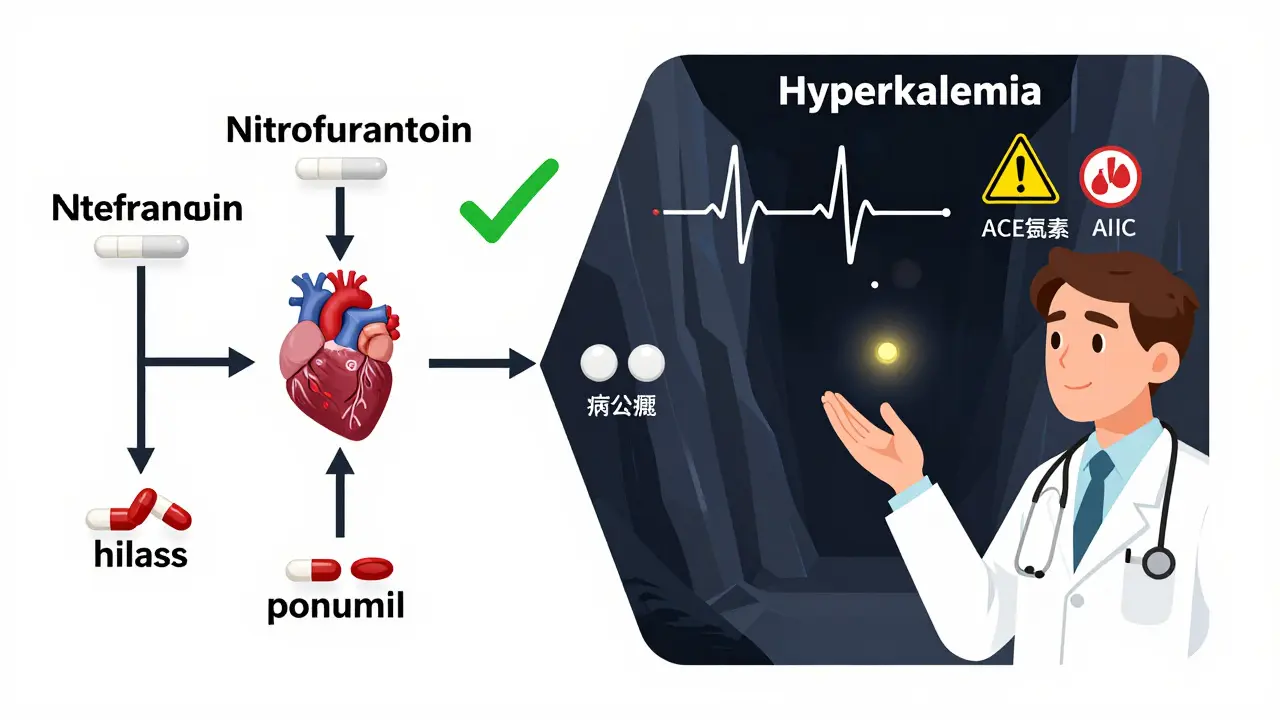
Nitrofurantoin is the go-to for uncomplicated UTIs in older adults or those on blood pressure meds. Studies show it doesn’t raise potassium levels at all. It’s not perfect - it can cause lung issues in long-term use - but for short courses, it’s much safer than trimethoprim.
For other infections, amoxicillin, cephalexin, or doxycycline are often just as effective and carry no hyperkalemia risk. Even if your doctor says “Bactrim is the best for this,” ask: “Is there another option that won’t mess with my potassium?”
For patients who absolutely need trimethoprim - like those with Pneumocystis pneumonia (common in HIV or transplant patients) - the Infectious Diseases Society of America says it’s still first-line. But only if potassium is checked before, 48 hours after, and weekly during treatment. No exceptions.
What Should You Do?
If you’re prescribed trimethoprim, here’s what you need to do - no matter what your doctor says:
- Ask if you’re on a potassium-raising medication. ACEIs, ARBs, spironolactone, eplerenone, or even some herbal supplements like licorice root? Tell your doctor.
- Ask for a baseline potassium test before you start. If they say “it’s not necessary,” push back. This is a known, documented risk.
- Get a repeat test 48 to 72 hours after your first dose. That’s when potassium spikes are most likely.
- Know the warning signs. Muscle weakness, irregular heartbeat, fatigue, nausea, or tingling in your hands or feet? Stop the drug and go to urgent care. Don’t wait.
- Don’t assume normal kidney function means you’re safe. Many people with early kidney damage have normal creatinine. Potassium is the real early warning system.
Why Do Doctors Still Prescribe It?
Because it’s cheap, effective, and widely available. In 2022, over 14 million trimethoprim-sulfamethoxazole prescriptions were filled in the U.S. Nearly 4.2 million went to people over 65 - the group most at risk.
A 2023 survey found only 41.7% of primary care doctors routinely check potassium before prescribing it to patients on blood pressure meds. Emergency room doctors? Just 32.4%. Nephrologists? Almost 90%. That gap is deadly.
Some hospitals have fixed this by adding electronic alerts. If you’re on lisinopril and your doctor tries to order Bactrim, the system pops up: “High risk of hyperkalemia. Consider nitrofurantoin instead.” One study showed that cut hyperkalemia cases by over half.
The Bottom Line
Trimethoprim isn’t dangerous for everyone. But for a lot of people - especially older adults and those on common blood pressure meds - it’s a silent threat. It doesn’t cause nausea or rash. It doesn’t make you feel sick. It just quietly raises your potassium until your heart can’t handle it.
If you’re prescribed Bactrim, Septra, or any trimethoprim-containing drug, don’t just take it. Ask questions. Demand a potassium test. Push for alternatives. Your heart might depend on it.

This is wild - I took Bactrim last year for a UTI and felt like my whole body was turning to jelly. Didn’t think twice until my cousin, a nurse, asked if I’d been checked for potassium. Turns out I was at 5.9. I almost died in the ER. No joke. This needs to be on every prescription label.
It’s terrifying how many life-saving meds come with silent killers built in. We treat antibiotics like candy - pop a pill, feel better, forget about it. But the body doesn’t forget. Potassium doesn’t care if your creatinine is ‘normal.’ It only cares if your heart keeps beating. This post is a quiet wake-up call, and I’m grateful for it.
I’m a nurse in a rural clinic and I’ve seen this exact scenario play out three times this year. All elderly, all on lisinopril, all told ‘it’s fine’ by their PCP. One patient coded in the waiting room. We now have a standing order: no trimethoprim without a baseline K+ and a follow-up in 48 hours. Simple. Life-saving.
Oh, please. Another alarmist piece disguised as medical advice. The FDA has over 1,200 reports? That’s less than 0.01% of all prescriptions filled. People are dying from car crashes, opioid overdoses, and falling down stairs - but we’re panicking over a common antibiotic? This isn’t science - it’s fearmongering dressed in white coats. If you’re on ACEIs, sure, be cautious. But don’t turn every UTI into a cardiac emergency.
Let me tell you something: I’ve spent 18 years in geriatric care, and I’ve watched too many elderly patients get discharged from the ER with potassium levels over 7.0 after being prescribed Bactrim. The ‘normal creatinine’ myth is the deadliest lie in primary care. Kidney function isn’t just about creatinine - it’s about glomerular filtration, tubular secretion, and electrolyte balance. Trimethoprim blocks ENaC channels like a brick in a drain. It’s not subtle. It’s not rare. And it’s not acceptable that we’re still not testing potassium before prescribing it to high-risk groups. If your doctor won’t order the test, find a new doctor. Your life isn’t a gamble.
Thank you for this. In Nigeria, we don’t always have access to potassium tests, but we do have access to nitrofurantoin. I’ve started pushing for it in my community clinics for UTIs in elderly patients. One old man came back two weeks later saying he felt ‘lighter’ after switching from Septra. No tremors. No dizziness. Just peace. Sometimes the simplest fix is the one we ignore.
This is precisely why American medicine is collapsing - doctors are being pressured into ‘safe’ alternatives by fear-driven narratives instead of evidence-based protocols. Trimethoprim is cheap, effective, and widely studied. If you’re over 65, you should be under regular monitoring anyway - not because of one drug, but because of aging. Blaming the antibiotic instead of the lack of systemic follow-up is irresponsible. This is not a crisis. It’s a failure of care coordination.
They’re hiding the truth. The pharmaceutical companies know trimethoprim causes hyperkalemia. That’s why they pushed it as ‘OTC-friendly’ - it’s cheaper than alternatives, and they don’t want you testing your blood. The FDA’s database? Fabricated. The ‘43 deaths’? Mostly elderly people who were already dying. They’re using fear to sell nitrofurantoin - which costs 3x as much. Don’t be fooled. Your doctor is just following the script.
I’ve been on lisinopril for 12 years. Took Bactrim last winter for a sinus infection. Got my potassium checked the next week - 5.1. No symptoms. No drama. Just a simple blood test. That’s all it takes. This isn’t about fear. It’s about awareness. Ask. Test. Know. You’re not being paranoid - you’re being smart.