
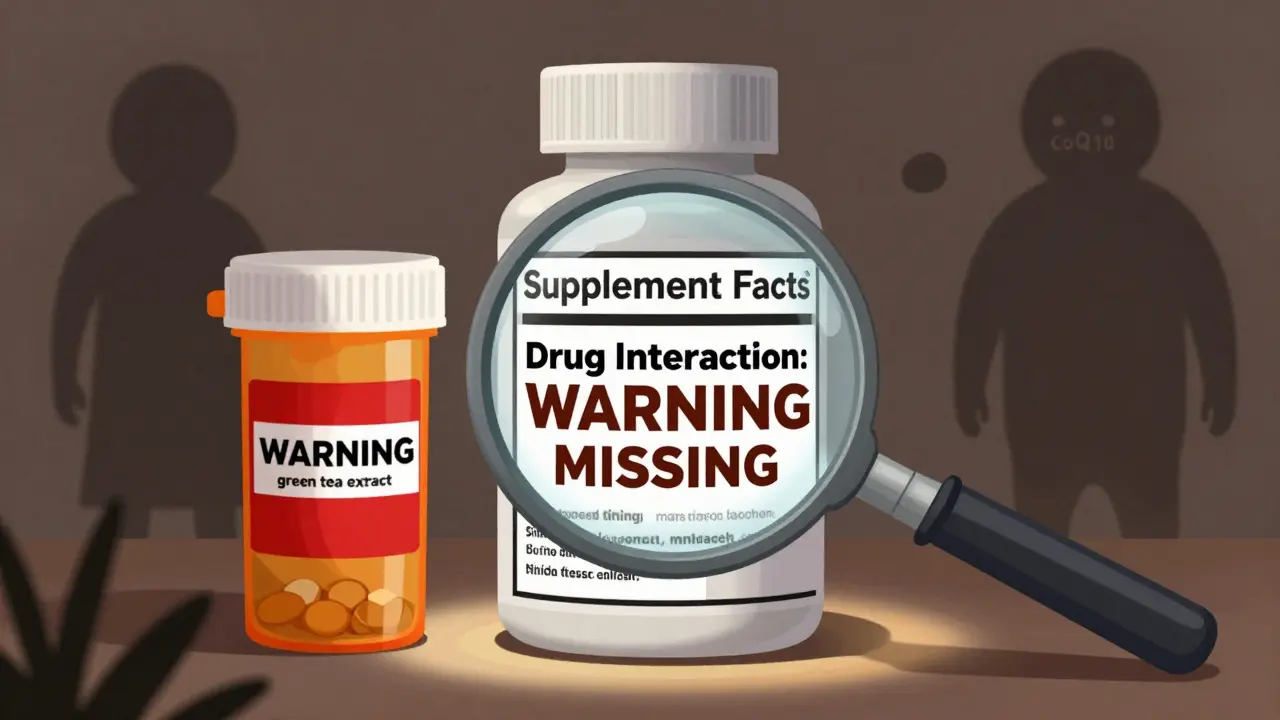
Every year, millions of people take supplements alongside their prescription meds-magnesium with blood pressure pills, vitamin D with thyroid medicine, green tea extract with blood thinners. And most of them have no idea what they’re risking. Why? Because the label on that bottle might not tell you a thing.
Unlike your prescription drug, which screams warnings in bold letters, supplement labels are often silent. No red flags. No alerts. Just a list of ingredients you can’t fully trust. And that’s not an accident-it’s the law.
What’s Actually on a Supplement Label?
Look at the front of your supplement bottle. You’ll see a panel labeled Supplement Facts a standardized label format required by the FDA for dietary supplements, showing serving size, amount per serving, and percent daily value for each ingredient. This looks similar to a nutrition label on food, but there’s a big catch: it doesn’t have to tell you everything.
Here’s what’s required:
- Serving size and number of servings per container
- Amount of each ingredient per serving
- Percent Daily Value (DV) for certain nutrients-like vitamin D, calcium, iron
- Complete list of ingredients, including fillers and additives
- Allergen warnings for the eight major allergens: milk, eggs, fish, shellfish, tree nuts, peanuts, wheat, soy
But here’s what’s missing:
- Any mention of drug interactions
- Exact amounts of ingredients in proprietary blends
- Warnings about side effects or long-term risks
Proprietary blends are the sneakiest part. Companies group several ingredients together under one name-like "Energy Blend" or "Immune Support Complex"-and list the total weight without breaking down how much of each component is in there. One 2023 ConsumerLab.com analysis found that 38% of supplements using these blends hid ingredient amounts that could be dangerous when mixed with medications.
How Drug Labels Work (and Why Supplements Don’t)
Now compare that to your prescription pill bottle or OTC painkiller. Those labels follow strict FDA rules. They’re built around a Drug Facts a standardized labeling format for over-the-counter medications, requiring seven mandatory sections including active ingredients, uses, warnings, and directions panel. It includes:
- Active Ingredients: Exact name and dosage (e.g., "Lisinopril 10 mg")
- Purpose: What it does (e.g., "blood pressure reducer")
- Uses: Approved conditions it treats
- Warnings: Contraindications, side effects, and drug interactions
- Directions: How much and how often to take
- Other Information: Sodium content, storage instructions
- Inactive Ingredients: Fillers, dyes, preservatives
And here’s the kicker: Every single OTC drug and prescription medication is legally required to list drug interactions. The FDA mandates this after reviewing clinical data. If a drug interacts with grapefruit juice, warfarin, or antidepressants, it’s written in bold.
Supplements? Not even close. A 2021 FDA analysis of 500 popular supplements found only 12.7% included any drug interaction warning. Compare that to 94% of OTC drugs and 100% of prescription meds. The reason? The Dietary Supplement Health and Education Act (DSHEA) a 1994 U.S. law that classifies dietary supplements as food rather than drugs, exempting them from pre-market safety review and mandatory interaction labeling of 1994. Under DSHEA, supplement makers don’t need FDA approval before selling. They don’t need to prove safety. And they don’t need to test for interactions.
Real-World Dangers You Can’t Ignore
This isn’t theoretical. People are getting hurt.
In 2022, the FDA recorded 1,960 adverse events linked to supplements. Nearly 28% of those involved possible drug interactions, according to the National Center for Health Research. Here are real examples:
- St. John’s Wort and digoxin: This herbal supplement for mood drops digoxin levels in the blood by 26%. That’s enough to make heart failure treatments fail. The American Heart Association has issued clear warnings.
- Vitamin K and warfarin: Found in green tea extract and leafy greens, vitamin K can cut warfarin’s effectiveness by 30-50%. One study showed patients on warfarin had dangerous blood clots after starting green tea supplements.
- CoQ10 and warfarin: The FDA confirmed in 2023 that CoQ10 shortens prothrombin time by 15-25%, making blood thinner less effective. Patients didn’t know-because their CoQ10 bottle didn’t say a word.
- Milk thistle and metformin: Diabetics using this liver supplement reported blood sugar dropping to dangerously low levels-42 mg/dL in one case. No warning on the label.
- Vitamin C (over 1,000 mg/day) and antiretrovirals: A 2023 pharmacy study showed it reduces drug absorption by 22% by changing stomach pH. HIV patients were unaware.
And it’s not just herbs. Even common supplements like magnesium, calcium, and zinc can interfere with antibiotics, thyroid meds, and osteoporosis drugs. But you’ll never find that on the label.
How to Protect Yourself
Since manufacturers aren’t required to warn you, you have to do it yourself. Here’s how:
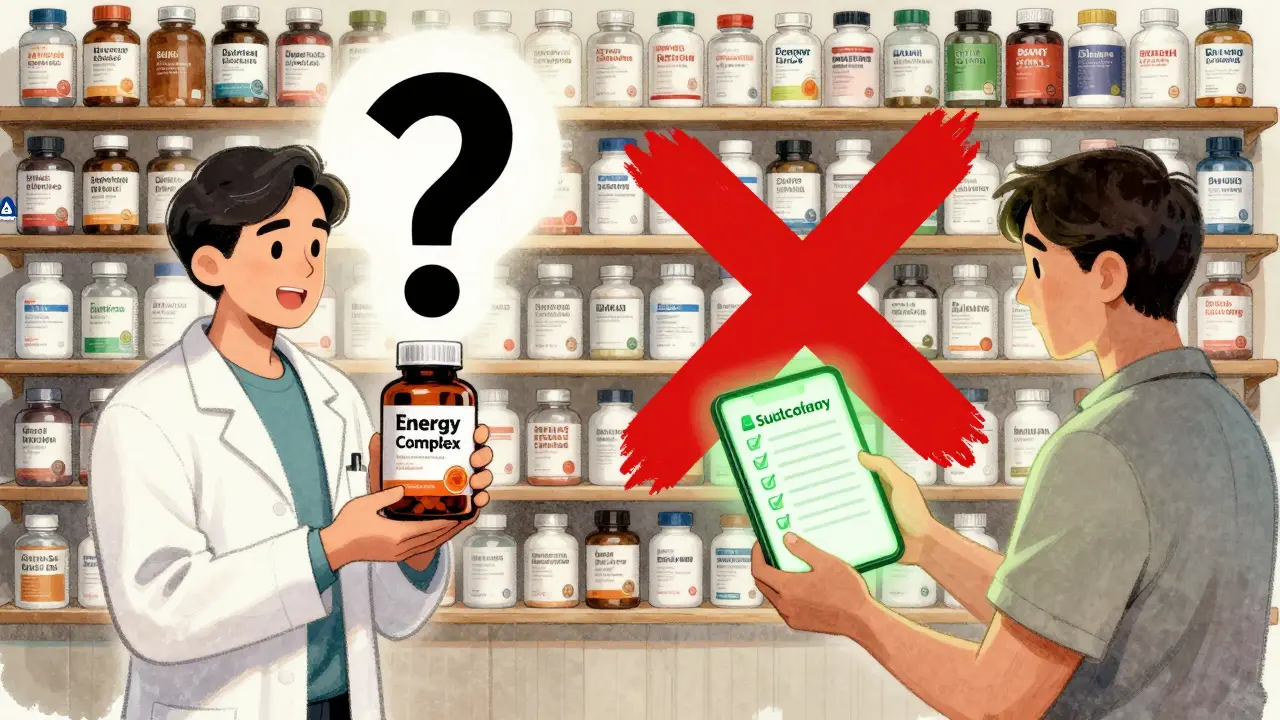
- Read the Supplement Facts panel like a detective. Note every ingredient-even "other ingredients" like cellulose or stearic acid. If you see something unfamiliar, Google it.
- Use the Medscape Drug Interaction Checker. It’s free. Type in your medication and the supplement name. It analyzes over 24,000 drug pairs. If it flags a risk, don’t ignore it.
- Take a photo of your supplement label. Bring it to your doctor or pharmacist. Say: "I’m taking this. Is it safe with my meds?" Most won’t ask unless you show them.
- Never assume "natural" means safe. Red yeast rice contains monacolin K-the same compound as the statin drug lovastatin. Taking it with other statins can cause muscle damage.
- Check for USP verification. Look for the "USP Verified" mark. It means the product was independently tested for ingredients, purity, and strength. Only 18% of brands carry it-but those are the ones you can trust more.
- Know your serving size. A 2023 University of Arizona study found 43% of people took double the recommended dose because they misread the label. One capsule might be 500 mg, but the serving size is two. That’s 1,000 mg. Is that safe with your meds? You need to know.
A University of Florida study showed that people who got just 15 minutes of label-reading training cut their risk of dangerous interactions by 63%. You don’t need a degree. You just need to be curious.
Why the System Is Broken
The supplement industry made $53.1 billion in 2023. Over 77% of Americans take at least one supplement. But the FDA’s Office of Dietary Supplement Programs has a $4.7 million budget-less than 0.03% of the FDA’s total funding. That’s not enough to inspect even 1% of products.
In 2023, the FDA flagged 1,247 supplement labels for misbranding or false claims. Only 28% of those led to recalls. The rest stayed on shelves. Meanwhile, Congress rejected the Dietary Supplement Listing Act of 2022 a proposed law that would have required pre-market notification of supplement products to improve regulatory oversight, which would have forced companies to register ingredients and potential risks.
The FDA did release draft guidance in March 2024 suggesting supplements voluntarily add interaction warnings. But voluntary means most won’t. Until the law changes, the burden is on you.
What’s Coming Next?
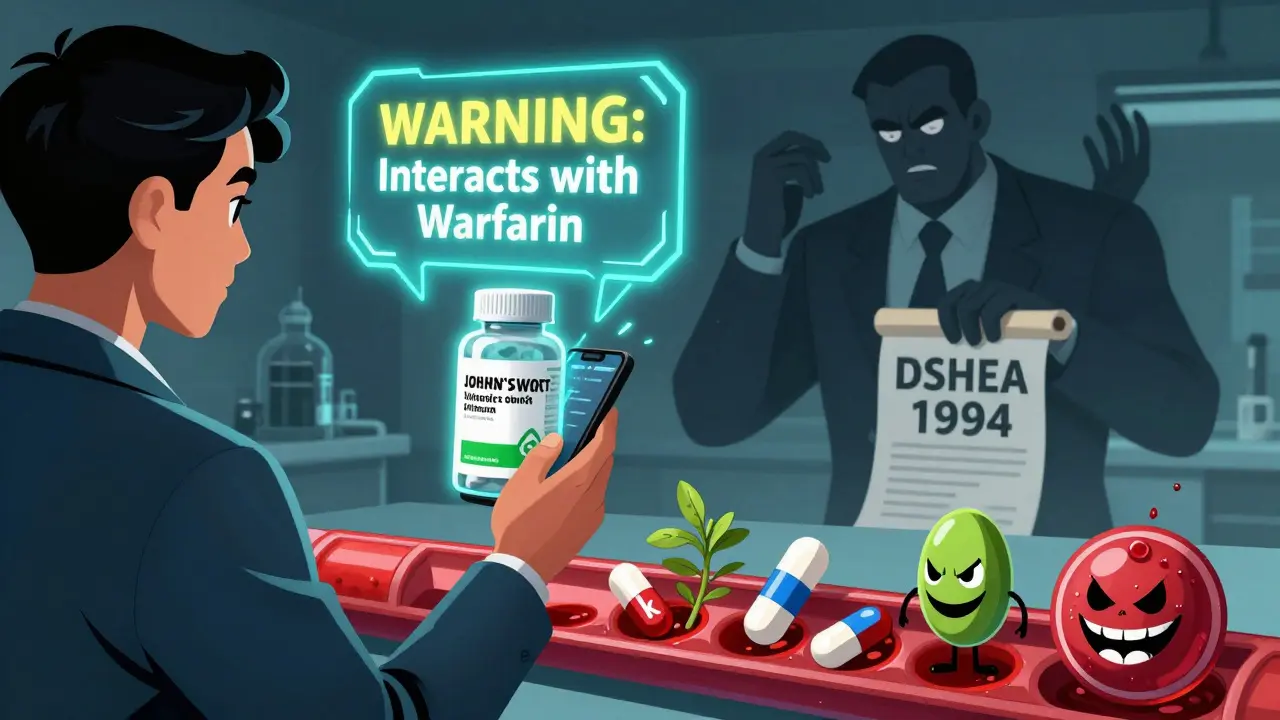
There’s a small glimmer of hope. The FDA is testing QR codes on supplement labels that link to real-time interaction databases. Imagine scanning your bottle and getting a safety alert tailored to your meds. Pilot programs are running in 2024.
The American Medical Association now recommends doctors ask every patient about supplement use during annual exams. If more providers start doing this, it could prevent 28,000 ER visits a year, according to Johns Hopkins modeling.
But until then, don’t wait for someone else to protect you. Your meds are carefully regulated. Your supplements? Not even close.
Read the label. Question everything. Talk to your pharmacist. And never assume silence means safety.
Do supplement labels have to list drug interactions?
No. Under U.S. law (DSHEA), supplement manufacturers are not required to include drug interaction warnings on labels. Unlike prescription and OTC drugs, which must list interactions by law, supplement labels can-and often do-leave this information out entirely. Only about 12.7% of popular supplements include any interaction warning, according to FDA data from 2021.
What should I look for on a supplement label?
Focus on the Supplement Facts panel: check the serving size, amount per serving, and full ingredient list. Look for allergens (milk, soy, nuts, etc.) and avoid products with proprietary blends that don’t break down ingredient amounts. Also check for a USP Verified mark-it means the product was independently tested for quality and accuracy.
Can I trust supplements labeled "natural" or "organic"?
No. "Natural" has no legal definition for supplements, and "organic" certification doesn’t guarantee safety or interaction-free use. Red yeast rice, for example, is natural but contains the same active ingredient as the prescription statin lovastatin. Taking it with other statins can cause dangerous muscle damage. Always research the actual ingredients, not marketing terms.
Which supplements are most likely to interact with medications?
St. John’s wort, vitamin K (in green tea extract), CoQ10, garlic, ginkgo, milk thistle, and high-dose vitamin C are among the top offenders. They can interfere with blood thinners, heart meds, antidepressants, diabetes drugs, and HIV treatments. Even common ones like magnesium, calcium, and zinc can affect antibiotics or thyroid medications. Always check for interactions before starting any new supplement.
How can I check if my supplement interacts with my medication?
Use the free Medscape Drug Interaction Checker. Enter your medication and the supplement name-it analyzes over 24,000 combinations. You can also bring your supplement bottle to your pharmacist and ask directly. Many pharmacists now routinely check supplement-medication interactions, especially for patients on multiple prescriptions.
Next Steps
If you’re taking supplements and medications together:
- Make a list of everything you take-prescriptions, OTCs, and supplements.
- Take photos of each supplement label.
- Bring them to your next doctor or pharmacy visit.
- Ask: "Do any of these interact with my meds?"
- Don’t stop or start supplements without talking to a professional.
Supplements aren’t harmless. They’re powerful. And if you don’t read the label, you’re flying blind.

so i took this 'energy blend' for a week and my heart felt like it was trying to escape my chest. no warning. just a pretty bottle with a cool logo. lol. thanks, FDA.
The lack of mandatory interaction disclosure stems from DSHEA's regulatory loophole. Supplement manufacturers aren't classified as drug manufacturers, so they're exempt from 21 CFR Part 201. This means no pharmacokinetic data review, no post-marketing adverse event reporting mandates, and zero requirement to disclose CYP450 enzyme interactions. Your CoQ10 and warfarin combo? That's a CYP3A4/2C9 interference. Should be labeled. It's not. Because the law doesn't force it.
I knew it... I KNEW IT!!! The FDA is in bed with Big Supplement!!! They're letting them poison us on purpose!!! I read a blog once that said the moon is made of cheese and the government is hiding the truth about vitamin K and warfarin!!! I have 17 different bottles and I've been taking them all together for 3 years... and now I think my neighbor is spying on me through the supplement cap!!!
OMG YES!!! I started green tea extract last month and my BP went crazy!!! I almost didn't make it to my yoga class 😱 but now I check every single thing with my pharmacist!! She's like my superhero!! 💪❤️
i always take a pic of my labels before i take anything new. my doc laughs but i told him 'you wouldn't eat a mystery meat burrito without asking what's in it'... and supplements are way more dangerous than that. just saying.
Wow. So the law says you can't warn people about deadly interactions... but you can slap '100% natural!' on it like it's a virtue? 🤡 That's not a loophole. That's a crime scene.
I’m from Texas and I’ve been taking magnesium with my blood pressure med for years. Never had a problem. Maybe it’s just me? Or maybe the whole 'danger' thing is just hype from people who don’t know how their own body works. I mean, my grandpa took 12 different pills and a handful of herbs and lived to 94. He didn’t Google anything.
this is why we need to ban supplements. completely. they're all snake oil. if you're taking 'immune support complex' you're literally paying for glitter and sugar. and now you're risking a stroke because you didn't read the 10-page pdf on the company's website that's buried under 3 ads for keto gummies? yeah. that's the system. genius.
I’m so glad this post exists. I used to think 'natural' meant safe. Then my mom had a bad reaction to ashwagandha with her thyroid med. We didn’t know. Now I check everything with my pharmacist. She’s awesome. And yes, I bring the bottles. No shame. Your health > pride.
The real issue here is not the FDA's budget-it's the neoliberal commodification of health. Supplement manufacturers exploit the biopolitical vacuum created by the post-DSHEA regulatory architecture. The absence of interaction labeling is a structural feature of capitalist healthcare, not a bug. Until we de-commodify wellness and re-embed it within public health infrastructure, this will persist. Also, 'USP Verified' is a marketing gimmick. Their testing protocols are proprietary and non-transparent.
i just found out my 'joint support' had turmeric in it and i was on blood thinners. i almost died. now i check every single thing on medscape. it's free. use it. i'm not a doctor but i'm not dumb either. my life matters.
lol i just read the comment above and thought 'wait... did this guy actually read the whole thing?' because if he did... he'd know the guy who wrote this post is the same guy who got his thyroid meds messed up by milk thistle. so yeah. you're welcome.