
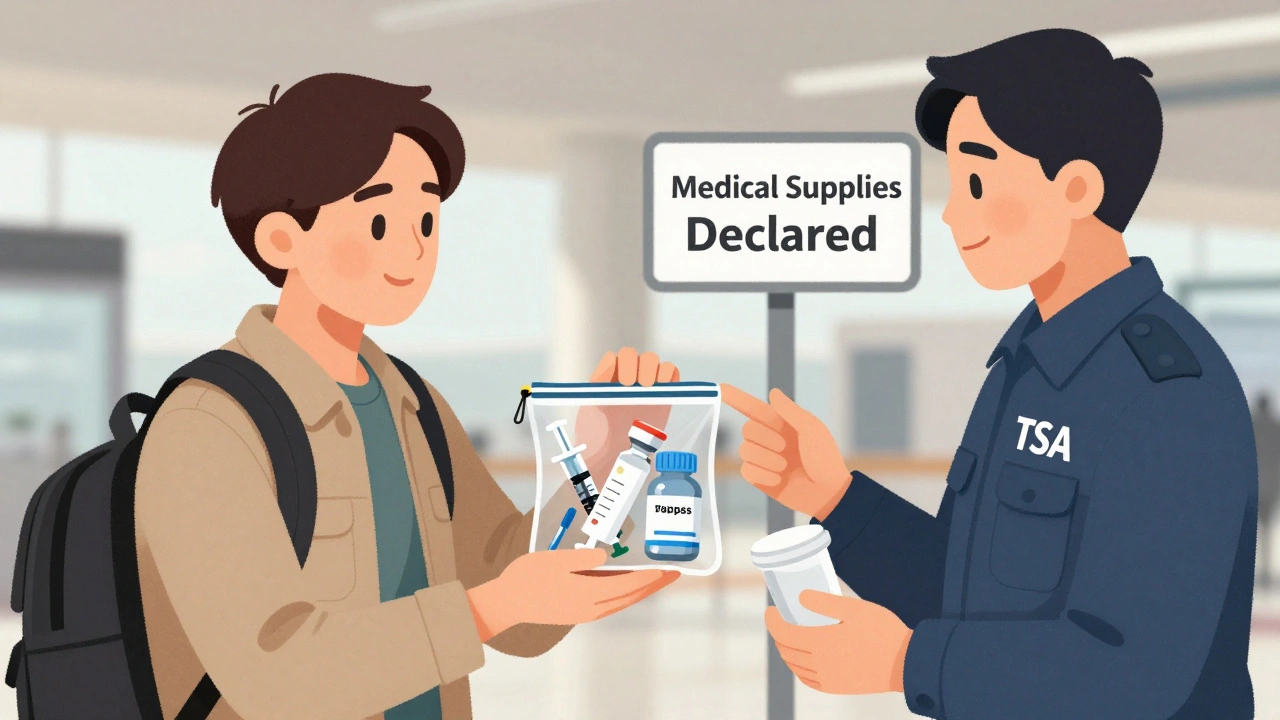
Traveling with injectable medications like insulin, EpiPens, or hormone treatments doesn’t have to be stressful-if you know the rules. Every year, millions of people with diabetes, autoimmune conditions, or chronic illnesses fly with syringes and sharps. Some breeze through security. Others get stuck for 30 minutes because they didn’t prepare. The difference? Knowing what’s allowed, how to pack it, and how to talk to TSA agents.
What You’re Allowed to Bring
The TSA lets you bring injectables, syringes, and sharps on planes-no limit on quantity, as long as they’re for personal medical use. This includes insulin vials, pen needles, auto-injectors, and unused syringes. Used needles? Also allowed, but they must go in a proper sharps container. No exceptions.
You don’t need a doctor’s note to fly within the U.S. But here’s the catch: if you don’t have one, and an officer questions your supplies, you’ll waste time explaining. A simple note saying “Patient requires daily insulin injections” can save you 15 minutes at security. Same goes for prescription labels-make sure the name on the bottle matches your ID. TSA doesn’t require original packaging, but it helps. If your insulin is in a vial without a label, you’re asking for trouble.
How to Pack Liquid Medications
The 3-1-1 liquids rule doesn’t apply to medically necessary liquids. That means you can bring a full 10ml, 20ml, or even 50ml insulin vial-even if it’s way over the 3.4-ounce limit. But you must declare it. Don’t hide it in your toiletries bag. Pull it out before you get to the X-ray machine. Say, “I have insulin and syringes for medical use.”
Keep liquids in clear, sealable bags. It’s not required, but it makes screening faster. If you’re carrying multiple vials, group them together. TSA agents see hundreds of bags a day. Making things easy for them makes things easy for you.
Temperature-sensitive meds? Bring ice packs or gel packs. They’re allowed, even if they’re larger than a fist. Just be ready for them to be inspected. If the pack is dripping, TSA might ask you to wrap it in a towel. No problem. Just keep it clean and dry.
Sharps Containers: Non-Negotiable
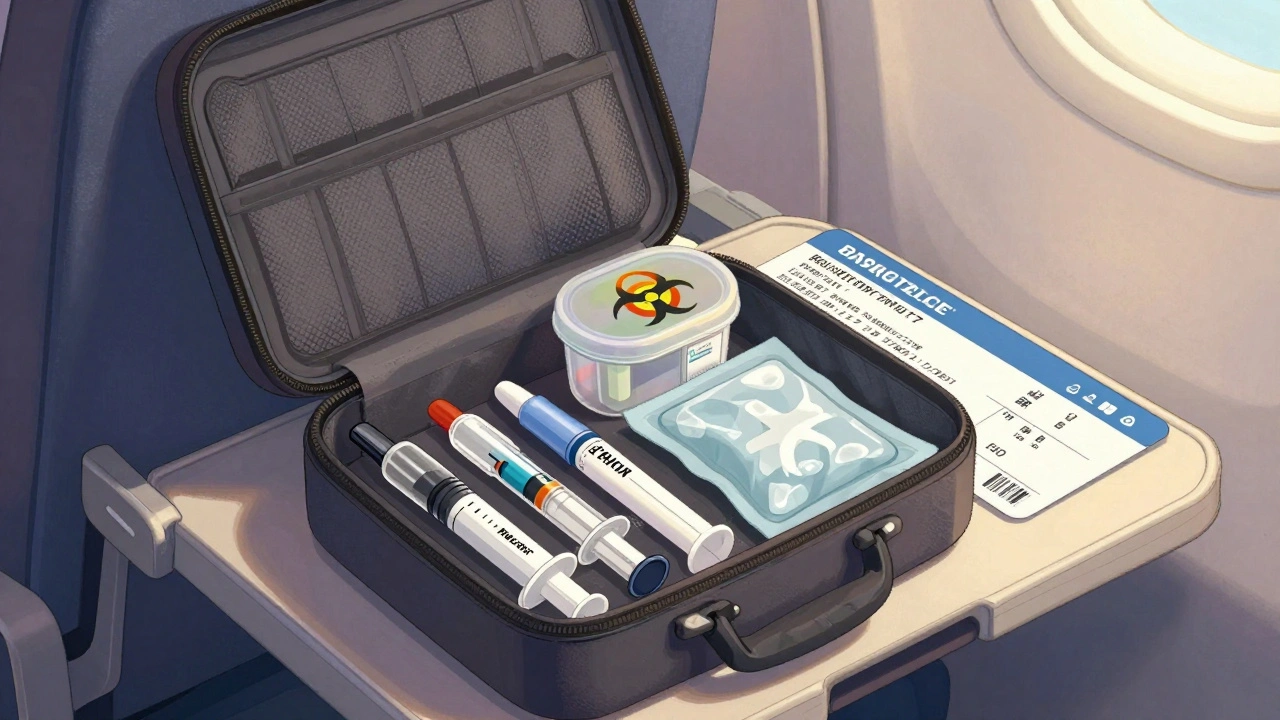
Used syringes? Never toss them in your carry-on or checked bag loose. That’s a safety hazard-and it’s against federal rules. You need a sharps container. Not a soda bottle. Not a coffee can. Not a plastic pill organizer. You need a rigid, puncture-resistant container labeled with the biohazard symbol.
Most pharmacies sell these for under $5. Look for ones that meet ANSI/ISEA Z308.1-2021 standards. Many come with prepaid return mailers-perfect for international trips. If you’re flying internationally, check if your destination country allows sharps containers. Japan, for example, requires special permits for more than 10 syringes. Australia lets you bring them in, but they must be sealed and declared.
Pro tip: Keep your sharps container in your carry-on. Checked bags get tossed around. A needle could puncture a bag, injure a baggage handler, or get lost. You don’t want to risk that.
International Travel? Know the Rules
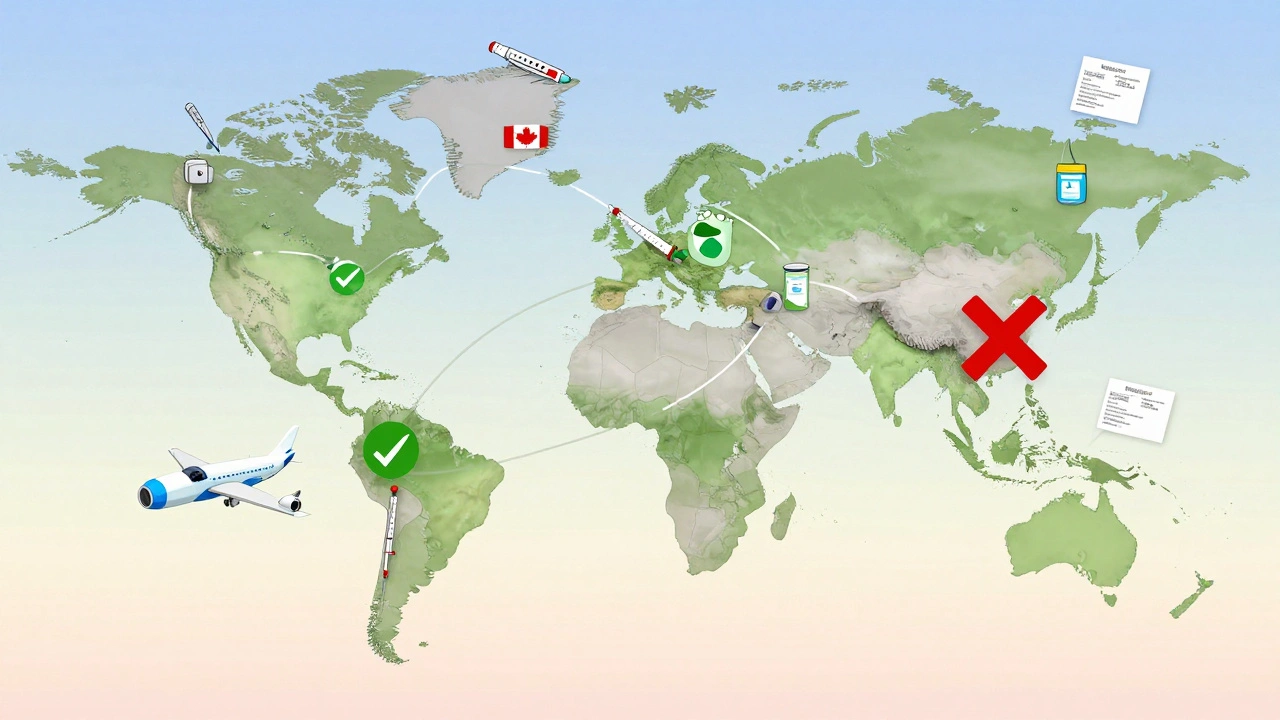
Domestic flights in the U.S. follow TSA rules. But when you land abroad, local laws take over. The European Union follows EASA regulations, which require documentation in the destination language. In the UK, you can bring syringes with a prescription. In Canada, no permit is needed if it’s for personal use. But in Singapore, you need prior approval from the Health Sciences Authority.
Here’s what to do: 30 to 60 days before your trip, visit the embassy website of your destination country. Search for “medical supplies” or “import of syringes.” Some countries have online forms. Others require a letter from your doctor. Don’t wait until the airport. One traveler I spoke with got turned away in Dubai because her syringes weren’t labeled in Arabic. She missed her connecting flight.
Always carry a copy of your prescription-even if you’re not asked. Translation apps help, but a printed note in the local language is better. If you’re diabetic, carry a letter from your endocrinologist. It says who you are, what you need, and why.
What Happens at Security
At the checkpoint, you have two choices: let your supplies go through the X-ray, or ask for a visual inspection. If you’re carrying insulin pumps, glucose monitors, or temperature-sensitive meds, ask for a hand inspection. X-rays can damage some devices. TSA agents are trained to do this. Just say, “I’d prefer a visual inspection for my medical equipment.”
Don’t wait to be asked. As soon as you approach the screening area, say, “I have medical supplies.” Hold up your insulin, syringes, and sharps container. This cuts screening time by half. According to TSA’s 2023 report, 92% of medical screening issues were resolved when travelers declared items upfront.
PreCheck? Use it. If you’re enrolled, medical screening takes about 50% less time. You won’t need to remove your liquids or electronics. That’s huge if you’re juggling a glucose meter, insulin pen, and sharps container.
What Not to Do
Don’t hide your supplies. TSA has seen it all. If they find syringes in your socks or makeup bag, you’ll get flagged. That means extra screening, possible delays, and maybe even a call to airline security.
Don’t use makeshift containers. A pen cap or pill bottle might seem fine, but it’s not safe. And it’s not legal. TSA agents are trained to spot them. You’ll be asked to repack everything-and you’ll miss your flight.
Don’t assume all airports are the same. Larger airports like JFK, LAX, or ORD have trained medical screening teams. Smaller ones? Not always. A 2023 study found 41% of complaints about medical supply delays came from airports with fewer than 5 million passengers a year. Be extra prepared if you’re flying out of a regional hub.
Real-Life Tips from Travelers
One woman with type 1 diabetes flew from Seattle to Tokyo with 12 insulin pens and 50 needles. She packed them in a TSA-approved sharps container, kept the original boxes, and printed a doctor’s note in Japanese. She got through security in 7 minutes. No questions.
Another traveler kept his EpiPen in his shirt pocket. He didn’t declare it. The scanner beeped. He had to open his bag. The officer didn’t know what it was. He spent 20 minutes explaining. He missed his boarding call.
On Reddit, a user said: “I used to panic flying. Now I keep my meds in a small clear pouch with my ID and prescription. I say ‘medical supplies’ before I even reach the belt. It’s 10 seconds. It’s worth it.”
What to Bring in Your Travel Kit
- Insulin or other injectables in original packaging
- Unused syringes (no limit)
- FDA-approved sharps container with biohazard symbol
- Doctor’s note (recommended)
- Prescription labels matching your ID
- Ice pack or gel pack (if needed)
- TSA Notification Card (download from tsa.gov)
- Printed copy of destination country’s medical rules
Keep it all in one small, clear bag. Put it in your carry-on-right on top. You’ll thank yourself later.
What’s Changing in 2025
TSA is rolling out new medical screening lanes at 50 major U.S. airports by the end of 2024. These lanes have trained staff who know exactly how to handle insulin pumps, glucagon kits, and sharps. The goal? Cut screening time to under 5 minutes.
International efforts are also underway. The World Health Organization is working on global standards for medical travel supplies. By 2026, you might see the same rules in Paris, Sydney, and Singapore. But for now? Know your destination. Be prepared. Stay calm.
You’re not breaking any rules. You’re managing your health. And you have every right to travel safely with your medication.
Can I bring insulin syringes on a plane?
Yes. TSA allows unlimited insulin syringes and other medical syringes on planes as long as they’re for personal use and accompanied by the corresponding medication. Unused syringes don’t need a prescription label, but keeping them in original packaging helps avoid delays.
Do I need a doctor’s note to fly with syringes?
No, it’s not required by TSA for domestic flights. But having a note from your doctor-especially if you’re flying internationally or carrying multiple types of injectables-can prevent delays. A simple note saying “Patient requires daily injections of [medication]” is enough.
Can I put sharps in checked luggage?
No. Used syringes must be in a proper sharps container and carried in your carry-on bag. Checked luggage is handled roughly, and loose needles can injure baggage handlers or get lost. TSA requires sharps to be accessible during screening and kept with you at all times.
What if my insulin gets confiscated at security?
It shouldn’t happen if you follow the rules. If an officer tries to take your insulin, ask to speak to a supervisor. Show your prescription and medication label. If they still refuse, ask for a copy of the TSA’s Medical Supplies Policy. You can also call TSA Cares at 1-855-787-2227 for help. They have specialists who assist travelers with medical needs.
Can I bring a needle cleaner or alcohol swabs on a plane?
Yes. Alcohol swabs and antiseptic wipes are allowed in carry-on bags. If they’re in liquid form, they must be under 3.4 ounces and follow the 3-1-1 rule. But if they’re for medical use, you can bring larger amounts if declared. Just keep them with your other medical supplies and mention them at screening.
Are insulin pens treated differently than vials and syringes?
No. Insulin pens are treated the same as vials and syringes. You can bring them in your carry-on, no limit. If the pen has a built-in needle, keep the cap on. You don’t need to remove the needle. Just declare it at security. Some pens are sensitive to X-rays-ask for a hand inspection if you’re unsure.
What if I’m flying to a country that bans syringes?
Some countries, like Japan and Singapore, restrict syringes without prior approval. Check your destination’s health ministry website at least 30 days before you fly. You may need to apply for a permit or get a letter from your doctor translated into the local language. Don’t assume your U.S. prescription is enough. Always verify.

Just flew from London to NYC last month with my insulin pump and 15 spare pens. Did exactly what this guide says-declared it upfront, kept everything in a clear pouch, and had zero issues. TSA agent even said, 'You’re the first person who didn’t make me check a manual.' Life’s too short to panic at security. Do the thing.
The real victory here isn’t just compliance-it’s the normalization of bodily autonomy in transit. We’ve been conditioned to hide our medical needs as if they’re shameful secrets, when in reality, they’re as mundane as carrying a wallet or a phone. The fact that TSA has protocols for this at all is progress. But the burden still falls on the patient to educate, to advocate, to perform health in a way that’s palatable to bureaucracy. That’s not justice. That’s survival.
Wow. A whole article about not getting arrested for having a needle. What a country we live in. Next up: How to Carry Your Oxygen Tank Without Getting Profiled by the FBI. I’m sure the TSA has a 12-page PDF on that too. Just give me my meds and let me fly. I’m not a terrorist. I’m just diabetic. And apparently that’s a threat.
People still don’t get it. You don’t get to bring syringes because you’re 'sick.' You get to bring them because you’re a human being who needs to live. And if you’re using a soda bottle? You’re not just irresponsible-you’re a liability. And yes, I’m calling you out. I’ve seen it. I’ve had to wait 45 minutes because some idiot thought a pill organizer was 'fine.' Don’t be that guy.
Let us be clear: the medical-industrial complex has weaponized the language of 'safety' to control the disabled. The sharps container requirement? Fine. But why must it be labeled with a biohazard symbol? Why not just 'medical device'? Because they want you to feel like a danger. Because they want you to beg for permission to exist in public space. This guide is a bandage on a bullet wound.
I carry my EpiPen in my bra. Not because I’m weird-I’m just tired of digging through bags while my kid’s face turns purple. I once had a TSA agent ask if it was a 'weapon.' I said, 'No, it’s my child’s lifeline.' She looked away, nodded, and waved me through. No paperwork. No fuss. Sometimes, the truth is the best policy. And yeah, I cry every time I board a plane. But I get to see my daughter. That’s worth it.
You think this is about needles? It’s about control. They don’t care if you’re diabetic, they care if you’re visible. If you’re quiet. If you don’t make waves. The moment you ask for a hand inspection? You become a problem. The moment you bring a doctor’s note? You become a threat. This guide isn’t helping you-it’s training you to perform compliance. And that’s the real tragedy.
Respected sir/madam, I am writing to express my profound appreciation for the meticulous attention to detail presented in this comprehensive guide. As a person who regularly travels internationally with insulin-dependent dependents, I can attest that adherence to the prescribed protocols-particularly the use of ANSI/ISEA Z308.1-2021-compliant sharps containers-has been instrumental in ensuring uninterrupted medical continuity across jurisdictions. I have personally encountered customs officials in Bangkok who were unaware of EASA regulations; thus, the inclusion of embassy verification protocols is not merely helpful-it is indispensable. Thank you for your diligence.
I’m sorry, but I need to ask-did you verify that the sharps container you’re using is FDA-cleared for air transport? Because if it’s not, you’re in violation of 49 CFR § 175.300. Also, are your insulin pens stored in a temperature-controlled environment during transit? Because if not, you’re risking degradation of the biologic, which could lead to hyperglycemic episodes. I’m not trying to scare you. I’m just saying: if you’re going to do this, do it right. And if you’re not sure, consult a certified medical logistics specialist before you book your ticket.