
When you see an FDA safety alert about your medication, it’s natural to panic. Your heart races. You start wondering if you should stop taking it right away. But here’s the truth: FDA safety announcements are not emergency stop signs. They’re warning lights-sometimes flickering, sometimes steady-and understanding them can save your health without causing unnecessary fear.
What FDA Safety Announcements Actually Mean
The FDA doesn’t issue these alerts because a drug is dangerous. They issue them because something new showed up in the data-and they’re trying to figure out if it matters. These announcements come in different forms: Drug Safety Communications, Safety Labeling Changes, and Potential Signals Reports. The most common is the Drug Safety Communication, published about once a week. But here’s what most people miss: the FDA rarely says a drug causes harm. Instead, they say: “We’re seeing reports that might suggest a link.” That’s not the same as proof. Take the 2021 alert about menstrual changes after COVID-19 vaccines. Thousands of women called their doctors, terrified. But when the FDA dug deeper, they found no causal link. The reports were real-but so were stress, sleep disruption, and immune activation from the virus itself. The alert didn’t mean the vaccine caused irregular periods. It meant: “We saw a pattern. Let’s check.”Understanding the Difference Between Adverse Events and Adverse Reactions
Not every bad thing that happens after you take a pill is caused by the pill. The FDA makes a critical distinction:- An adverse event is any negative health occurrence after taking a drug-whether or not the drug caused it.
- An adverse drug reaction is when there’s a reasonable chance the drug actually caused the problem.
How the FDA Decides What’s a Real Risk
The FDA doesn’t guess. They use a structured system called the risk-benefit framework. It’s not a formula. It’s a judgment call based on six key factors:- How serious is the condition? A drug for terminal cancer can have more side effects than one for acne.
- How strong is the benefit? Does it prevent death? Reduce hospital stays? Improve quality of life?
- How often does the risk happen? Is it 1 in 10,000? 1 in 100? Or 1 in 10?
- How severe is the risk? Is it a mild rash or liver failure?
- Are there alternatives? If this is your only option, you accept more risk.
- Can you manage the risk? Can you monitor for it? Can you avoid it in high-risk patients?
What to Look For in an FDA Alert
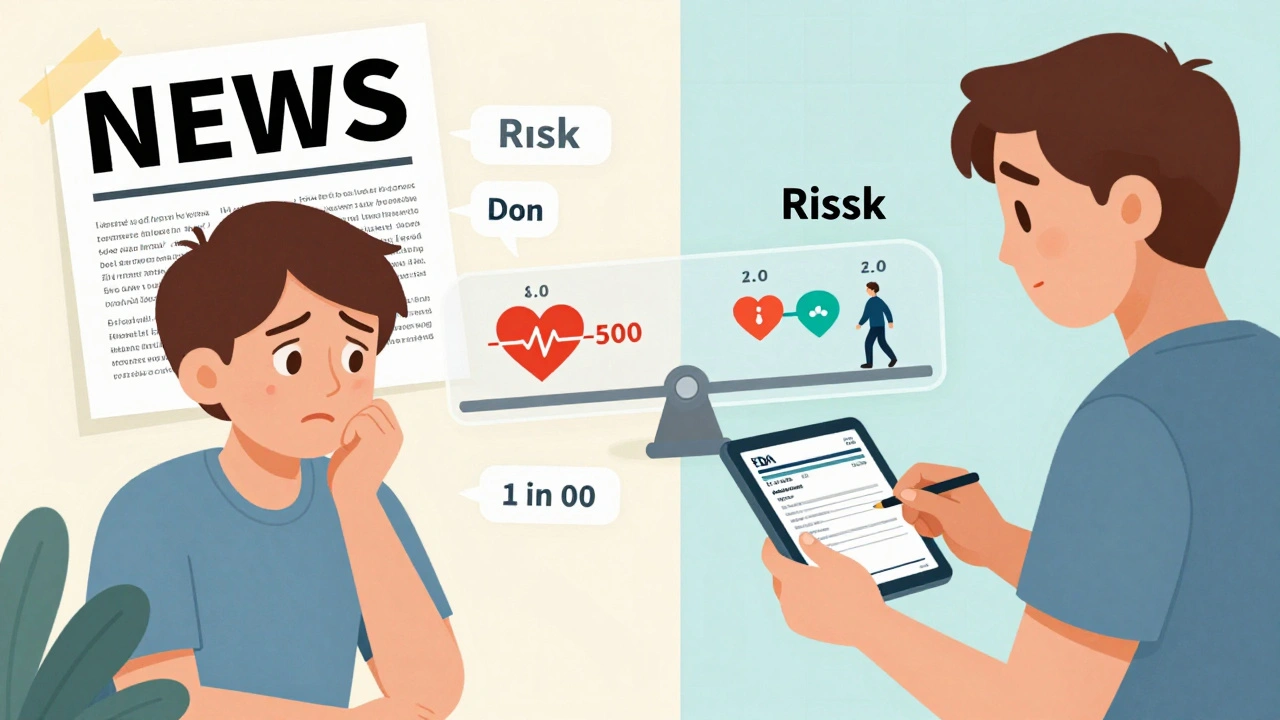
When you read one, don’t just skim. Ask these five questions:- Is this a “potential signal” or a “confirmed risk”? The FDA will say one or the other. If it says “potential,” it’s not proven. If it says “confirmed,” they’ve ruled out other causes.
- Is there a number? The best alerts say: “Risk increased from 0.05% to 0.2%.” That’s actionable. If it just says “risk may increase,” walk away until you get numbers.
- Who is affected? Is this only in older adults? Pregnant women? People with kidney disease? The risk might not apply to you.
- What’s the benefit? The alert should mention why the drug is still on the market. If it doesn’t, look it up yourself.
- Did the FDA tell you to stop? If they don’t say stop, don’t stop. The FDA is very clear: “This does not mean you should discontinue use.”
Why So Many Alerts Feel Confusing
You’re not imagining it. Many FDA alerts are poorly written. A 2022 study in the BMJ found that only 58% of Drug Safety Communications clearly state whether a risk is confirmed or suspected. A 2022 AMA survey of 1,200 doctors found that 68% felt the alerts lacked context. Patients are even worse off: 75% said they felt confused about whether to keep taking their medicine. The problem isn’t the FDA’s data-it’s their communication. They’re scientists, not storytellers. They’re trained to be cautious. But caution without clarity creates fear. That’s changing. By 2025, the FDA plans to roll out standardized risk formats. That means alerts will start saying things like: “Risk: 1 in 500. Benefit: 90% chance of preventing stroke.” No more vague language.
What You Should Do When You See an Alert
Don’t react. Don’t Google. Don’t call your pharmacy. Do this:- Find the original alert. Go to the FDA’s website. Don’t trust news headlines.
- Look for the key words: “potential signal” or “confirmed risk.” If it’s “potential,” wait.
- Check if they give numbers. If not, search for the drug’s full prescribing information on the FDA site. It’s called the “label.”
- Compare the risk to your condition. If you have heart failure and this drug cuts your hospital risk by 40%, a 0.1% chance of kidney swelling might be worth it.
- Call your doctor-not your friend or Reddit. Bring the alert. Ask: “Is this risk real for me? Is there a better option?”
When to Trust the FDA-and When to Doubt
The FDA is the most trusted drug watchdog in the world. They have over 25 million adverse event reports in their system. They use advanced analytics. They work with global agencies. Their process is science-based. But they’re not perfect. They move slowly. A signal can take 6 to 12 months to be confirmed. They’ve issued alerts that later turned out to be noise. They’ve been criticized for inconsistent standards across drug classes-especially in oncology, where the line between benefit and risk is thin. That’s why you need to be an active partner. Don’t wait for the FDA to tell you what to do. Learn how to read their language. Ask your doctor: “What’s the real risk here? What’s the real benefit?”Final Thought: Risk vs. Benefit Is Personal
There’s no universal answer. A drug that’s too risky for a healthy 30-year-old might be life-saving for a 70-year-old with heart disease. The FDA’s job is to protect the public. Your job is to protect yourself. The best safety system in the world won’t help if you don’t understand what it’s telling you. Learn to read between the lines. Ask for numbers. Know your condition. Know your options. And never stop a medication because of a headline.What’s the difference between a potential signal and a confirmed risk in FDA alerts?
A potential signal means the FDA noticed more reports of a side effect than expected, but they haven’t proven the drug caused it. A confirmed risk means after reviewing all the data-clinical trials, real-world reports, and scientific studies-they’ve determined there’s a reasonable likelihood the drug caused the problem. Only about 40% of initial signals become confirmed risks.
Should I stop taking my medication if I see an FDA safety alert?
No, unless the FDA explicitly tells you to. Most alerts say: “This does not mean you should stop taking the drug.” Stopping suddenly can be dangerous. For example, stopping blood thinners can cause clots; stopping antidepressants can trigger withdrawal or relapse. Always talk to your doctor first.
Why do some FDA alerts seem to cause panic when the risk is very low?
Because the FDA prioritizes caution over clarity. They’re legally required to warn about any potential signal, even if the risk is rare. But they often don’t include the actual numbers-like “1 in 10,000”-which makes it sound scarier than it is. This is changing, but for now, you need to look up the full prescribing label to find the real risk.
How can I find out the real risk of a drug?
Go to the FDA’s website and search for the drug’s full prescribing information, called the “label.” It’s under the “Drugs@FDA” section. Look for the “Warnings and Precautions” and “Adverse Reactions” sections. They list the most common side effects and how often they happen. If it says “less than 1%,” that’s rare. If it says “up to 15%,” that’s common.
Do FDA safety alerts apply to everyone taking the drug?
No. Many risks only apply to specific groups-for example, older adults, people with kidney disease, or pregnant women. The alert should say who’s at risk. If it doesn’t, check the drug’s label or ask your doctor. A risk that’s rare in young adults might be common in seniors. Don’t assume it affects you.

Let me guess - you stopped your blood pressure med after reading some headline and now you’re on a 3 a.m. Reddit spiral. Wake up. The FDA doesn’t scare people for fun. They’re drowning in data. If they flagged something, it’s because the signal is real enough to warrant attention. You don’t get to opt out of science because it’s inconvenient.
Most people don’t realize the FDA’s job isn’t to protect them from every possible side effect - it’s to make sure the benefit outweighs the risk across millions of people. That’s why a drug that causes liver damage in one in ten thousand might still be approved if it’s the only thing keeping a cancer patient alive for another year. We treat medications like they’re candy - take it, feel better, toss it. But medicine isn’t a buffet. It’s a scalpel. And scalpel use requires understanding the anatomy.
When I was on that SGLT2 inhibitor for diabetes, I saw the Fournier’s gangrene alert. My first thought was panic. My second thought was to go to the label. The risk was 0.2 per 1000 patient-years. That’s less than getting struck by lightning in a given year. I kept taking it. I monitor. I stay aware. I don’t let fear make decisions for me.
The real problem isn’t the FDA. It’s that we’ve outsourced our health literacy to headlines and influencers. You wouldn’t trust your car repair to a TikTok video. Why do you trust your medication decisions to a BuzzFeed listicle?
Doctors aren’t perfect. But they’re trained to interpret data. If you’re confused, take the alert to your provider. Ask them to walk you through the numbers. Don’t Google. Don’t Reddit. Don’t panic. Just ask.
The FDA’s new standardized format is a start. But until we stop treating medical risk like a horror movie trailer, people are going to keep stopping meds and ending up in the ER.
And yes, I know this sounds like a lecture. But if you’ve ever had to explain to a relative why stopping antidepressants cold turkey is like jumping off a bridge because the elevator was slow - you know this needs saying.
Oh wow the FDA is so wise and trustworthy just like the CDC in 2020
The notion that the FDA operates as an impartial arbiter of public health is a comforting myth. Their institutional inertia, regulatory capture by pharmaceutical interests, and chronic underfunding render their risk-benefit analyses profoundly compromised. The 2022 guidance on patient perspectives is performative - a PR maneuver to deflect scrutiny while maintaining the status quo. The data is manipulated. The language is obfuscated. The only beneficiaries are shareholders.
When you see a 'potential signal,' you are not seeing science - you are seeing the bureaucratic machinery of a system designed to delay, not protect. The fact that 60% of alerts lack clarity isn't an accident. It's a feature. It creates uncertainty. And uncertainty creates dependency. Dependency creates compliance. Compliance creates profit.
Stop worshipping the FDA. Start questioning the entire pharmacovigilance architecture. The system is rigged. You are not safe. You are a data point.
Big respect for this breakdown - seriously. I’ve seen so many people freak out over FDA alerts and then stop their meds and end up worse. I’m a fitness coach and I’ve had clients panic over statin alerts. I just tell them: ‘Go read the label. What’s the actual number? Are you 70 with heart disease or 25 and healthy?’ Most times, the risk is tiny. The benefit? Huge. Don’t let fear rewrite your health story.
Also - if you’re not checking the FDA’s official site, you’re reading gossip. Always go to Drugs@FDA. It’s free. It’s clear. It’s real.
How quaint. The FDA’s ‘risk-benefit framework’ - a beautifully sanitized lexicon masking the brutal calculus of pharmaceutical capitalism. One must ask: whose benefit is being prioritized? The patient’s? Or the shareholder’s? The ‘patient perspective’ inclusion is performative neoliberal tokenism - a rhetorical flourish to legitimize an inherently exploitative system. The numbers are never neutral; they are curated, contextualized, and commodified. The real risk isn’t the drug - it’s the epistemic obedience we’ve been conditioned to exhibit toward institutional authority.
I took my diabetes med for 3 years and then I saw the alert and I panicked and stopped it and I had a stroke and now I’m in a wheelchair and I hate myself and I hate the FDA and I hate everyone who said it was fine
Great post. I appreciate how you broke down potential signal vs confirmed risk - that’s the core thing people miss. I’m a pharmacist and I see this every day. Patients come in with a headline and ask if they should quit. I always say: ‘Show me the label.’ The prescribing info has the real numbers. Most alerts say ‘risk may increase’ - but the label says ‘incidence: 0.07%.’ That’s 7 in 10,000. You’re more likely to die from a bee sting than from this side effect.
Also - the FDA’s new format coming in 2025? Huge win. If they start saying ‘Risk: 1 in 500 | Benefit: 90% reduction in stroke’ - people will finally understand. We need more of this. Less fear. More facts.
And yes, doctors are your best resource. Not Reddit. Not your aunt. Not TikTok. Your doctor. Bring the alert. Ask for the numbers. You’ve got this.
So many people think if the FDA says ‘possible link’ it means ‘you’re gonna die’ - nope. It means ‘we saw something weird and we’re looking.’ Like when your phone says ‘low battery’ - it doesn’t mean it’s dead. It means plug it in. Same thing. Don’t panic. Don’t stop. Just check the label. And if you’re on meds for heart disease or depression - please don’t quit because of a scary headline. That’s how people end up in the ER. I’ve seen it. It’s ugly. Be smart. Not scared.
THE FDA IS A CORPORATE TOY. THEY LET OXYCONTIN KILL A NATION AND NOW THEY WANT YOU TO TRUST THEM WITH YOUR ANTIDEPRESSANTS? LOL. THE ‘RISK-BENEFIT FRAMEWORK’ IS JUST A LUXURY BRAND LOGO FOR MASS MEDICATION. THEY’RE NOT SCIENTISTS - THEY’RE MARKETERS WITH A LICENSE. AND YOU? YOU’RE THE PRODUCT.
STOP TAKING YOUR MEDS. START ASKING QUESTIONS. THE SYSTEM IS BROKEN. AND IF YOU’RE STILL TAKING THAT PILLS BECAUSE ‘THE FDA SAID SO’ - YOU’RE NOT HEALTHY. YOU’RE PROGRAMMED.
It’s disgusting how the FDA lets foreign drugmakers push dangerous meds into American bodies. We’ve got the best scientists in the world - why are we trusting data from China and India? And now they’re letting patients ‘weigh in’? Who gave them a voice? This isn’t a town hall. It’s medicine. We need experts, not emotional testimonials. This is why America’s healthcare is falling apart.
TL;DR: Don’t stop your meds. Read the label. Ask your doctor. The FDA isn’t your enemy - but your panic is.