
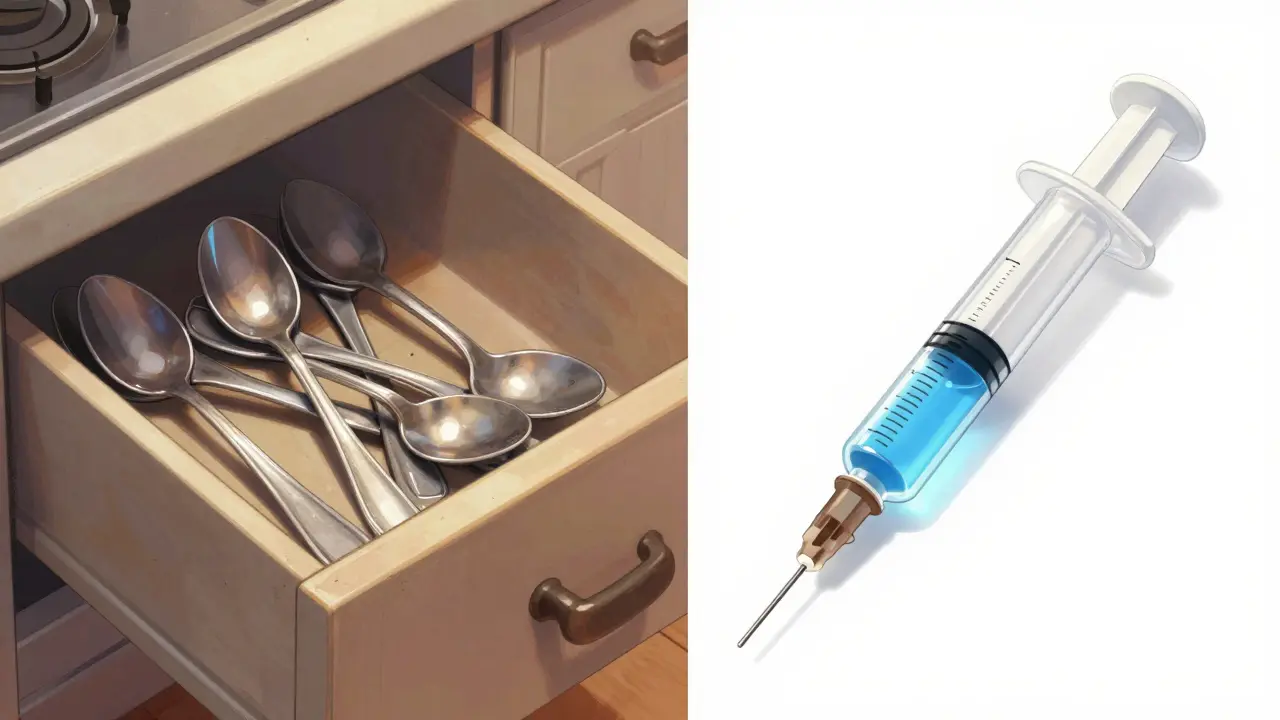
Imagine you’re in the middle of the night. Your child has a fever, and you need to give them liquid medicine. You reach into the kitchen drawer, grab a regular teaspoon, and pour out what looks like the right amount. It seems simple enough, right? But that single action might just be one of the most dangerous mistakes a parent can make.
Using household spoons for children’s medicine is not just an outdated habit-it’s a serious safety risk. Despite warnings from major health organizations for decades, many parents still use kitchen utensils to measure doses. The result? Thousands of preventable medication errors every year, ranging from ineffective underdoses to life-threatening overdoses.
The Hidden Danger in Your Kitchen Drawer
You might think all teaspoons are created equal. They aren’t. In fact, they vary wildly. A standard medical teaspoon is defined as exactly 5 milliliters (mL). But the spoon sitting in your silverware drawer? It could hold anywhere from 3 mL to 7 mL. That’s a variance of up to 40%.
Think about what that means. If your doctor prescribes 5 mL of cough syrup, and you use a small kitchen spoon that only holds 3 mL, your child gets less than two-thirds of the needed dose. The infection isn’t treated properly. On the flip side, if you use a large spoon holding 7 mL, you’ve given a 40% overdose. For sensitive medications like ibuprofen or acetaminophen, that extra amount can strain a child’s liver or kidneys.
The confusion gets worse when tablespoons enter the picture. A medical tablespoon is 15 mL. If you accidentally grab a tablespoon instead of a teaspoon, you’re giving three times the intended dose. That’s not a typo-that’s a potential emergency room visit.
How much do household spoons vary in size?
Household teaspoons can vary significantly, typically holding between 3 mL and 7 mL, compared to the standard medical teaspoon of 5 mL. This creates a potential error margin of up to 40%, which can lead to serious underdosing or overdosing in children.
What the Data Really Shows
This isn’t just theoretical. The numbers paint a stark picture. Research funded by the National Institutes of Health (NIH) and published in *Pediatrics* in 2014 found that using teaspoons or tablespoons doubled parents’ chances of administering an incorrect dose. Nearly 40% of parents incorrectly measured their intended dose, and over 41% made errors in measuring the prescribed amount.
Every year, poison control centers receive more than 10,000 calls specifically related to incorrect dosing of liquid medications for children. These aren’t rare edge cases-they’re common occurrences that happen because we rely on imprecise tools.
A 2016 study in *Academic Pediatrics* revealed another layer of the problem: labeling. When medicine labels used "tsp" or "teaspoon," nearly one-third (33.3%) of parents considered using a kitchen spoon. But when labels used "milliliter" or "mL," less than 10% of parents thought about using a non-standard tool. That’s a 23.3 percentage point difference in absolute risk. The way we label medicine directly influences how accurately we measure it.
Why Children Are More Vulnerable
Adults have larger bodies and more robust metabolic systems. A slight miscalculation in an adult’s dose might cause mild side effects or no effect at all. Children are different. Their organs are still developing, and their bodies process medications differently. Even small dosing errors can have disproportionate effects.
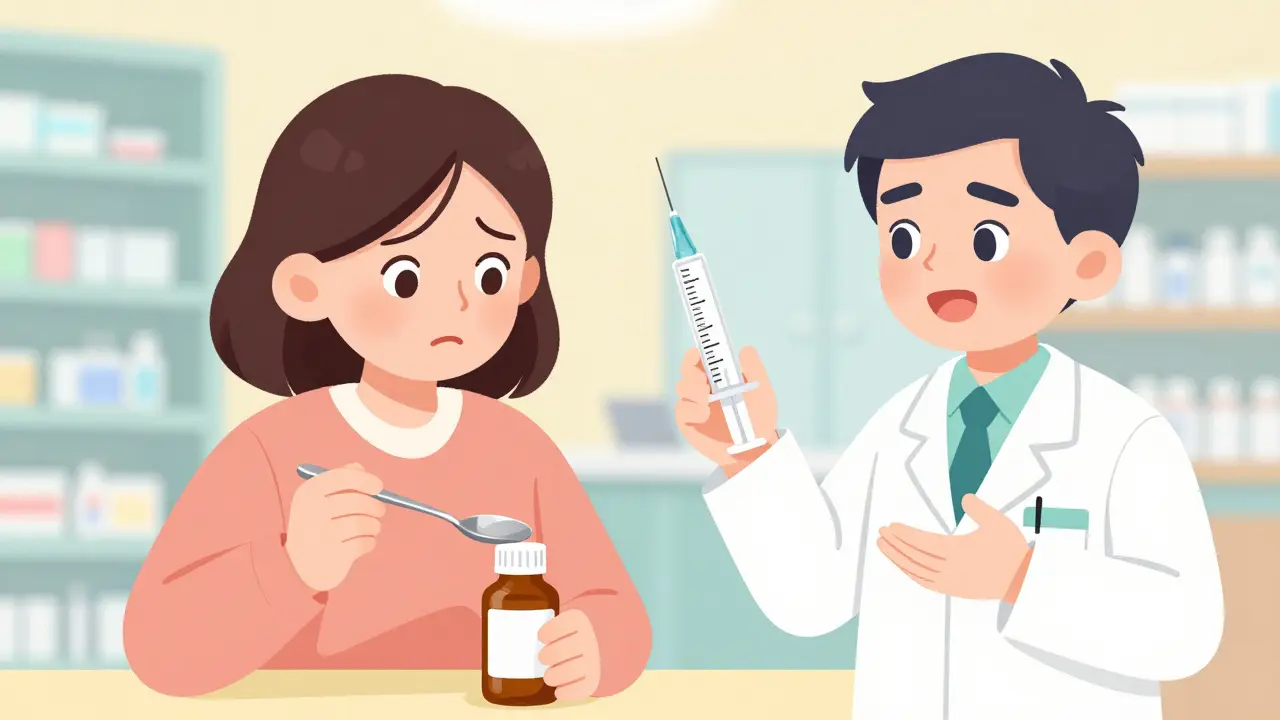
Dr. Shonna Yin, lead author of the NIH-funded study, put it simply: "A big part of the problem is parents confusing medicine spoons with kitchen spoons. Many people confuse the two. Errors are much less likely when parents use medicine droppers and oral syringes calibrated in milliliters."
Children’s sensitivity to medications means that precision isn’t optional-it’s essential. An overdose can lead to severe side effects, including respiratory depression or organ damage. An underdose means the illness isn’t being treated, potentially leading to complications or prolonged suffering.
The Right Tools for the Job
If kitchen spoons are out, what should you use? The answer is clear: calibrated medical devices. Here’s a breakdown of the best options:
| Tool | Accuracy | Best For | Limitations |
|---|---|---|---|
| Oral Syringe | High (0.1 mL increments) | Precise doses, especially <5 mL | Requires proper technique |
| Dosing Cup | Moderate (5 mL increments) | Larger doses (>5 mL) | Imprecise for non-5 mL amounts |
| Medicine Dropper | High | Infants, very small doses | Time-consuming for larger volumes |
| Household Spoon | Very Low (3-7 mL variance) | None | Unpredictable volume, high error rate |
Oral syringes are widely regarded as the most accurate and convenient dosing device. A 2023 study in *Frontiers in Public Health* confirmed that oral syringes account for the least percentage of imprecise dosing. Their graduated markings allow precise measurement down to 0.1 mL increments, making them ideal for complex doses like 3.5 mL or 0.5 mL.
Dosing cups are useful for larger volumes but fall short when precision is needed. They’re typically marked at 5, 10, 15, and 20 mL intervals. Trying to measure 3 mL with a cup designed for 5 mL jumps is guesswork, not science.
Medicine droppers are excellent for infants who need tiny amounts. However, they can be tedious for older children requiring larger doses. Oral syringes bridge this gap, offering accuracy across the full range of pediatric dosing requirements.
How to Measure Medicine Correctly
Having the right tool is only half the battle. How you use it matters just as much. Follow these steps to ensure accuracy:
- Use the device provided. Most liquid medicines come with an oral syringe or dosing cup. Stick with it. Don’t substitute with kitchenware.
- Read at eye level. Hold the syringe or cup at eye level to read the measurement accurately. Looking from above or below can distort the meniscus (the curve of the liquid), leading to errors.
- Measure in milliliters (mL). Always check that the prescription and the device are both in mL. If there’s any confusion, ask your pharmacist to clarify.
- Administer gently. Safe Kids Worldwide recommends squirting the medicine gently between your child’s tongue and the side of the mouth. Avoid putting it directly in the back of the throat, which can trigger gagging or choking.
- Ask for help if needed. If you don’t have a proper measuring device, ask your pharmacist. Many pharmacies provide oral syringes with clear milliliter markings free of charge.
Olivia Bishop, a pharmacy resident at Aspirus, emphasizes: "Using milliliters for dosing liquid medications is important because it ensures we're getting the patient the correct dose. If we're not measuring it correctly, we can either be overdosing our patients, which puts them at risk of side effects, or underdosing, which means the infection or issue we're treating isn't being addressed."

Why the Confusion Persists
You might wonder why so many parents still use kitchen spoons despite decades of warnings. The American Academy of Pediatrics (AAP) first issued its formal recommendation against using household spoons in 1978. Yet, according to the Consumer Medication Safety Institute, approximately 75% of Americans still rely on teaspoons from their kitchen drawers.
Cultural habits die hard. For generations, grandparents told parents to use a teaspoon. Pharmacies sometimes dispensed medicines without proper dosing devices. Labels often included both "tsp" and "mL," creating ambiguity. It wasn’t until recently that regulatory bodies pushed for standardized milliliter-only labeling.
The CDC’s "Spoons are for Soup" campaign (launched in 2023) aims to change this narrative. The message is direct: "Milliliters (mL) are for Medicine." By decoupling cooking measurements from medical ones, the campaign seeks to eliminate confusion at its source.
FDA Commissioner Robert Califf reinforced this stance in 2023, stating that "standardized dosing tools and clear labeling are essential components of pediatric medication safety." Pharmaceutical manufacturers are increasingly adopting milliliter-only labels, though implementation remains inconsistent.
What You Can Do Today
Change starts at home. Here’s how to protect your child:
- Throw away the idea of kitchen spoons. Treat them as strictly for food. Keep them far from medicine cabinets.
- Always ask for a dosing device. When picking up a prescription, confirm you have an oral syringe or dosing cup. If not, request one from the pharmacist.
- Check the label. Ensure the dosage is listed in milliliters (mL). If it says "tsp" or "teaspoon," ask your pharmacist to re-label it in mL.
- Educate other caregivers. Grandparents, babysitters, and school nurses need to know the rules too. Share this information openly.
- Keep devices clean. Wash oral syringes and dosing cups with warm, soapy water after each use. Rinse thoroughly and let them air dry.
Remember, precision saves lives. A few extra seconds to measure correctly can prevent hours of worry-or worse.
Is it safe to use a medicine spoon from the pharmacy?
Yes, but only if it’s a calibrated medicine spoon marked in milliliters. Never use a generic kitchen spoon. The American Academy of Pediatrics advises using only the spoon that comes with the medicine, ensuring it has clear mL markings.
What if my prescription says "1 tsp" instead of "5 mL"?
Contact your pharmacist immediately. Ask them to re-label the bottle in milliliters. Using "tsp" increases the likelihood of parents choosing a kitchen spoon, leading to dosing errors. Milliliter-only labeling is the safest standard.
Can I reuse oral syringes?
Yes, oral syringes can be reused if cleaned properly. Wash them with warm, soapy water after each use, rinse thoroughly, and let them air dry. Replace them if they become cracked, cloudy, or difficult to pull back.
Why are children more sensitive to medication errors?
Children’s bodies are still developing, and their organs process medications differently than adults’. Even small dosing errors can lead to significant side effects, including liver or kidney strain, respiratory issues, or inadequate treatment of the underlying condition.
What should I do if I accidentally give the wrong dose?
If you suspect an overdose or underdose, contact your pediatrician or poison control center immediately. Do not wait for symptoms to appear. Provide details about the medication, the intended dose, and the actual amount given.