
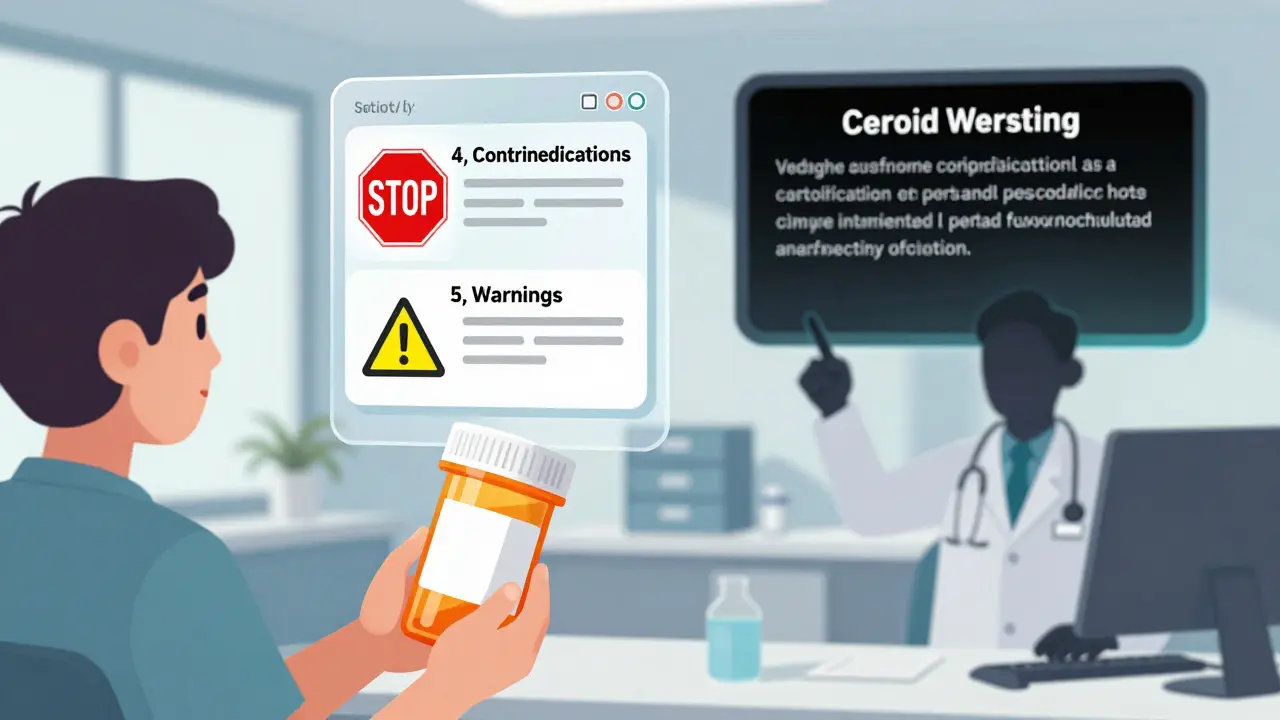
Every time you pick up a prescription or reach for an over-the-counter pill, there’s a hidden safety manual on the label. It’s not written for marketers or pharmacists-it’s written to keep you alive. But most people skip it. They glance at the dosage, check the expiration date, and move on. That’s a mistake. Contraindications and warnings on drug labels aren’t legal jargon-they’re life-or-death instructions. And if you don’t know how to read them, you’re flying blind.
What’s the Difference Between a Contraindication and a Warning?
Think of it this way: a contraindication means don’t take this drug at all. It’s a hard stop. A warning means proceed with caution. You might still take it, but only if you’re monitored, adjusted, or prepared. On prescription labels, contraindications are in Section 4. The FDA requires them to be based on solid evidence-like clinical trials or proven medical harm. For example, the blood thinner Xarelto has a contraindication for people with active bleeding. If you’re currently bleeding from an ulcer, a surgery, or a trauma, taking Xarelto could kill you. No exceptions. Warnings, in Section 5, are broader. They list serious side effects that might happen, even if they’re rare. Take Humira, used for arthritis. Its warning says: “Serious infections including tuberculosis and sepsis have occurred.” That doesn’t mean everyone gets TB. It means if you’ve had TB before, or live in an area where it’s common, your doctor needs to test you before starting. It’s not a no-go-it’s a need-to-check.Boxed Warnings: The Red Flag You Can’t Ignore
If you see a black box at the top of a drug’s prescribing information, stop. Read it. Then read it again. Boxed warnings, once called black box warnings, are the FDA’s strongest safety alert. They’re reserved for risks that can cause death or serious injury. About 40% of new drugs approved between 2008 and 2012 got one within five years. That’s not rare. That’s normal. Warfarin (Coumadin) has a boxed warning for major or fatal bleeding. Bupropion (Wellbutrin) has one for increased suicidal thoughts in young adults. These aren’t theoretical. These are real events that happened in enough people to force the FDA to put a black border around them. Here’s what to do: If your drug has a boxed warning, ask your doctor: “What’s the actual risk for me?” Not “Is this dangerous?”-but “How likely is this to happen to someone like me?”OTC Labels Are Different-But Just as Important
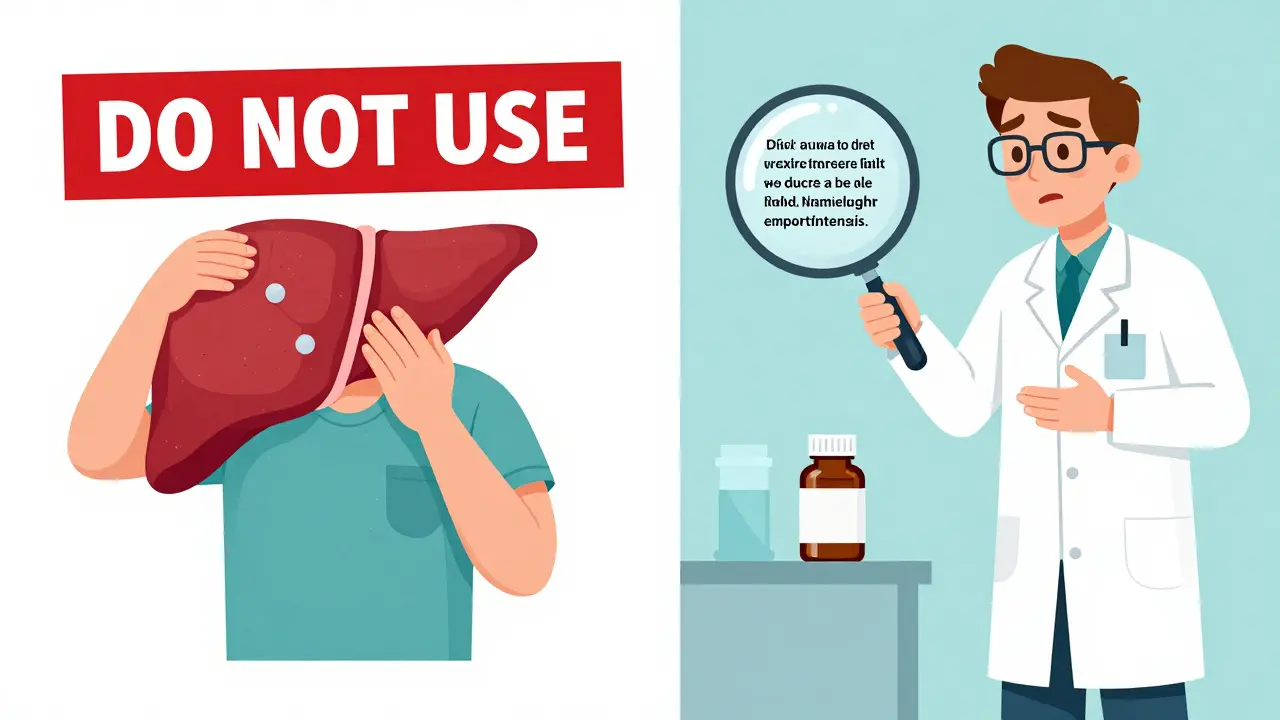
You don’t need a prescription to buy painkillers, allergy meds, or sleep aids. But that doesn’t mean they’re safe for everyone. Over-the-counter labels follow the Drug Facts format. Look for two key phrases:- “Do not use” - This is the OTC version of a contraindication. If you have liver disease and the label says “Do not use if you have liver problems,” don’t take it. Even if you feel fine.
- “Ask a doctor before use if…” - This is a warning. It means you might still use it, but only after talking to someone who knows your health history. For example, “Ask a doctor before use if you have high blood pressure” means your meds might make it worse.
Relative vs. Absolute: The Hidden Trap
Here’s where most people get tripped up. Not all contraindications are the same. An absolute contraindication means never. No exceptions. Like being allergic to penicillin and being told not to take any penicillin-based antibiotic. A relative contraindication means maybe, but carefully. For example, amiodarone (a heart rhythm drug) has a contraindication for “severe” lung disease. But what if you have mild lung disease? The label doesn’t say “no”-it says “severe.” That’s a gray zone. A Reddit user shared their story: their cardiologist prescribed amiodarone despite mild lung issues because the label said “severe.” The pharmacist almost refused to fill it because they didn’t read the fine print. The patient ended up fine-but they got lucky. Not everyone does. The key? Don’t guess. If a label says “severe,” “advanced,” or “uncontrolled,” ask your doctor: “Is my case severe enough to be a problem?” Don’t assume. Don’t skip.How to Actually Use This Info
Reading the label isn’t enough. You need to act on it. Here’s how:- Read the Boxed Warning first. If it’s there, everything else is secondary. This is your highest risk.
- Check Section 4: Contraindications. Are you in any of those categories? Pregnancy? Kidney failure? Allergy to an ingredient? If yes, ask if there’s an alternative.
- Scan Section 5: Warnings and Precautions. Look for things like “monitor liver function,” “avoid alcohol,” or “may cause dizziness.” These aren’t suggestions-they’re requirements.
- For OTC drugs, scan “Do not use” and “Ask a doctor.” If you’re over 65, pregnant, or on other meds, those lines are for you.
- Write down your questions. Don’t rely on memory. Write: “What’s the risk of X? How often does it happen? What signs should I watch for?”
Why This Matters More Than You Think
The Institute of Medicine estimates 1.3 million injuries each year in the U.S. come from medication errors-and poor labeling is a big part of that. Many of those injuries are preventable. Take the case of a 72-year-old man on warfarin. He started taking a new OTC cold medicine. The label didn’t say “avoid with blood thinners.” He didn’t ask. He got a brain bleed. He survived-but barely. The drug didn’t fail. The system failed. The warning wasn’t clear enough. The patient didn’t know to look. That’s why you need to know how to read these labels. Not because you’re a doctor. But because you’re the one taking the pill.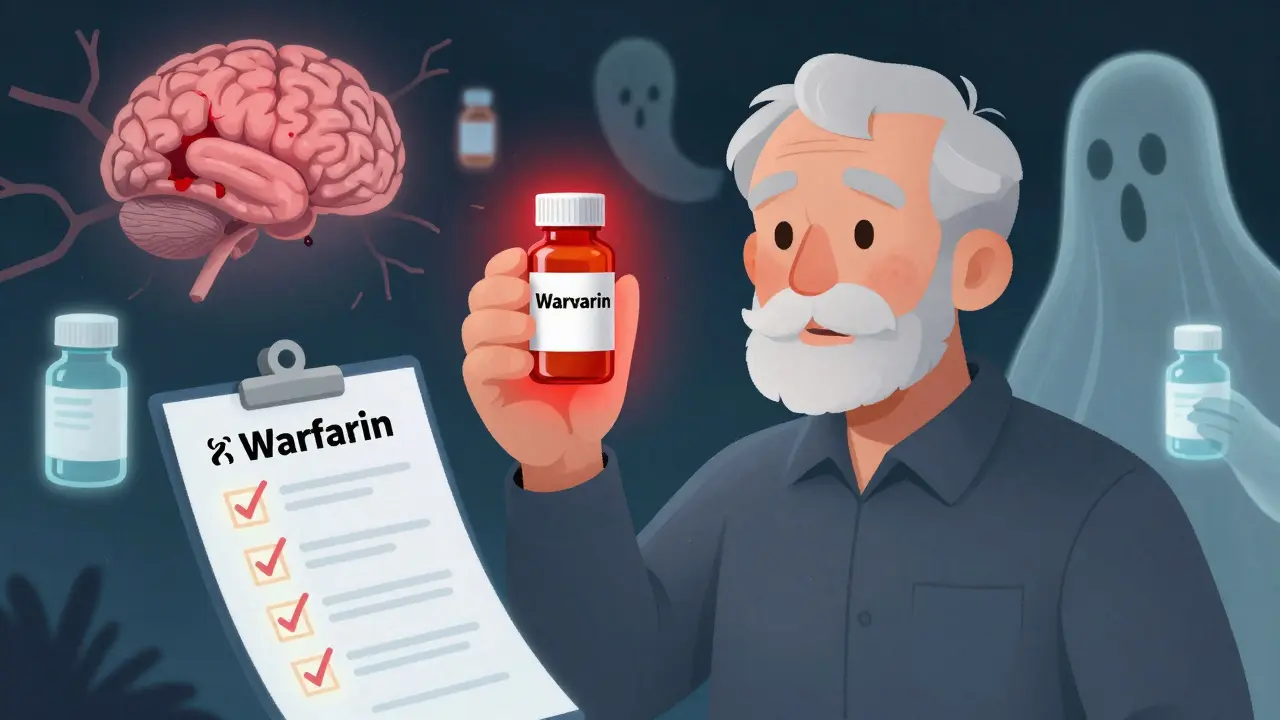
What’s Changing? And What You Should Watch For
The FDA isn’t sitting still. In 2024, they required all new drugs to include a “Highlights” section at the top of the label-summarizing the most critical contraindications and warnings in plain language. They’re also testing color-coded risk levels (red = high, yellow = medium) and quantitative data like: “Increases risk of heart attack by 1.8 times in people over 65.” That’s better than saying “may increase risk.” Some companies are even building digital tools that personalize warnings based on your age, other meds, and health history. Mayo Clinic and Kaiser Permanente are already piloting these. But here’s the truth: none of that helps if you don’t know what to look for.Final Checklist: What to Do Before Taking Any New Medication
- ✅ Is there a boxed warning? Read it.
- ✅ Does it say “Do not use” if you have X condition? Do you have X?
- ✅ Does it say “Ask a doctor” if you’re on Y drug? Are you on Y?
- ✅ Are you pregnant, breastfeeding, over 65, or have liver/kidney issues? Check the label for those.
- ✅ Do you know the exact name of the active ingredient? Many people don’t realize Tylenol = acetaminophen, and taking both together causes liver damage.
- ✅ Did you ask your doctor: “What’s the worst thing that could happen-and how likely is it?”
What’s the difference between a contraindication and a side effect?
A side effect is something that might happen-like dizziness, dry mouth, or nausea. It’s unpleasant, but not always dangerous. A contraindication is a reason not to take the drug at all. It’s not about discomfort-it’s about risk of death or serious injury. For example, a side effect of ibuprofen might be an upset stomach. A contraindication is having a bleeding ulcer-you shouldn’t take it because it could make the bleeding worse and kill you.
Can a drug have a boxed warning and still be safe for me?
Yes. Boxed warnings are about risk, not impossibility. For example, many antidepressants have a boxed warning for suicidal thoughts in young people-but they’re still prescribed because the benefits outweigh the risks for many patients. The key is whether your doctor has assessed your personal risk factors. If you’re 22 and have a history of depression and self-harm, your doctor might choose a different drug. If you’re 22 with no history and severe anxiety, the benefit may still be worth the risk-with close monitoring.
Why don’t drug labels just say “Don’t take this if you’re over 65”?
Because it’s not that simple. Age alone isn’t always the issue-it’s what comes with age. Older adults often have kidney or liver problems, take multiple drugs, or have other conditions. A label might say “Use with caution in patients with impaired renal function” instead of “over 65” because a 70-year-old with healthy kidneys might be fine, while a 55-year-old with kidney disease isn’t. Labels aim for medical accuracy, not age-based generalizations.
I read the label, but I still don’t understand it. What should I do?
Ask your pharmacist. They’re trained to interpret these labels. Or ask your doctor: “Can you explain this part to me in plain language?” Don’t be embarrassed. Even doctors sometimes need help understanding complex labeling. The goal isn’t to memorize the text-it’s to know what it means for you.
Do generic drugs have the same warnings as brand-name ones?
Yes. By law, generic drugs must have the same active ingredient, strength, dosage form, and safety information as the brand-name version. The label wording might be slightly different, but the contraindications and warnings are identical. If your brand-name drug has a boxed warning, the generic does too.
Can drug labels change after I start taking them?
Yes. The FDA can require updates if new safety data comes out. For example, if a new study finds a rare but deadly interaction with a common supplement, the label will be updated. That’s why it’s smart to check the label again if you refill a prescription after a year. You might have missed a new warning. The FDA issued 217 label changes in 2023 alone-many based on real-world patient data.

Finally, someone explains this without jargon. I wish I’d known this when I almost took ibuprofen with my blood thinner.
This is exactly the kind of practical, life-saving info that gets buried under marketing fluff. I’ve been teaching my elderly parents to read these labels for years - they used to just trust the pharmacist blindly. Now they ask questions. It’s changed everything.
Especially the part about ‘Do not use’ vs. ‘Ask a doctor.’ So many seniors think ‘ask a doctor’ means ‘it’s probably fine,’ when it’s really a red flag screaming for attention.
Also, the FDA’s new ‘Highlights’ section? Long overdue. If they keep pushing plain language, we might actually reduce preventable ER visits.
Everyone talks about labels like they’re some sacred text but the truth is most people don’t even know what ‘contraindication’ means. You think a 70-year-old grandma reading a pill bottle in 8-point font is going to parse ‘severe renal impairment’? No. She’s going to take it because the nurse said so.
And don’t get me started on generics. People think they’re ‘weaker’ because they cost less. They’re not. The FDA doesn’t play games. But the system still fails because it assumes everyone can read. They can’t. And no amount of ‘read the label’ advice fixes that.
US doctors are the best in the world but even they skip the warnings. I work in a clinic. Saw a guy on warfarin get prescribed a new OTC sinus med that says ‘avoid with anticoagulants’ right on the box. The doctor didn’t check. The pharmacist didn’t catch it. The patient almost bled out.
It’s not the label’s fault. It’s the culture. We treat meds like candy. And now we wonder why our healthcare costs are insane.
I’m a nurse and I can’t tell you how many times I’ve had to sit down with a patient and walk them through the label. One woman cried because she realized she’d been taking Tylenol with her arthritis med for years - and didn’t know they were the same thing.
This guide? It’s not just helpful. It’s necessary. Thank you for writing it. I’m printing copies for my patients.
Also - yes, generics are identical. Always ask for the active ingredient. That’s the real key.
Let’s be real - the FDA doesn’t care about you. They care about lawsuits. The boxed warnings are there because someone died, not because someone was thoughtful.
And don’t believe the myth that ‘more regulation = safer.’ The system is designed to react, not prevent. We’re still playing whack-a-mole with drug risks while pharmaceutical companies quietly fund the studies that get approved.
Reading labels won’t save you. Knowing who profits from your ignorance? That’s the real warning.
Thank you for this. I’m a caregiver for my mom with kidney disease, and I’ve spent hours trying to decode these labels - and I still get confused.
One thing I’ve learned: if the label says ‘use with caution’ and you’re over 65, take it as ‘probably not safe unless monitored.’ Don’t wait for the doctor to say it - ask. Say: ‘I’m concerned about her kidneys - is this still okay?’
Also - the ‘Ask a doctor’ line? That’s not a suggestion. It’s a plea. I’ve seen people ignore it and end up in the ER. Please don’t be one of them.
I appreciate the breakdown of contraindications versus warnings - I’ve been using this guide with my patients in my primary care practice.
One thing I’d add: many patients don’t realize that ‘over-the-counter’ doesn’t mean ‘risk-free.’ I had a patient who took 4 Advil a day for months because ‘it’s just pain relief.’ Turns out, he had undiagnosed hypertension. The label said ‘ask a doctor if you have high blood pressure.’ He didn’t.
It’s not about scaring people. It’s about empowering them with clarity. This post does that.
Coming from India, I’ve seen how drug labeling varies wildly - even within countries. In the U.S., at least there’s a standard. But here? Labels are often in English, Hindi, and regional languages, but the warnings are buried in tiny print.
What struck me most is how universal this problem is. Whether you’re in Lagos or Lahore, the same thing happens: people trust the packaging, not the science.
I’ve started teaching my community to look for ‘Do not use’ and ‘Ask a doctor’ - simple, visual cues. It’s working. No jargon needed.
Ah, the great American ritual: consume, consume, consume - then blame the label when the system fails you. The truth is, we’ve outsourced our autonomy to corporate medicine. The label isn’t the problem - the entire paradigm is.
You think reading ‘Boxed Warning’ will save you? Please. The real contraindication is believing that a pill can fix a society that commodifies health.
And while you’re scanning Section 5, ask yourself: who benefits from your fear? Who profits when you’re medicated, not healed?
Read the label? Sure. But read the system too - before it reads you.
Did you know the FDA is secretly funded by Big Pharma? That’s why the ‘Highlights’ section is so vague - they’re not trying to protect you, they’re trying to avoid liability.
And the color-coded warnings? Just a distraction. The real danger is the tracking chips embedded in every pill bottle - yes, they’re real - that monitor your compliance and feed data to insurers. If you miss a dose, your premiums go up.
They’re not warning you about bleeding - they’re warning you about non-compliance.
Read the label? No. Burn it. And demand transparency. Or you’re just another data point in their algorithm.
Beautifully written. I’ve been teaching my students in rural India that medicine isn’t magic - it’s a tool, and like any tool, it has limits.
One of my students asked: ‘If the label says ‘severe lung disease,’ and I have mild cough - should I stop?’ I said: ‘Ask your doctor. Don’t assume. Don’t guess.’
That’s the lesson. Not fear. Not blind trust. Just curiosity. And the courage to ask.
Thank you for reminding us that knowledge is the first dose of safety.