
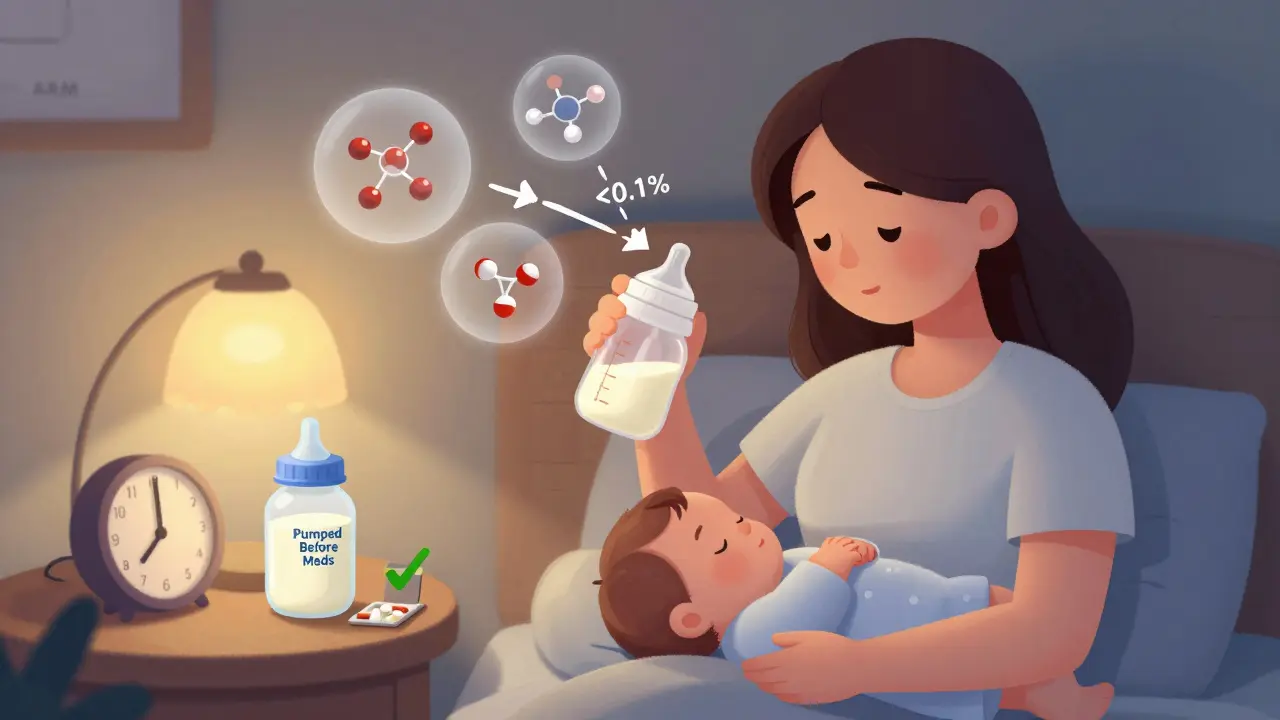
Many new parents hear one thing when they start taking medication while breastfeeding: pump and dump. It’s repeated in doctor’s offices, online forums, and even by well-meaning family members. But here’s the truth - in almost every case, you don’t need to throw away your milk. The idea that all medications contaminate breast milk comes from outdated warnings on drug labels, not science. Most drugs pass into breast milk in tiny, harmless amounts. The real goal isn’t to stop feeding - it’s to feed safely.
Why Pump and Dump Is Usually Unnecessary
The myth that you must discard milk when taking medicine started because drug manufacturers, worried about liability, wrote blanket warnings like “not recommended during breastfeeding.” But those warnings don’t mean “dangerous.” They mean “we haven’t tested it enough in nursing moms.” The American Academy of Pediatrics says only about 1% of medications require you to stop breastfeeding. That’s it. The rest? Safe - even if you’re taking them daily. Take common painkillers like acetaminophen or ibuprofen. When you take a standard dose, less than 0.1% of that medicine ends up in your milk. Your baby would need to drink over 100 liters of breast milk in a day to get the same dose you took. That’s impossible. Ibuprofen clears from your system in about 2 hours. Acetaminophen? Even faster. No need to pump and dump. Antidepressants like sertraline (Zoloft) are another example. Studies tracking over 1,000 babies whose moms took sertraline found no link to sleep problems, fussiness, or developmental delays. The relative infant dose - how much the baby actually absorbs - is under 2.5%. Compare that to naproxen (Aleve), which has a longer half-life and has been linked to rare cases of anemia in newborns. That’s why timing matters more than dumping.How Medications Actually Get Into Breast Milk
Not all drugs behave the same way. What makes one safe and another risky? It comes down to four key factors:- Molecular size: Drugs heavier than 500 Daltons (like heparin) don’t easily pass into milk.
- Protein binding: If a drug sticks tightly to proteins in your blood (over 80%), it can’t float freely into your milk.
- Half-life: Shorter half-life = faster clearance. A drug with a 3-hour half-life is gone from your system by the next feeding.
- Oral absorption in babies: Even if a little drug gets into milk, if your baby’s gut can’t absorb it well (like many antibiotics), it just passes through.
When You Actually Need to Pause Breastfeeding
There are exceptions. Very few medications truly require you to stop. These include:- Radioactive isotopes used in imaging tests (like thyroid scans)
- Some chemotherapy drugs
- Ergot alkaloids (used for migraines)
- Certain antiviral drugs for HIV (if mom is not on treatment)
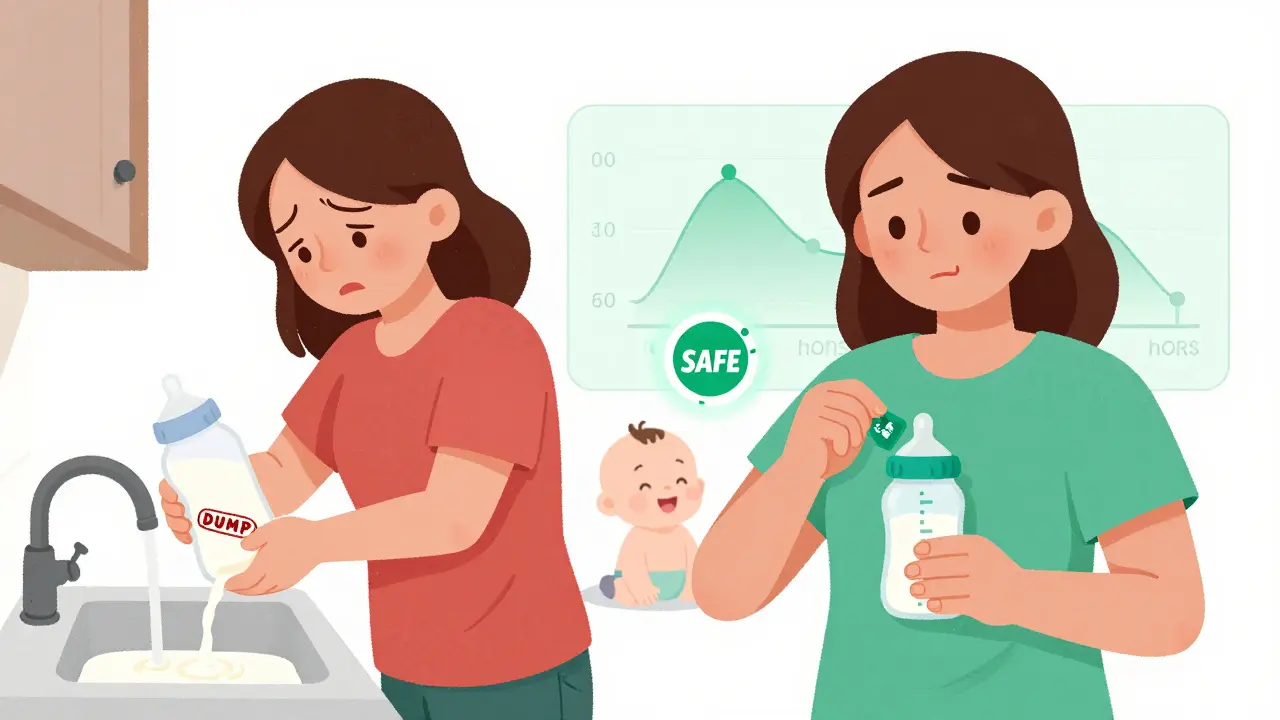
Timing: The Smart Alternative to Pump and Dump
Instead of tossing milk, use timing to protect your baby. Here’s how:- Take your dose right after a feeding - especially after the longest stretch of sleep (usually at night).
- Wait 6-8 hours before the next feeding. This lets your body clear most of the drug.
- For meds taken multiple times a day, feed right before the dose. Peak levels in your blood happen 1-2 hours after taking it. Feeding before then means less exposure.
Storage Rules Don’t Change
Whether you’re on medication or not, milk storage stays the same:- Room temperature (up to 25°C): 4 hours
- Refrigerator (up to 4°C): 4 days
- Freezer (-18°C): 6 months
What to Do When You’re Unsure
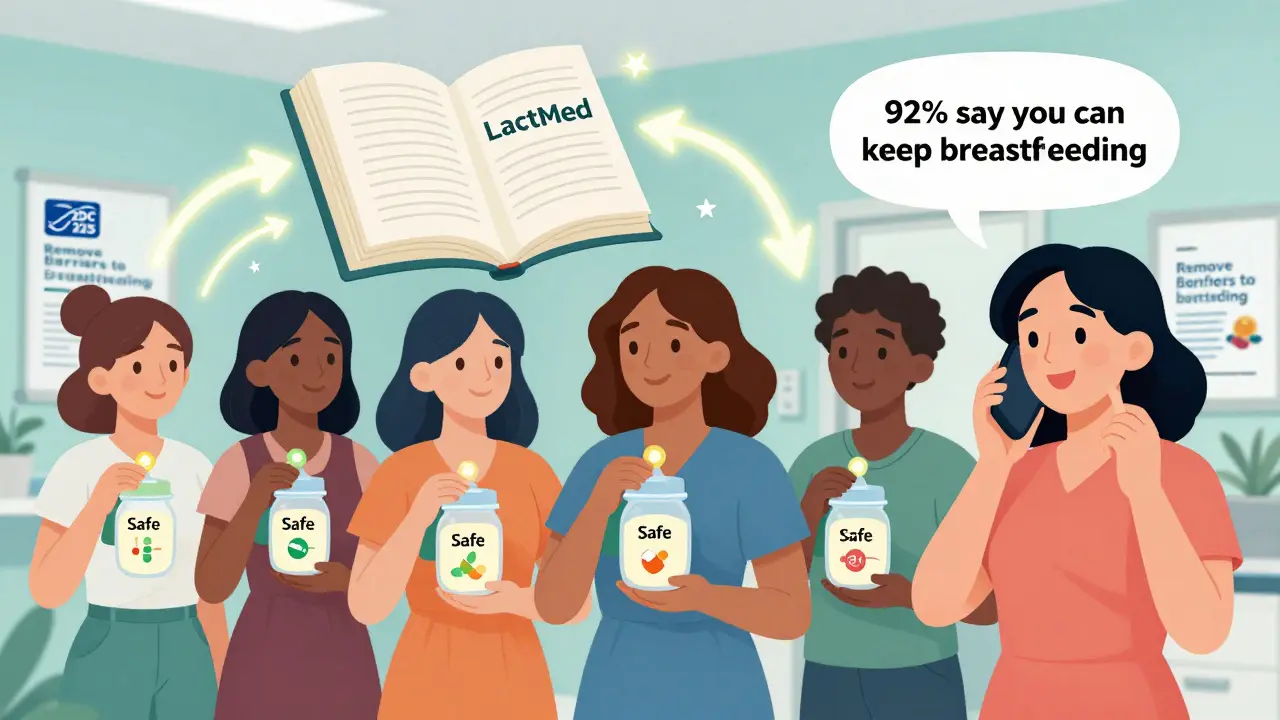
Don’t rely on your pharmacist’s printed insert. Don’t trust random Google results. Don’t guess. Use these trusted, science-backed resources:- LactMed - a free, updated weekly database from the National Institutes of Health. It lists over 1,300 medications with detailed pharmacokinetic data and infant risk levels.
- MotherToBaby - call 866-626-6847. Their experts are trained lactation consultants and pharmacists who give personalized advice in under 10 minutes.
- InfantRisk Center - offers a free app with real-time ratings and a helpline. They handle over 12,000 calls a year - and 92% of the time, they tell people they can keep breastfeeding.
What Happens When You Dump Too Much
Throwing away milk doesn’t just waste time and money - it hurts your supply. One study found that skipping just 24 hours of breastfeeding or pumping reduces milk production by 30-50%. For 42% of women, that loss is permanent. That means you might end up switching to formula - not because the medicine was unsafe, but because you were told to pump and dump. One mom in Chicago pumped and dumped for 72 hours after being told to avoid an antibiotic. Her supply dropped 40%. She never fully recovered. Another mom in Texas took sertraline, followed timing advice from MotherToBaby, and breastfed her 6-week-old without a single issue. Her baby slept well, gained weight, and never showed signs of discomfort. The difference? Evidence - not fear.What’s Changing in 2026
The tide is turning. The FDA is requiring drug labels to include more specific, evidence-based guidance for breastfeeding by 2024. Hospitals are switching from outdated pamphlets to LactMed as their standard reference. The CDC’s 2023-2025 plan lists “removing unnecessary barriers to breastfeeding during medication use” as a top priority. More moms are speaking up. Reddit’s breastfeeding community saw a 40% drop in “pump and dump” posts from 2021 to 2023 as people found better resources. Lactation consultants report that 68% of their calls now involve correcting misinformation. You’re not alone. And you don’t have to choose between your health and your baby’s. With the right info, you can take the medicine you need - and still feed your baby with your own milk.Do all medications pass into breast milk?
Yes, most medications pass into breast milk in tiny amounts - but that doesn’t mean they’re harmful. The amount your baby receives is usually less than 1% of your dose, and many drugs aren’t absorbed well by infants. Only a small number of drugs, like certain chemotherapy agents or radioactive substances, require you to stop breastfeeding.
Is it safe to breastfeed after taking ibuprofen or acetaminophen?
Absolutely. Both ibuprofen and acetaminophen are considered among the safest pain relievers for breastfeeding mothers. The amount that enters your milk is extremely low - less than 0.1% of your dose. You can take them as directed without pumping and dumping.
Should I pump and dump after taking antibiotics?
Almost never. Antibiotics like penicillin, amoxicillin, and cephalexin are safe and commonly used in newborns. Even clindamycin, which has a higher transfer rate, rarely causes issues unless the baby is very young or has a sensitive gut. Always check LactMed or call MotherToBaby before assuming you need to dump.
Can I store milk I pumped before starting medication?
Yes. Milk pumped before you started a medication is completely safe to use. Label it clearly and store it according to standard guidelines. You can even freeze it ahead of time if you’re planning to start a new medication and want to have a safe supply on hand.
How do I know if my medication is safe while breastfeeding?
Check LactMed (from the NIH) or call MotherToBaby at 866-626-6847. These are science-based, up-to-date resources that give you clear, personalized advice. Avoid relying on drug package inserts - they’re often written for legal protection, not medical accuracy.
Will pumping and dumping protect my baby from medication?
Not really. Pumping and dumping doesn’t remove the medication from your body faster - it only removes milk that’s already been produced. The drug is still circulating in your blood. The best way to protect your baby is to time your doses after feedings and use trusted resources to confirm safety.
Can I take antidepressants while breastfeeding?
Yes, many antidepressants are safe. Sertraline (Zoloft) is one of the most studied and safest options, with very low transfer to breast milk and no documented harm in thousands of cases. Paroxetine and fluoxetine are less ideal due to higher transfer rates. Always consult a specialist - don’t stop your medication without guidance.
What if my doctor says to stop breastfeeding?
Ask them to check LactMed or refer you to MotherToBaby. Many doctors aren’t trained in lactation pharmacology. Your right to breastfeed while taking medication is supported by the American Academy of Pediatrics, the CDC, and the American College of Obstetricians and Gynecologists. You deserve evidence-based advice - not fear-based recommendations.

Finally someone says it loud and clear. I pumped and dumped for 3 days after my C-section pain meds because my nurse said 'better safe than sorry.' Turned out my supply dropped 40% and I spent weeks crying over bottles. The real danger was the guilt, not the medicine. LactMed changed my life.
Stop letting fear dictate your parenting. You're not a lab rat.
Oh sweet jesus the drug labels are written by lawyers who’ve never held a baby. I took sertraline while nursing my twins and they’re now 8 and perfectly normal. Meanwhile my cousin’s kid is on gluten-free, dairy-free, sugar-free, anti-antidepressant diet because her OB told her to ‘dump it.’
Some people need a PhD in overthinking.
Im not sure why we let pharma companies dictate what we do anymore. In america we dont even have real healthcare and now theyre telling us how to feed our kids? I mean cmon. The fact that we need a website like lactmed just to know if we can take tylenol while breastfeeding is a national disgrace. This is what happens when you outsource your medical advice to profit driven corporations.
Also i hate emoticons so i wont use one but you get the point.
my friend had a baby last year and her doctor told her to stop breastfeeding because of her anxiety med. she cried for a week. then she found mothertobaby and they told her sertraline was fine. she kept nursing. her baby gained weight. she got her life back.
you dont need to be a scientist to know that if a drug is prescribed to babies, its probably safe in tiny amounts in milk. but most docs dont know this. so we have to teach them. or at least google it for them.
yo i just want to say this post is literally a gift from the breastfeeding gods. i’m from india and here the culture is still like ‘if you take medicine you stop breastfeeding’ full stop. my sister was told to dump her milk after a simple antibiotic for a UTI. she lost her supply and now her baby is on formula and she feels like a failure.
the science is so clear: molecular size, protein binding, half-life - these aren’t buzzwords, they’re lifelines. and timing? holy hell, that’s the secret weapon. take meds after the night feed, sleep, wake up, feed, repeat. no dumping. no panic. just science.
also i know i typo a lot but i mean every word. this needs to be on every OB’s desk.
So what you're saying is we should trust a website over a doctor? Interesting. And yet the same people who trust LactMed over their MD will still Google 'is it safe to eat sushi while pregnant' and believe the first blog post they see.
Also I'm pretty sure the FDA doesn't care about your Reddit post.
wait so if i take ibuprofen after my 10pm feed and my baby wakes up at 5am i'm good?
and what about if i take it twice a day?
does the half life mean i can feed right before the pill or after?
why does no one explain this in simple terms
also is this true for every drug or just painkillers
Thank you for this. I'm a UK midwife and I’ve had to correct so many patients who were told to dump milk after antibiotics. One lady thought she had to stop for 2 weeks after amoxicillin because her pharmacist said 'it's a strong one'. I showed her LactMed and she cried. Not from sadness - from relief.
Also, storing milk before meds? Genius. I started doing that with my second. Saved my sanity.
My wife took Zoloft while nursing our daughter. We timed it like this: she’d take it right after the 11pm feed. By 7am, when the baby woke up, the levels were basically zero. No fussiness. No sleep issues. No dumping.
And honestly? The real tragedy isn’t the meds - it’s the fact that doctors still push pump-and-dump like it’s gospel. We’re not in 1998 anymore. We have data. Use it.
While the general sentiment of this post is aligned with current pharmacokinetic literature regarding transmammary drug transfer, it is imperative to note that the relative infant dose (RID) thresholds referenced are derived from population-based pharmacokinetic models and may not account for individual metabolic variability, neonatal hepatic immaturity, or concurrent polypharmacy. The clinical applicability of timing protocols assumes consistent feeding schedules, which may not be feasible in preterm or medically fragile neonates. Further, the assertion that 'most drugs are safe' may inadvertently downplay the risk of idiosyncratic adverse reactions, particularly with drugs exhibiting nonlinear kinetics or active metabolites. Therefore, while LactMed is a valuable resource, individualized risk-benefit analysis remains paramount in clinical decision-making.
THIS. IS. EVERYTHING.
Let me just say - if you’re reading this and you’re scared to take your meds because someone told you to ‘pump and dump’ - I see you. I’ve been there. The guilt. The sleepless nights. The feeling that you’re choosing between being a good mom and being a healthy person.
But here’s the truth: your mental health is not a luxury. Your physical health is not optional. And your milk? It’s not a vessel for fear - it’s a lifeline of love.
When I took sertraline while nursing my son, I didn’t just feed him milk - I fed him peace. He slept better. I slept better. We both thrived.
Don’t let outdated warnings steal your joy. Use LactMed. Call MotherToBaby. Trust the science. And if someone says ‘dump it’ - smile, nod, and whisper: ‘I’m sorry, but my baby deserves better than myths.’ 💪🍼❤️