
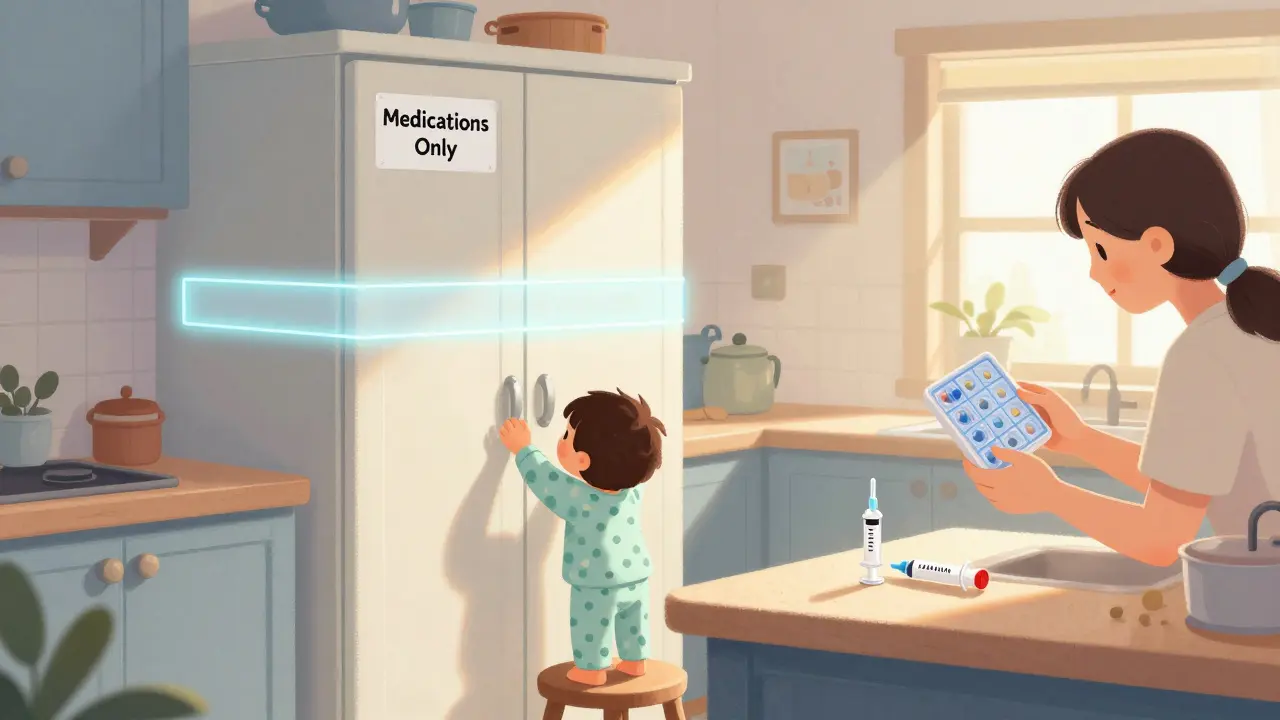
Every year, tens of thousands of children end up in emergency rooms because they got into medicine they weren’t supposed to. Most of the time, it wasn’t because a parent was careless-it was because the medicine was left where a curious toddler could reach it. A grandparent’s purse on the couch. A pill bottle on the bathroom counter. A bottle of cough syrup in the kitchen cabinet. These aren’t rare accidents. They’re preventable. And the solution isn’t just keeping medicine out of sight-it’s building a medication safety routine that works for your whole family.
Start with Where You Store It
Where you keep your medicine matters more than you think. The bathroom might seem convenient, but humidity from showers and sinks can weaken pills and liquids over time. The CDC and the American Academy of Pediatrics both warn against storing medications there. Instead, pick one cool, dry spot-like a high cabinet in the bedroom or a locked drawer in the kitchen. And make sure it’s not just out of reach, but out of reach and out of reach.Little kids climb. They pull on drawers. They stand on chairs. Even if you think your child can’t reach the top shelf, they might surprise you. Dr. Lorraine Kelley-Quon from Children’s Hospital Los Angeles says, “Keep them up and away” isn’t just a phrase-it’s a rule. And if you have opioids in the house, that rule becomes even more critical. Opioid overdoses in children can happen fast: small pupils, slow breathing, extreme drowsiness. Keep naloxone (Narcan) on hand if you’re storing these medications, and store them in a locked box, separate from other pills.
Use child-resistant caps-yes, the ones that click when you push and turn. But don’t assume they’re foolproof. Only 55% of parents use them correctly. Always lock the cap after each use. And never rely on height alone. A 2022 CDC study showed that households using the “up and away” method with locked storage saw a 34% drop in pediatric exposures. Add a lock, and that number climbs even higher.
Know Exactly What’s in Your Medicine Cabinet
Most families don’t know what’s actually in their medicine cabinet. They assume they do-until they find three different bottles of ibuprofen, a half-empty bottle of blood pressure pills from last year, and a box of expired antihistamines. This isn’t just messy-it’s dangerous.Start with a full inventory. Gather every pill, liquid, patch, cream, vitamin, and herbal supplement everyone in your home is taking. Include over-the-counter meds like Tylenol, cold syrup, and allergy pills. Don’t forget the supplements-fish oil, melatonin, magnesium. These can interact with prescriptions in ways you might not expect.
Create a master list. Write down:
- Medication name (brand and generic)
- Dosage
- How often to take it
- Why it’s prescribed
- Start date
- Any side effects to watch for
Keep this list on the fridge, taped to the inside of a cabinet door, or in a notebook by the medicine cabinet. Update it every time you get a new prescription or stop taking something. This isn’t just for you-it’s for babysitters, grandparents, and emergency responders.
Use the Five Rights Every Time
Giving medicine isn’t just about handing over a pill. It’s a five-step check you do every single time:- Right child-Is this medicine for the person you’re giving it to?
- Right medication-Does the label match the list?
- Right dose-Are you using the right measuring tool?
- Right route-Is it supposed to be swallowed, applied to the skin, or inhaled?
- Right time-Is it the correct time of day?
For kids, dosing errors are the most common mistake. A tablespoon isn’t the same as a teaspoon. A cup might look accurate, but studies show oral syringes reduce dosing errors by 47%. Always use the syringe or dosing cup that came with the medicine. Never use kitchen spoons-they’re not precise.
For older adults taking five or more medications, the risk of mix-ups is high. One in three seniors takes a medication that increases their risk of falling. The American Geriatrics Society’s 2023 Beers Criteria lists anticholinergic drugs-common in sleep aids, allergies, and bladder medications-as especially risky. Ask your pharmacist or doctor every six months: “Is this still necessary?”

Organize and Automate
A 7-day pill organizer is one of the most effective tools for families juggling multiple medications. AARP’s 2023 caregiver survey found that 68% of families who used one reported fewer errors. But don’t just dump pills in-it needs to be organized by time of day. Use separate compartments for morning, afternoon, evening, and bedtime.Color-coding helps too. One Reddit user used painter’s tape to mark containers: green for morning meds, red for nighttime. They cut their errors by 60%. You can do the same with labels or stickers.
For tech-savvy families, apps like Medisafe or MyTherapy send reminders and track doses. But don’t force it on older relatives who aren’t comfortable with phones. A simple alarm on a basic clock radio, or a sticky note on the fridge, works just as well. The goal isn’t to go high-tech-it’s to go consistent.
Review and Reconcile Regularly
Medications change. New ones are added. Old ones are stopped. But families rarely update their lists.Every six months, do a “brown bag” check. Gather every medication your family is taking-including vitamins and supplements-and bring them to your pharmacist. Pharmacists are trained to spot interactions, duplicates, and outdated prescriptions. The American Pharmacists Association says this simple step cuts adverse drug events by up to 27%.
For seniors, ask about deprescribing-phasing out medications that are no longer needed. The American Medical Association found that 15% of hospital admissions for older adults are caused by inappropriate meds. A pharmacist review can often safely remove one or two drugs, reducing side effects and fall risk.

Dispose of What You Don’t Need
Expired, unused, or unwanted meds shouldn’t sit in the cabinet. They shouldn’t go down the drain. And they shouldn’t go in the trash without being made unusable.The safest way? Take them to a pharmacy drop-off box. Many pharmacies, including those in New Zealand, offer free take-back programs. If that’s not available, mix pills with coffee grounds or cat litter in a sealed bag before tossing them. Crush tablets if possible. This makes them unappealing and unusable to kids or pets.
Never flush unless the label says to. Most meds don’t need it-and flushing harms water systems.
Plan for the Unexpected
What if your child swallows something? What if your elderly parent misses a dose? What if you’re away from home and need to give medicine to a grandchild?Keep a printed emergency sheet taped to the fridge. Include:
- Emergency contact numbers (Poison Control: 1-800-222-1222)
- All current medications and dosages
- Allergies
- Primary doctor’s name and number
- Any chronic conditions
If a dose is missed, don’t double up. HealthyChildren.org says: “Give it as soon as you remember, then go back to the regular schedule.” Never give two doses at once unless a doctor says so.
For households with opioids, keep naloxone (Narcan) nearby. It’s available without a prescription in many places, and it can reverse an overdose in minutes. Learn how to use it. Practice with the trainer device. Keep it in the same locked cabinet as the meds-so it’s safe, but quick to grab.
It Takes Time, But It’s Worth It
Setting up a safe medication routine doesn’t happen overnight. It takes 2 to 3 weeks to build habits. The first step-gathering all meds and making the list-might take 60 to 90 minutes. But after that, daily use becomes automatic.And the payoff? Fewer trips to the ER. Fewer mistakes. Less stress. More confidence when you’re giving medicine to your child, your partner, or your aging parent.
The Institute for Safe Medication Practices says 80% of preventable medication errors happen at home. That’s not a failure of care-it’s a failure of systems. Fix the system, and you fix the risk.
You don’t need to be perfect. You just need to be consistent. Locked cabinet. Clear list. Right dose. Right time. And always, always know where the Poison Control number is.
What’s the most common mistake families make with medication safety?
The most common mistake is storing medicine where children can reach it-even if it’s on a high shelf or in a cabinet that’s “out of sight.” Kids climb, open drawers, and search through purses. The CDC found that 79% of emergency visits for kids under 2 happen when a caregiver was nearby but not actively watching. Always lock it up, even if you think it’s safe.
Can I use the same pill organizer for everyone in my family?
No. Even if two people take the same medication, each person’s schedule may differ. Mixing pills in one organizer increases the risk of giving the wrong dose to the wrong person. Use separate organizers labeled with names, or use color-coded containers with clear labels. It’s a small step that prevents big mistakes.
How do I know if a medication is expired?
Check the expiration date on the bottle or box. If it’s past that date, don’t use it-even if it looks fine. Liquid medications, antibiotics, and insulin degrade faster and can become ineffective or harmful. If there’s no date, call your pharmacy. They can tell you the original expiration date based on when it was dispensed.
Should I keep a medicine cabinet in the bathroom?
No. Humidity from showers and sinks can break down pills and liquids, making them less effective. Store medicines in a cool, dry place like a bedroom cabinet or a locked drawer in the kitchen. If you must keep them in the bathroom, use a sealed container and check expiration dates more often.
What should I do if my child swallows medicine they weren’t supposed to?
Call Poison Control immediately at 1-800-222-1222. Don’t wait for symptoms. Don’t try to make them vomit. Have the medicine container ready so you can tell them what was taken, how much, and when. Keep this number saved in your phone and posted on the fridge. Most poisonings can be handled at home if you act fast.
Is it safe to give someone else’s leftover medication?
Never. Medications are prescribed for specific people, conditions, and weights. A pill that helps your headache might cause a dangerous reaction in your child. Even if it’s the same drug, the dose or formulation may be different. Always use only medications prescribed for the person taking them.

I used to keep all my meds in the bathroom until my 3-year-old pulled down my blood pressure pills. Now everything’s in a locked cabinet above the fridge. No more panic attacks when I turn my back for two seconds.
Best decision ever.
Medication safety isn’t about locks or lists-it’s about confronting the illusion of control. We think we’re protecting our families by storing pills ‘out of sight,’ but we’re really just delaying the inevitable collapse of our fragile systems.
Death doesn’t care if your cabinet is locked. It only cares if you’re paying attention.
And most of us? We’re distracted. Always distracted.
LOL the CDC says humidity ruins meds? Bro, I’ve had amoxicillin in my bathroom since 2019 and it still works. You know what else works? Common sense.
Also, why are we pretending kids can’t open childproof caps? My niece opened a bottle of melatonin at 18 months. It’s not about locks-it’s about supervision. Stop outsourcing responsibility to plastic caps and cabinets.
Also, Narcan in every home? Next you’ll tell us to keep defibrillators in the toy box.
This is such a thoughtful, practical guide. I especially love the five rights checklist-I printed it and taped it next to my pill organizer.
For anyone new to managing meds for kids or elderly parents: start small. Pick one thing-like moving meds out of the bathroom-and stick with it for a week. Build from there.
You don’t need to be perfect. Just consistent. And you’re already ahead of 80% of households.
Correction: The CDC study cited shows a 34% reduction in pediatric exposures with locked storage-not ‘up and away’ alone. Also, ‘child-resistant caps’ are not the same as ‘childproof.’ The correct term is ‘child-resistant packaging’ per FDA guidelines. Precision matters when lives are at stake.
Additionally, the American Pharmacists Association’s 27% reduction figure refers to pharmacist-led medication therapy management (MTM), not general brown bag reviews. Please cite accurately.
My grandma used to keep her pills in a little jewelry box on her nightstand. We thought it was cute. Then she gave my cousin her heart med by accident. Now everything’s in a locked box labeled with her name, and I update the list every Sunday.
It’s not glamorous. But it’s quiet, reliable, and keeps us all alive.
Also-yes, you can use the same pill organizer if you label it. Just don’t be lazy.
Why are we wasting time on this? In Australia we just put meds in the fridge and let the kids learn from their mistakes. If your kid survives a pill overdose, they’re tougher. If they don’t? Well, nature’s got a way of thinning the herd.
Also, why are we giving kids melatonin? That’s just pharmaceutical parenting. Grow up.
Who gave the CDC the right to tell me where to store my medicine? This is tyranny disguised as safety. Next they’ll ban sugar, then caffeine, then laughter.
My grandmother kept her pills in a drawer next to her lingerie. She lived to 98. My son took a Tylenol once and survived. He’s 12 now. He knows better.
Locking up meds is a sign you don’t trust your own family. That’s the real danger.
Forgive me for being blunt, but this entire post reads like a corporate wellness pamphlet written by someone who has never held a crying toddler at 3 a.m. while searching for a lost bottle of amoxicillin.
Also, ‘brown bag’ checks? How quaint. In real life, people don’t have time for this. We’re working two jobs, raising kids, and paying for insulin out of pocket. You think we care about expiration dates when we’re choosing between food and meds?
Also, Narcan? Who even has that? It’s not like it’s available at every gas station. This is performative safety for people who have privilege to worry.
I cried reading this. Not because it’s sad-but because it’s the truth I’ve been too scared to admit.
My daughter swallowed half a bottle of my anxiety meds last year. I didn’t even know they were missing until I saw her staring at the ceiling, unresponsive. The ER nurse said, ‘This happens every week.’
Now I have a locked box. I have a list. I have Narcan. I have a new fear: that I’ll forget to lock it again.
But I won’t. Not ever again.
As a nurse in Mumbai, I’ve seen too many cases where grandparents give adult pills to kids because ‘it’s the same medicine.’
Always label everything-even if it’s just with a Sharpie on the bottle. Use a pill organizer with days and times. And if you’re unsure? Call your pharmacist. They’re paid to help you.
It’s not complicated. It’s just consistent.
Most people don’t realize that 60% of pediatric poisonings involve prescription meds from their own home. The rest? Grandparents’ pills. That’s not an accident-it’s negligence.
And don’t get me started on melatonin. It’s not a vitamin. It’s a hormone. Don’t treat it like candy.
Also, if you’re using kitchen spoons? You’re not a parent. You’re a liability.
OMG I just realized my 4-year-old has been opening my CBD gummies 😭 I thought they were candy!!
Now I’m crying and locking everything and I feel like such a bad mom but also I’m so scared and I just need someone to tell me I’m not alone??
❤️❤️❤️
What’s interesting here isn’t the storage or the lists or even the childproof caps-it’s the underlying assumption that safety can be engineered through systems. But systems are made by humans, and humans are fallible, distracted, grieving, exhausted.
What if the real problem isn’t that we don’t lock our cabinets-but that we’re expected to be perfect caretakers while living in a world that gives us no support? What if the medication cabinet is just a metaphor for the entire burden of modern parenting and elder care?
Maybe the answer isn’t a locked drawer. Maybe it’s a society that doesn’t make us do this alone.
As a former paramedic in rural Ohio I’ve seen it all. Kids swallowing grandma’s blood thinners. Teens taking dad’s Adderall. Grandparents mixing OTC with prescriptions because they can’t read the tiny print.
Lock the cabinet. Use the syringe. Make the list. Call Poison Control before you Google it.
And if you’re too tired to do it? Ask for help. Your neighbor. Your cousin. Your church group. We’re not meant to do this alone.
It’s not about being perfect. It’s about being present.
And if you’re reading this? You already are.