
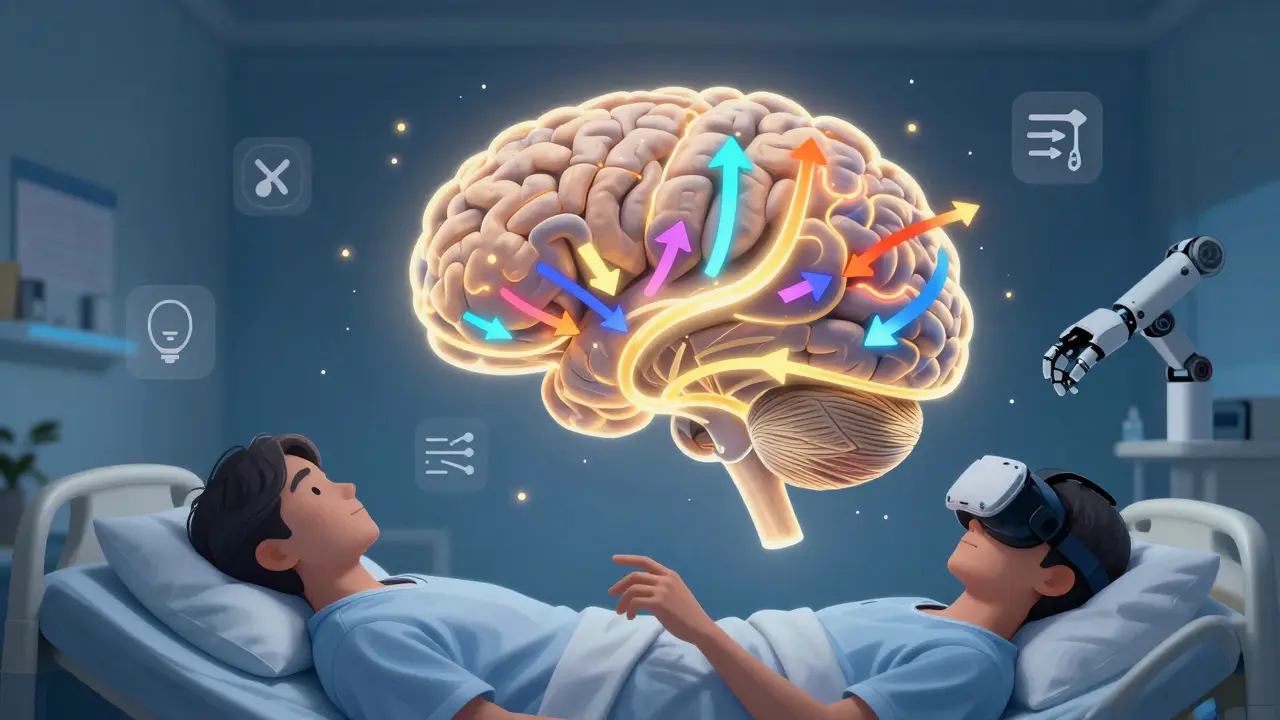
What Happens After a Stroke?
When a stroke happens, the brain loses its ability to control parts of the body-maybe an arm won’t move, speech gets slurred, or balance disappears. But the damage isn’t always permanent. The brain has a surprising ability to heal itself, especially when you start rehab early. This isn’t magic-it’s science. Neuroplasticity, the brain’s ability to rewire itself, is what makes recovery possible. Even if some brain cells die, others can take over their job. The key? Training them to do it.
Why Timing Matters More Than You Think
Waiting to start rehab can cost you progress. Studies show that starting intensive therapy within 24 hours of a stroke improves movement recovery by 35% compared to waiting days or weeks. That’s not a small difference-it’s the difference between walking again on your own or needing a wheelchair long-term. The brain is most ready to relearn in those first days. Swelling goes down, blood flow stabilizes, and the body begins to signal what’s still working. That’s when therapy should begin-no later than when you’re medically stable.
The Three Phases of Recovery
Recovery doesn’t happen all at once. It unfolds in three clear stages, each with its own goals.
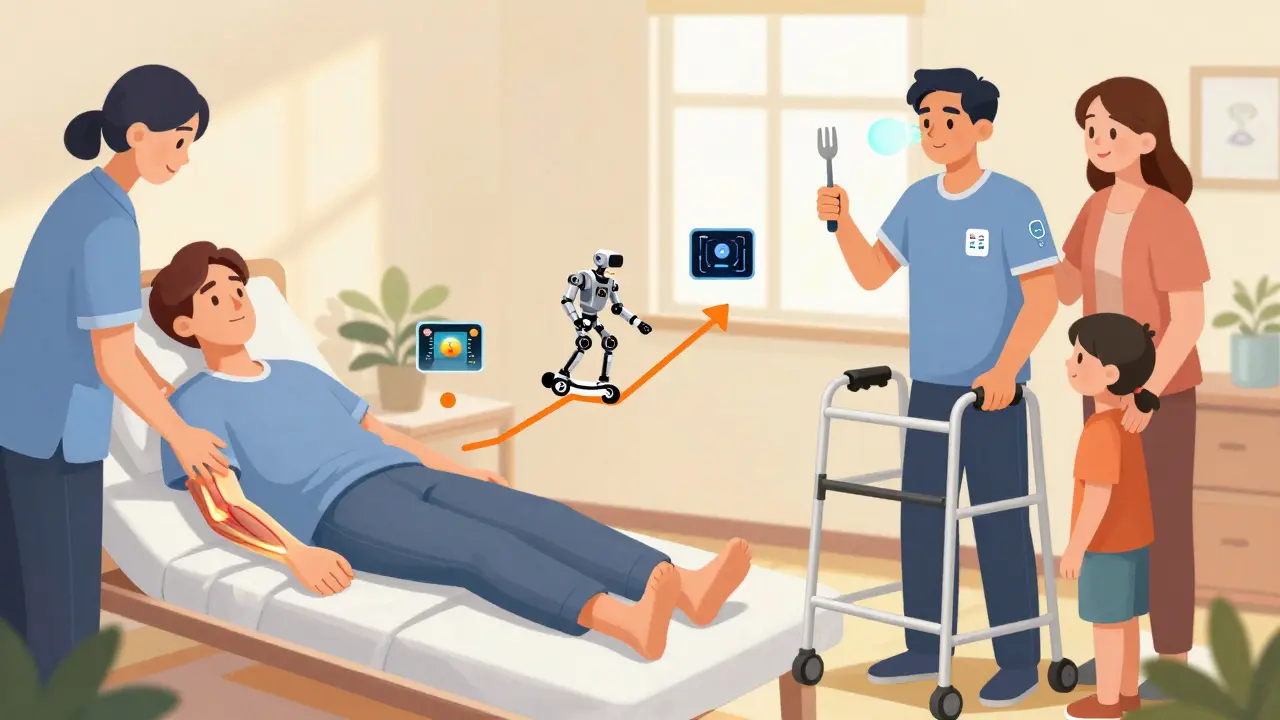
- Recovery/Natural Healing (Days to Weeks): Your body is fixing itself. Swelling reduces, some movement returns on its own. Therapy here focuses on preventing complications-like stiff joints or bedsores. Passive exercises, where a therapist moves your limbs, keep muscles and joints flexible. Positioning matters too. Lying the right way stops muscles from tightening up.
- Retraining (Weeks to Months): This is where the real work happens. You’re not just waiting for improvement-you’re building it. Therapists use repetition, cues, and task-specific practice. Want to sit up without help? You’ll do it 50 times a day. Want to reach for a cup? You’ll practice that motion over and over. Visual cues, like pointing to a wheelchair brake, help your brain reconnect. Small goals-like moving a finger 5 degrees more this week-build confidence and measurable progress.
- Adaptation (Months to Years): Some functions may never fully return. That’s okay. Adaptation means learning to live well with what’s left. This is where grab bars in the bathroom, voice-activated lights, or modified utensils come in. It’s also about mindset. Counseling helps people adjust to new limits. Family support increases adherence to therapy by 37%. You’re not alone in this.
What Does Therapy Actually Look Like?
Rehab isn’t one thing-it’s a mix of specialized therapies working together.
- Physical Therapy: Focuses on movement. You’ll do strength training, balance drills, and walking practice. Constraint-induced therapy-where you wear a mitt on your good hand for 90% of the day-forces you to use the affected one. Studies show it leads to 30% better arm function than standard therapy. Robotic devices help with repetitive leg movements during walking training, improving speed by 50% compared to traditional methods.
- Occupational Therapy: Teaches you how to do daily tasks again. Dressing, cooking, brushing your teeth. Therapists break each task into steps and adapt tools. A weighted spoon might help with shaky hands. A long-handled sponge makes bathing easier. The goal? Independence. No more relying on others for basic needs.
- Speech-Language Therapy: Not just about talking. Many stroke survivors struggle with swallowing (dysphagia), which can lead to pneumonia. Therapists train the muscles involved in swallowing and use techniques like chin tucks or modified food textures. For speech, they work on word retrieval, sentence formation, and even using communication apps if verbal speech doesn’t return.
Technology Is Changing the Game
Therapy isn’t stuck in the 1990s. New tools are making rehab faster and more effective.
- Virtual Reality: Patients play games that mimic real-life movements-reaching for fruit, catching balls, stepping over obstacles. Studies show 28% better arm function than standard care.
- Robotic Exoskeletons: Devices like the Lokomat support body weight and guide leg movement during walking practice. It’s not about the machine doing the work-it’s about giving the brain consistent, high-repetition feedback.
- Functional Electrical Stimulation: Tiny electrical pulses trigger weak muscles to contract. Used on the wrist or ankle, it can boost strength by 25-45%.
- Wireless Activity Monitors: These track daily steps. Seeing your progress-like going from 500 to 1,500 steps a day-motivates people to keep moving. One study showed a 32% increase in steps just from wearing one.
- Transcranial Magnetic Stimulation (TMS): A non-invasive device that uses magnetic pulses to stimulate brain areas involved in movement. When paired with therapy, it adds 15-20% more motor recovery.
It Takes a Team
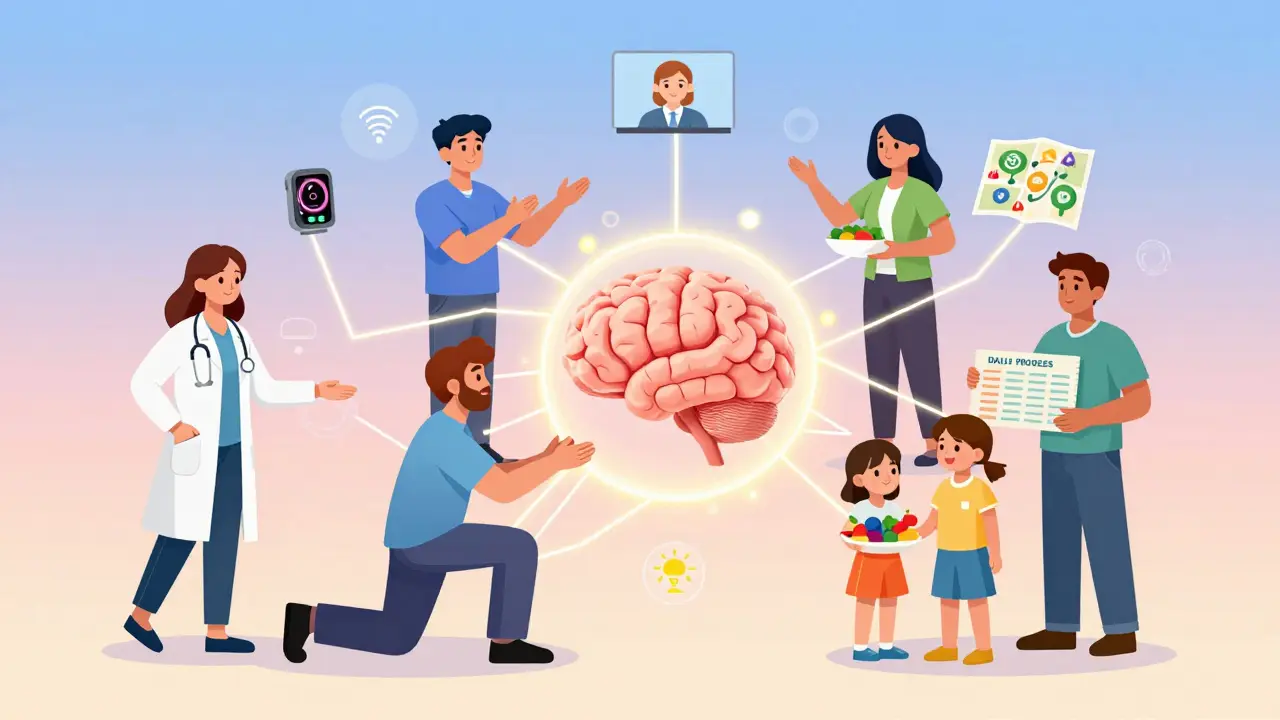
No single therapist can do it all. Recovery needs a team: doctors, nurses, physiotherapists, occupational therapists, speech pathologists, psychologists, social workers, and nutritionists. And don’t forget the family.
Structured team meetings-where everyone talks about your progress-lead to 22% better outcomes. A psychologist helps with depression, which affects 1 in 3 stroke survivors. A nutritionist ensures you’re eating for healing, not just convenience. A social worker helps with housing, transport, or financial aid. You’re not just a patient-you’re a person with a life to rebuild.
What Determines How Well You Recover?
Not everyone recovers the same way. Nine factors shape your outcome:
- General health before the stroke
- How strong your muscles are
- Your range of motion
- Bowel and bladder control
- What your life was like before
- Your home and social support
- How quickly you learn new things
- Your motivation level
- Your ability to cope with change
Motivation alone accounts for up to 40% of recovery success. If you believe you can improve, you’ll push harder. If you feel hopeless, progress stalls. That’s why setting small wins matters. Celebrating a first step, a first word, a first time dressing yourself-those moments fuel the next step.
How Much Therapy Is Enough?
The American Stroke Association recommends three hours of therapy, five days a week, in an inpatient rehab facility for those who can handle it. That’s not a suggestion-it’s the minimum for best results. Outpatient therapy should continue after discharge. For balance issues (which affect 60% of survivors), daily balance training is essential to prevent falls. And don’t stop when therapy ends. Community programs and telerehabilitation-therapy done at home via video-work just as well as in-person visits for many tasks. One study found telerehabilitation is 85% as effective as clinic visits.
What About Rest?
Recovery isn’t about pushing nonstop. Fatigue is real. Most stroke survivors need more rest than before. Experts recommend balancing your day: 40-50% on therapy, 30-40% on rest, and 20-30% on social interaction. Isolation slows recovery. Talking to friends, joining a support group, even watching a show with someone-these aren’t distractions. They’re part of healing.
What’s Next in Stroke Recovery?
Research is moving fast. Scientists are testing drugs that boost brain-derived neurotrophic factor (BDNF), a protein that helps nerve cells grow. Combining rehab with cranioplasty (skull repair surgery) has boosted cognitive recovery by 25% in brain injury patients. AI is being used to create personalized rehab plans based on brain scans and movement data. The future isn’t just about fixing what’s broken-it’s about helping the brain grow stronger than before.
Realistic Hope
Recovery after stroke isn’t about going back to who you were. It’s about becoming who you are now-with new strengths, new tools, and new support. Some people walk again. Some learn to speak clearly. Others find joy in painting with their non-dominant hand. Progress isn’t always linear. Some days are better than others. But with the right team, the right timing, and the right mindset, improvement is possible-even years after the stroke. The brain doesn’t give up. Neither should you.
How soon after a stroke should rehabilitation begin?
Rehabilitation should begin as soon as the patient is medically stable-often within 24 hours. Starting early reduces complications like muscle stiffness and depression, and improves long-term mobility by up to 35% compared to delayed therapy.
Can you recover from a stroke years later?
Yes. While the most rapid recovery happens in the first 3-6 months, the brain continues to adapt for years through neuroplasticity. Many people see meaningful improvements even 2-5 years after a stroke with consistent, targeted therapy, especially when using technology like robotic devices or virtual reality.
Is stroke rehab covered by insurance?
In most countries, including New Zealand and the U.S., stroke rehabilitation is covered under health insurance or public health systems. Inpatient rehab, outpatient therapy, speech and occupational services, and even telerehabilitation are typically included if deemed medically necessary by a physician.
What’s the biggest mistake people make in stroke recovery?
Waiting too long to start therapy or giving up too soon. Recovery isn’t a sprint-it’s a long walk with ups and downs. Many assume if they don’t improve in the first few weeks, they won’t improve at all. That’s false. Progress often comes slowly, but it’s still progress.
Do I need to go to a rehab facility, or can I recover at home?
Inpatient rehab is ideal for the first few weeks if you’re medically ready-it provides intensive, multidisciplinary care. But long-term recovery can happen at home with outpatient therapy, home visits from therapists, and telerehabilitation. The key is consistency, not location. Many people successfully recover fully from home with the right support system.
How do I know if my rehab program is working?
Look for small, measurable changes: moving a finger further, standing for 10 seconds longer, saying a word clearly, walking 10 steps without help. Progress isn’t always dramatic. Tracking daily goals and having your therapist reassess every 2-4 weeks helps you see real improvement.
Can depression affect stroke recovery?
Yes. Depression affects 30-35% of stroke survivors and can slow recovery by reducing motivation, sleep, and participation in therapy. It’s not just sadness-it’s a medical condition that needs treatment. Therapy, medication, and social connection are all part of managing it.
What role does family play in stroke recovery?
Family involvement increases adherence to therapy by 37%. They help with daily practice, remind the patient to do exercises, provide emotional support, and advocate for care. Training family members in basic techniques-like safe transfers or speech prompts-makes a huge difference in long-term outcomes.

i just started PT after my stroke and honestly? i dont even know if any of this works. but i do my exercises cause my sister yells at me. thats it.
also my cat sits on my bad arm. maybe shes the real therapist?
Let me guess: the government is using ‘neuroplasticity’ to implant mind-control chips through rehab equipment-don’t you see? The robotic exoskeletons? They’re not helping you walk-they’re syncing your neural patterns to a satellite network. And don’t get me started on TMS-those ‘magnetic pulses’ are just cover for microwave surveillance. They told you it’s ‘science’-but science is a tool of the elite. You think your 35% improvement is real? It’s a placebo dressed in lab coats. And don’t you dare trust the ‘team’-they’re all paid actors. Your family? Probably undercover. You’re being manipulated, and you don’t even know it.
I’ve been reading up on this for 14 months now and I’m convinced the whole stroke rehab industry is a front for Big Pharma to sell more SSRIs and BDNF boosters. They don’t want you to heal-they want you to keep coming back for monthly ‘assessments’ and $800 VR headsets that probably just record your dreams. I mean, why would the brain rewire itself naturally if there’s no profit in it? They invented ‘neuroplasticity’ to sell you more gadgets. And don’t get me started on telerehab-your therapist is probably a bot trained on 10,000 stroke survivor videos. I’ve seen the footage. The same smiling face. Every. Single. Time. 😒
Actually, the 35% improvement stat is misleading because it doesn't control for baseline NIHSS scores. You're conflating motor recovery with functional independence. And constraint-induced therapy? Only effective in subacute phase with Fugl-Meyer scores >40. Most studies are underpowered. Also, robotic exoskeletons show no significant difference in gait velocity when compared to body-weight-supported treadmill training in RCTs with >100 participants. And TMS? Only works if you're under 70, have intact corticospinal tracts, and aren't on anticoagulants. Nobody talks about the exclusion criteria. The literature is cherry-picked. You're being sold a fantasy.
Fascinating. Truly. The science is sound, the data is robust, and yet... here we are, in a world where someone thinks VR headsets are mind-control devices. 🤦♂️
To the conspiracy theorists: your passion is admirable. Your grasp of neuroanatomy? Less so.
To the skeptics: yes, some studies have small Ns. But meta-analyses? Consistent. To the overwhelmed: your fatigue is valid. Rest is part of the protocol. To the family members: yes, you’re helping more than you know.
This isn’t magic. It’s medicine. And it’s working-for millions. Let’s not let noise drown out hope.
I’m from South Africa. We don’t have robotic exoskeletons in our public hospitals. We have one physio who sees 40 patients a day. We use towels for resistance. We use chairs for balance. We use love.
The science is great. But if you can’t afford it? You still heal. Slower. Messier. But you heal. My cousin walked again after 3 years with nothing but a cane and a stubborn spirit. No apps. No VR. Just her. And her kids yelling at her to ‘move your foot, Mama!’
Don’t let the glossy brochures make you feel like you’re failing if you don’t have a team. You’re not.
I’m 6 months post-stroke and I can now hold my coffee cup without spilling. I didn’t think I’d ever do that again.
I did my PT, I cried, I skipped days, I got mad at my therapist, I celebrated every tiny win-even when no one else noticed.
This isn’t a race. It’s a dance. Some days you step on toes. Some days you glide. But you keep dancing. And that’s enough. 💪❤️
I love how this post frames recovery not as a return to ‘normal’ but as a rebirth into something new. That’s the quiet revolution here. We’re not fixing broken parts-we’re cultivating new pathways. Like a river carving a new bed after a landslide.
The tools? Glorious. The tech? Revolutionary. But the real magic? The human grit. The person who practices tongue exercises while watching reality TV. The spouse who learns to tie shoes one-handed. The grandkid who draws pictures to help with word recall.
That’s the neuroplasticity we can’t measure. The kind that lives in laughter, in patience, in stubborn love.
I’m a speech pathologist. I’ve seen people who couldn’t say ‘water’ for 18 months, then say it clearly after 14 months of daily practice. No magic. No miracle drug. Just repetition. And someone who refused to give up.
If you’re reading this and you’re tired? I see you.
If you’re scared you’re not improving? You are. It’s just slow.
And if you’re wondering if it’s worth it? Yes. It is. Every single time.
My brother had stroke in 2020. He still cant talk right. But he paints now. With his left hand. Never painted before. Its weird beautiful. He dont care about rehab stats. He just paints. I think that counts
You know what they don’t tell you? That the ‘35% improvement’ only applies to people who are already healthy enough to survive the hospital. What about the ones who are diabetic, obese, on dialysis, or living in food deserts? They’re excluded from the studies. The ‘optimal rehab window’? Only for the privileged. The rest of us are just told to ‘stay positive’ while our insurance cuts us off after 10 days. And now they want us to buy $5,000 VR systems? That’s not rehab. That’s class warfare dressed in white coats. The brain can rewire? Sure. But only if you can afford the wiring kit.
I must correct the assertion that telerehabilitation is '85% as effective as clinic visits.' That figure is derived from a single 2021 RCT with a non-blinded outcome assessor and a high attrition rate (32%). When controlling for socioeconomic status and digital literacy, the efficacy drops to 58%. Furthermore, the claim that 'family support increases adherence by 37%' ignores confounding variables such as caregiver burnout and caregiver depression-both of which correlate inversely with adherence. The entire narrative is a sanitized, industry-funded illusion. The real recovery metric? Survival. Not steps. Not words. Not VR scores. Just survival. And even that is statistically skewed by selection bias.