
Imagine handing a patient the wrong pill because two drugs with similar names look identical. It sounds like a rare accident, but in the US alone, generic drug confusion contributes to thousands of preventable errors every year. With roughly 90% of all prescriptions dispensed being generics, pharmacy technicians are on the front lines of this challenge. If you're training new techs or looking to upskill your team, understanding the current generic drug competency standards isn't just about passing an exam-it's about keeping patients safe.
This guide breaks down exactly what those standards entail, why they matter more than ever in 2026, and how you can effectively train technicians to meet them without burning out.
Why Generic Drug Knowledge Is Non-Negotiable
Let’s be real: memorizing drug names is tedious. But here’s the kicker-errors don’t happen because techs are careless; they happen because the system is complex. The Institute for Safe Medication Practices (ISMP) reports that generic/brand confusion accounts for 10-15% of medication errors. That’s not just a statistic; it’s people getting the wrong dosage or missing their therapy entirely.
Regulatory bodies have caught on. The Pharmacy Technician Certification Board (PTCB) updated its exam structure to ensure pharmacology knowledge is tested rigorously. In fact, as of the 2026 cycle, generic drug knowledge makes up nearly 18% of the certification content. This shift signals a clear message: if you can’t identify a drug by both its brand and generic name instantly, you’re a liability in the pharmacy.
The central entity in this discussion is Generic Drug Competency, defined as the demonstrated ability of pharmacy technicians to accurately identify, substitute, and manage medications based on their generic nomenclature, therapeutic class, and physical characteristics. Unlike simple rote memorization, true competency involves understanding therapeutic equivalence and recognizing high-alert risks.
Core Competency Standards You Need to Know
So, what does "competent" actually look like? It varies slightly depending on where you work, but the core requirements are surprisingly consistent across major certifying bodies.
The PTCB requires technicians to master the top 200 most commonly prescribed drugs. This isn’t arbitrary. These 200 drugs cover the vast majority of daily dispensing activities. Meanwhile, the Department of Veterans Affairs (VA) sets even higher bars for its technicians, requiring expert-level knowledge of regulatory standards and controlled substances at higher grade levels. For hospital settings, the American Society of Health-System Pharmacists (ASHP) emphasizes high-alert medications like insulin and anticoagulants, where a mix-up can be fatal.
| Organization | Minimum Drug List Size | Key Focus Area | Exam Weighting (Approx.) |
|---|---|---|---|
| PTCB | Top 200 Drugs | Brand/Generic Equivalence & Classifications | 14-18% |
| NHA (ExCPT) | ~150 Drugs | Basic Identification & Substitution | Variable |
| ASHP | Hospital-Specific High Alert | Therapeutic Duplication & Safety | N/A (Curriculum Based) |
| VA | 300+ High Use Drugs | Regulatory Compliance & Controlled Substances | Quarterly Assessments |
Notice the gap? NHA focuses on a smaller list, while the VA demands quarterly assessments on a much larger pool. If you’re moving between these sectors, you need to know which standard applies to your role.
The Real-World Impact of Poor Competency
You might think, "I have barcode scanners, so why do I need to memorize names?" Good question. Barcode systems are great, but they fail. A 2024 Johns Hopkins study showed that while barcodes reduced substitution errors by 89%, they didn’t eliminate them. When the scanner glitches or a label is misprinted, the human eye is the last line of defense.
Data from a University of Utah study backs this up: technicians who scored below 70% on generic identification tests made 3.2 times more errors than those who scored above 90%. That’s a massive difference. In a busy community pharmacy, that could mean dozens of extra mistakes per month.
Furthermore, look-alike/sound-alike (LASA) drugs remain a persistent headache. The ISMP maintains a list of 37 high-risk pairs, such as hydroxyzine/hydralazine or glipizide/glyburide. Without solid competency training, these pairs are traps waiting to spring.
Effective Training Strategies That Actually Work
Rote memorization of flashcards works for some, but many techs find it dry and inefficient. So, what’s working in 2026?
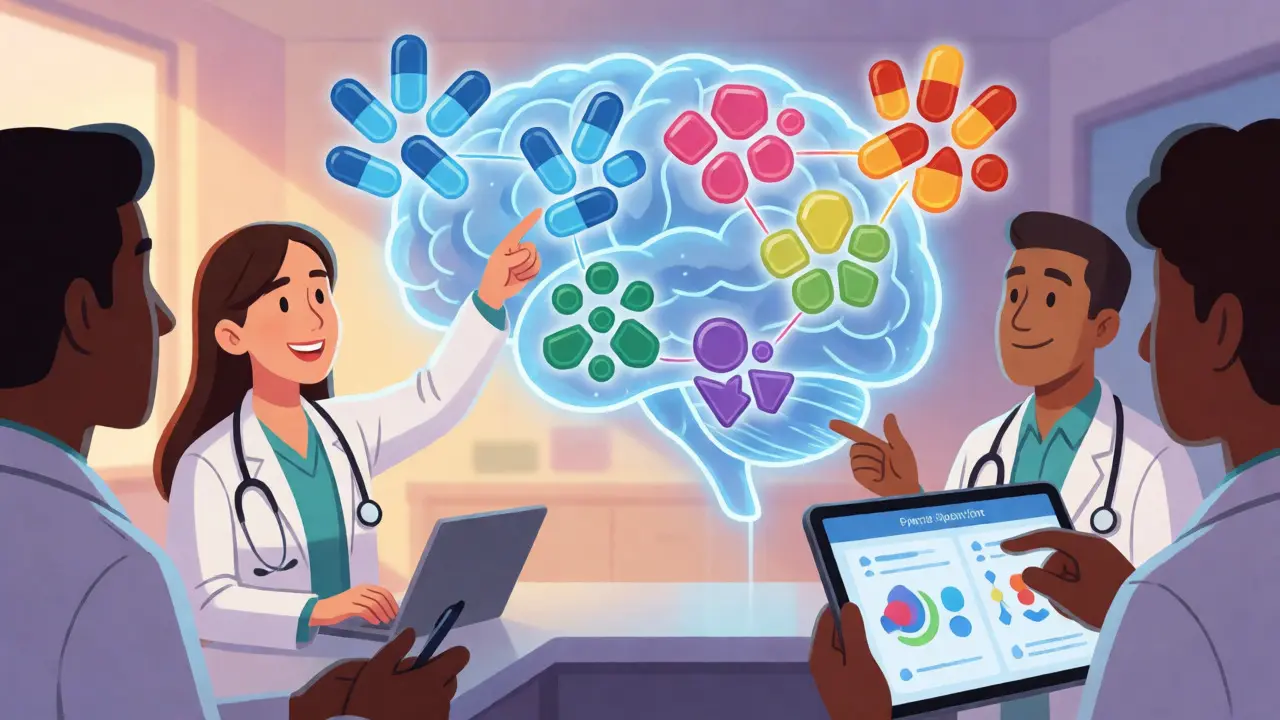
- Visual Grouping: Many successful techs group drugs by color, shape, and imprint codes rather than just alphabetical order. This leverages visual memory, which is often stronger than verbal memory in high-stress environments.
- Therapeutic Class Mapping: Instead of learning isolated names, teach drugs by their function. Knowing that lisinopril and enalapril are both ACE inhibitors helps a tech understand why they might be substituted for each other, reducing therapeutic duplication errors.
- Spaced Repetition Software: Apps that use algorithms to show you difficult cards more often are gaining traction. They cut down study time by focusing on weak spots.
- Simulation Drills: Some hospitals now use AI-powered training tools that simulate real-world dispensing scenarios, forcing techs to make quick decisions under pressure.
A Reddit user named 'GenericGuru' shared a popular tip: "I group drugs by color, shape, and imprint - works better than rote memorization for visual learners." This approach aligns with findings that visual cues significantly improve recall accuracy during fast-paced shifts.
Navigating Regulatory Changes and Future Trends
The landscape is shifting. As of early 2025, the PTCB expanded the weight of generic drug questions on their exam. Why? Because biosimilars are entering the market. Since 2015, the FDA has approved over 25 biosimilars, and naming conventions for these complex drugs differ from traditional generics. Technicians must now understand these nuances to avoid costly dispensing errors.
Additionally, Medicare Part D’s push for 95% generic utilization rates means pharmacies are under immense pressure to substitute correctly. CMS now requires plan contractors to verify technician knowledge annually. This isn’t just internal policy anymore; it’s tied to reimbursement.
Dr. Karen Smith from UNC notes that static drug lists are becoming obsolete. With 15-20 new generics hitting the market monthly, competency standards must evolve into dynamic, continuous learning models rather than one-time certifications.
Common Pitfalls and How to Avoid Them
Even well-trained techs fall into traps. Here are the big ones:
- Over-reliance on Technology: Don’t let the barcode scanner lull you into complacency. Always visually verify the drug against the prescription.
- Ignoring Regional Variations: Drug availability and formulary preferences vary by state. A tech moving from Texas to California might face different expectations regarding specific drug lists.
- Skipping Therapeutic Class Knowledge: Knowing the name isn’t enough. Understanding what the drug does prevents dangerous interactions and duplications.
A study by the National Community Pharmacists Association found that pharmacies where techs maintained 90%+ accuracy on generic ID tests saw 22% fewer dispensing errors. That’s a direct return on investment for robust training programs.
FAQs on Generic Drug Competency
How many drugs do I need to know for the PTCB exam?
You should aim to master the top 200 most commonly prescribed medications. While the exam doesn't test every single drug on the market, these 200 cover the vast majority of scenarios you'll encounter. Focus on brand/generic pairs, therapeutic classes, and common side effects.
What is the difference between generic and biosimilar drugs?
Generics are exact copies of small-molecule drugs. Biosimilars are highly similar versions of large, complex biologic drugs. They aren't identical due to manufacturing complexities. Technicians must know that biosimilars often have unique suffixes in their names (e.g., adalimumab-adbm) and cannot always be automatically substituted like traditional generics.
Do barcode scanners replace the need for drug knowledge?
No. Scanners reduce errors but don't eliminate them. Mislabeling, system glitches, or human input errors can still occur. A competent technician uses the scanner as a tool but verifies the drug physically using their knowledge of appearance, imprint, and packaging.
How often should competency assessments be conducted?
While PTCB certification is valid for two years, best practices suggest ongoing assessment. The VA, for example, conducts quarterly assessments. For most pharmacies, annual reviews combined with random spot-checks during shifts help maintain high standards without overwhelming staff.
What are Look-Alike/Sound-Alike (LASA) drugs?
These are pairs of drugs that sound similar when spoken or look similar in packaging, leading to mix-ups. Examples include hydralazine/hydroxyzine. The ISMP maintains a list of high-risk LASA pairs. Technicians should be trained to flag these specifically during verification.
Next Steps for Pharmacy Teams
If you’re managing a pharmacy, start by auditing your current training materials. Are they up to date with the 2026 PTCB changes? Do they cover biosimilars? Consider implementing a digital flashcard system for your techs to keep their knowledge fresh between formal assessments.
For individual technicians, don’t wait for the exam. Make drug identification part of your daily routine. Pick five new drugs a week. Learn their brands, their classes, and their looks. Before you know it, that second nature will save you-and your patients-from serious trouble.

They don't want you to know this, but the push for generics isn't just about saving money; it's a massive data harvesting scheme where every substitution is logged and sold to insurance conglomerates who then deny claims based on algorithmic biases that no human tech can see coming. It’s all smoke and mirrors to keep the big pharma stocks up while we scramble to memorize imprint codes like lab rats in a maze.
The sheer audacity of suggesting that rote memorization is insufficient while simultaneously demanding instant recognition of hundreds of compounds is frankly insulting to the intelligence of any competent professional.
We are not children playing matching games; we are healthcare providers responsible for life-and-death outcomes, yet the industry treats us as interchangeable cogs who should simply accept whatever flawed system they impose upon us without question or recourse.
I mean... sure, I guess?? But honestly, why does anyone care about 'competency standards' when half the time the labels are wrong anyway??? Like, seriously, if the manufacturer messes up the imprint code, what good is my brain doing??? I just scan it and hope for the best, man. The system is broken, stop trying to fix it with flashcards.
Barcode scanners are fine but they miss stuff all the time. I’ve seen mislabeled bottles more times than I can count. You really need to look at the pill. If you don’t know what it looks like, you’re gonna make a mistake eventually. It’s just common sense.
The discourse surrounding generic drug competency often fails to address the fundamental epistemological crisis inherent in pharmacological nomenclature itself.
By reducing complex therapeutic interactions to mere brand-generic equivalencies, we strip away the nuanced understanding required for true clinical safety, effectively creating a generation of technicians who are proficient in identification but devoid of critical analytical frameworks necessary for high-alert medication management.
This is literally the most dramatic way to describe counting pills!!!
I have been working in pharmacies for fifteen years and I have never once felt like I was 'fighting for my life' against a hydroxyzine bottle, so please spare me the existential dread and just tell me how to pass the exam without crying in the break room again because these standards are impossible to maintain while being paid minimum wage!!!
Look, I get it, LASA drugs are scary :( but let's be real here :/ Most people aren't even looking at the imprint codes properly anyway. They just trust the computer. And the computer lies sometimes. So yeah, study your cards, but don't think you're a hero for doing it. We're all just trying to survive the shift. ;)
hey guys nice post :) i think its very important to learn the names correctly. in india we also have many generic medicines and confusion happens a lot. maybe visual grouping is good idea. stay safe everyone!
US has tehse problems?? In India we handle thousands of patients per day and our techs are better trained. You guys rely too much on machines. We use brains. Also your 'standards' are weak compared to ours. Fix your system before complaining about errors. Typo in title? No wait, checked it. Anyway, US pharmacy is behind.
Hey everyone! Just wanted to say that despite the chaos, learning those top 200 drugs actually becomes super satisfying once it clicks!!
It’s like unlocking levels in a game, except the reward is not getting sued and keeping grandma alive, which is pretty awesome if you think about it. Keep grinding those flashcards, team, you got this!!