
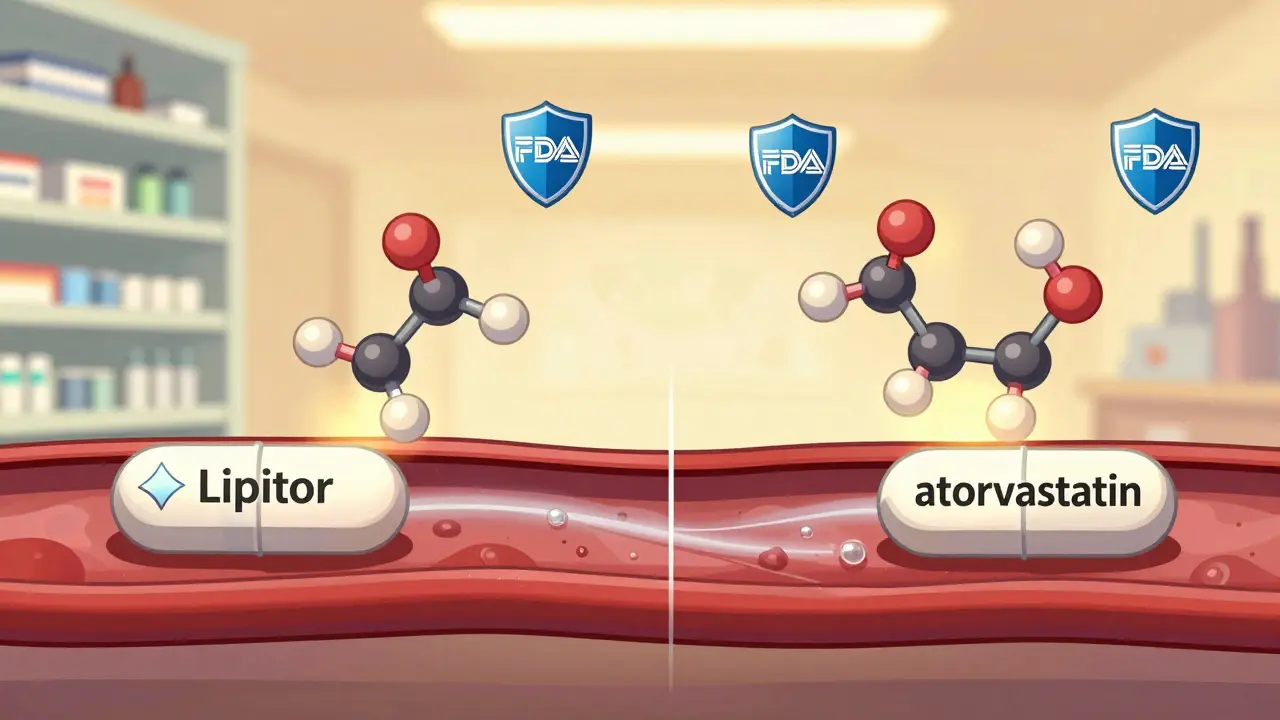
When you pick up a prescription, you might see two options on the label: a brand name like Lipitor or a generic name like atorvastatin. Many people wonder if the cheaper version is just as good. The answer is yes - when it’s approved by the FDA, a generic drug is not a copy or a downgrade. It’s the same medicine, made to the same strict standards.
What Exactly Is a Generic Drug?
A generic drug is a medication that contains the same active ingredient as a brand-name drug, in the same strength, dosage form, and route of administration. It works the same way in your body. The only differences are usually in the color, shape, or inactive ingredients - things like fillers, dyes, or flavors. These changes don’t affect how the drug works. They’re just there to meet trademark rules.
The key requirement? Bioequivalence. That means the generic drug must deliver the same amount of active ingredient into your bloodstream at the same rate as the brand-name version. The FDA requires that the amount of drug absorbed - measured by AUC (area under the curve) and Cmax (peak concentration) - falls within 80% to 125% of the brand-name drug. This isn’t a wide margin. It’s a tight, science-backed range designed to ensure your body responds exactly the same way.
How Are Generic Drugs Approved?
Before a generic drug hits the market, it must go through the Abbreviated New Drug Application (ANDA) process. This system was created by the Hatch-Waxman Act of 1984. Before that, every new drug - even if it was chemically identical - had to go through full clinical trials. That cost billions. The ANDA process changed everything.
Instead of repeating expensive animal and human trials, generic manufacturers prove their product is bioequivalent to the original. They don’t need to prove safety or effectiveness from scratch. They just need to show that their version performs the same in the body. The FDA reviews manufacturing processes, quality controls, and stability data. They inspect factories - often without warning - to make sure they follow Current Good Manufacturing Practices (cGMP). These rules are identical for brand-name and generic makers.
The FDA inspects about 3,500 generic drug facilities every year around the world. That’s more than any other type of drug facility. If a factory fails an inspection, the FDA can block the drug from being sold. There’s no special treatment for generics. They’re held to the same standard.
Why Are Generic Drugs So Much Cheaper?
Brand-name drugs often cost $2.6 billion to develop. That includes 10-15 years of research, clinical trials, and marketing. Once the patent expires - usually after 20 years - other companies can make the same drug. They don’t have to pay for those upfront costs. That’s why generics can be 80-85% cheaper.
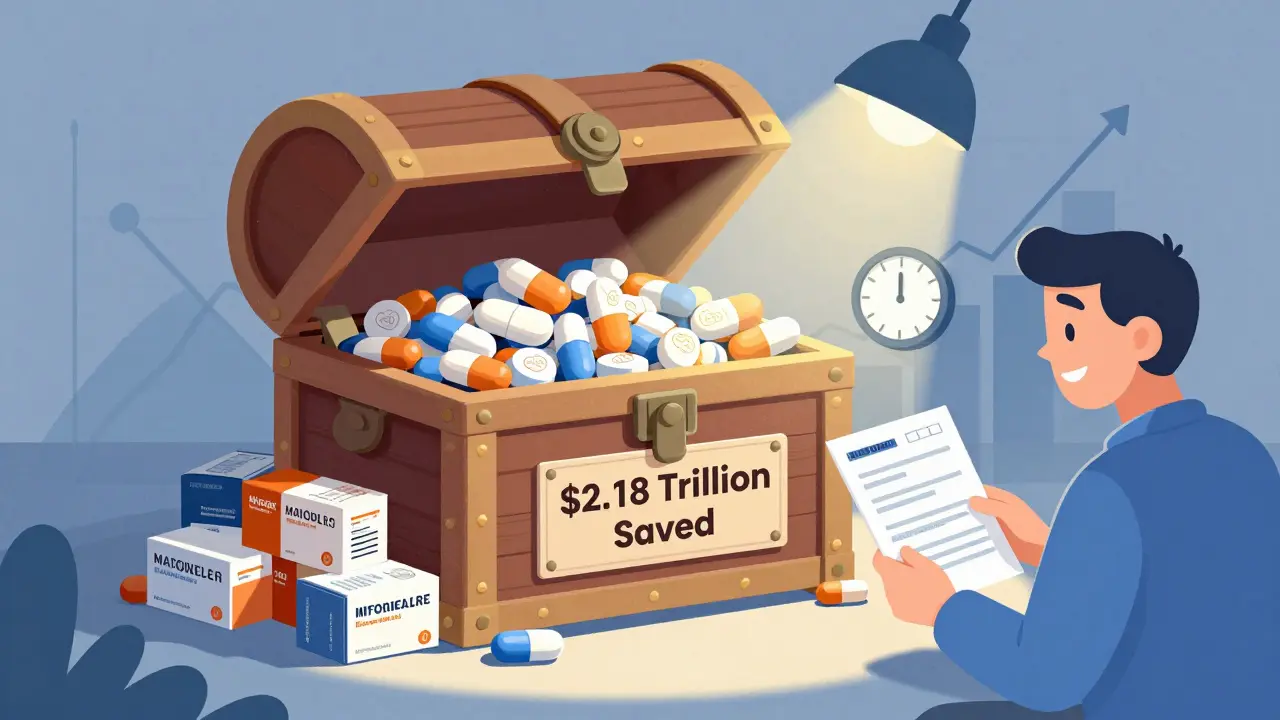
In the U.S., generics make up 90.5% of all prescriptions filled in 2022. But they account for only 13.1% of total drug spending. That’s a massive savings. Over the past decade, generics saved the U.S. healthcare system an estimated $2.18 trillion.
Price drops even further when multiple companies start making the same generic. If five or more manufacturers enter the market, prices can fall to just 9% of the original brand price. That’s competition at work.
Are Generic Drugs as Safe and Effective?
The short answer: yes. The FDA, the American Medical Association, the Institute of Medicine, and the American College of Physicians all agree. Generics are not second-rate. They are therapeutically equivalent.
Studies have looked at thousands of patients taking generic versions of heart medications, antidepressants, and epilepsy drugs. In every case, outcomes were the same. One major review of 38 clinical studies by the Institute of Medicine found no meaningful difference in effectiveness between generic and brand-name cardiovascular drugs.
Dr. Janet Woodcock, former head of the FDA’s drug center, said it plainly: “The FDA would not allow generics to be marketed unless they were therapeutically equivalent.”
There’s one exception: narrow therapeutic index (NTI) drugs. These are medications where even a small change in blood levels can cause serious side effects or make the drug stop working. Examples include warfarin (a blood thinner), levothyroxine (for thyroid), and some seizure drugs. For these, doctors may prefer to keep patients on the same version - brand or generic - to avoid any possible variation. But even here, switching is safe if done carefully and with monitoring.
What About Inactive Ingredients?
Yes, generics can have different fillers, dyes, or coatings. That’s why a generic pill might be blue instead of green, or oval instead of round. These ingredients don’t affect how the drug works. But they can matter for people with allergies or sensitivities.
If you’re allergic to a dye, for example, you might react to one brand of generic but not another. That’s why pharmacists are trained to check your profile. If you’ve had a reaction before, they’ll make sure you get a version without that ingredient.
Stability testing is also required. A generic drug must last just as long on the shelf as the brand-name version. If the brand lasts three years, the generic must prove it does too.
Global Supply and Manufacturing
Most generic drugs sold in the U.S. are made overseas. About 80% of the active ingredients come from facilities in India and China. The FDA inspects these plants just like U.S. ones. In fact, more than half of the agency’s inspections happen outside the country.
But this global supply chain has risks. In 2022, drug shortages rose 22%, partly because of quality issues at overseas factories. The FDA has responded by increasing inspections and pushing for more transparency. The goal is to prevent shortages before they happen.
The Future of Generic Drugs
Between 2023 and 2027, 350 brand-name drugs worth $138 billion will lose patent protection. That’s a huge wave of new generic opportunities. Drugs for high cholesterol, diabetes, and mental health are on the list.
The FDA is also working on better rules for complex generics - things like inhalers, eye drops, and topical creams. These are harder to copy than a simple tablet. In 2022 alone, the agency issued 37 new product-specific guidelines to help manufacturers get it right.
At the same time, companies are starting to make “authorized generics.” These are made by the original brand-name company but sold under a generic label. They’re not cheaper than other generics, but they give patients a familiar option.
What This Means for You
If your doctor prescribes a brand-name drug and a generic is available, ask your pharmacist. You’ll save money - often hundreds of dollars a year - without losing effectiveness. The FDA doesn’t approve generics unless they’re identical in performance. Your body can’t tell the difference.
Some people worry about switching from brand to generic. If you’ve been stable on a brand-name drug for years, that’s fine. But if you’re starting a new medication, choosing the generic is smart. It’s not a compromise. It’s the same medicine, priced fairly.
Pharmacists are trained to help you understand the difference. If your pill looks different this month, don’t panic. It’s likely just a different manufacturer. Talk to them. They’ll confirm it’s the same drug.
Generic drugs aren’t a loophole. They’re a cornerstone of modern medicine. They make treatment accessible. They keep people healthy. And they’ve saved trillions - all while meeting the same standards as the originals.
Are generic drugs really as effective as brand-name drugs?
Yes. The FDA requires generic drugs to be bioequivalent to their brand-name counterparts. That means they deliver the same amount of active ingredient into your bloodstream at the same rate. Studies involving thousands of patients have shown no meaningful difference in effectiveness. The FDA, AMA, and Institute of Medicine all confirm that generics work just as well.
Why are generic drugs cheaper if they’re the same?
Brand-name drugs cost up to $2.6 billion to develop, including clinical trials and marketing. Once the patent expires, other companies can make the same drug without repeating those expensive steps. Generic manufacturers only need to prove bioequivalence, which is far less costly. This allows them to sell the drug at 80-85% lower prices. Competition among multiple generic makers drives prices even lower.
Can I switch from a brand-name drug to a generic?
In most cases, yes. For the vast majority of medications - like those for high blood pressure, diabetes, or depression - switching is safe and effective. Your pharmacist can substitute a generic unless your doctor writes “dispense as written” on the prescription. For narrow therapeutic index drugs like warfarin or levothyroxine, your doctor may prefer you stay on the same version, but switching is still possible with proper monitoring.
Do generic drugs have the same side effects?
Yes. Because they contain the same active ingredient and work the same way in the body, side effects are identical. If a brand-name drug causes dizziness or dry mouth, so will the generic. The only possible difference is if you’re allergic to an inactive ingredient - like a dye or filler - which can vary between brands. Pharmacists can help you avoid those.
Are all generic drugs made in the U.S.?
No. About 80% of the active ingredients in generic drugs come from facilities in India and China. The FDA inspects these factories using the same strict standards as U.S. plants. Many U.S. generic manufacturers also source ingredients from overseas. The FDA conducts over 3,500 inspections annually worldwide to ensure quality and safety.