
Migraine with Aura Birth Control Risk Calculator
This tool helps you understand your personal stroke risk when considering estrogen-containing birth control. Based on the latest research from the American Migraine Foundation and WHO guidelines, this calculator identifies your risk level and provides clear guidance about birth control options.
Step 1: Migraine Frequency
Step 2: Recent Aura History
Step 3: Additional Risk Factors
If you get migraines with aura and are thinking about birth control, you’re not alone. But you’re also facing a decision that could affect your long-term health. The question isn’t just whether estrogen birth control works - it’s whether it’s safe for you. And the answer isn’t as simple as ‘yes’ or ‘no.’
What Exactly Is Migraine with Aura?
Migraine with aura isn’t just a bad headache. It’s a neurological event. Before the pain hits, you might see flashing lights, blind spots, or zigzag lines. Some people feel tingling in their fingers or face, or even have trouble speaking. These symptoms usually last 5 to 60 minutes and then fade - but they’re a warning sign your brain is temporarily misfiring.
It’s important to know what counts as aura. Nausea, sensitivity to light, fatigue, or mood changes? Those are premonitory symptoms, not aura. Aura means focal neurological changes - things your brain controls directly. If you’re unsure, track your symptoms. Write down what happens before your headache starts. That detail matters.
Why Estrogen Birth Control Is a Concern
Estrogen in birth control pills increases your risk of blood clots. That’s why it’s linked to stroke - especially when combined with migraine with aura. The numbers are startling: healthy young women without migraines have about a 6 in 100,000 chance of having an ischemic stroke each year. For women with migraine with aura who take estrogen-containing birth control, that jumps to about 30 in 100,000. That’s a fivefold increase.
The World Health Organization (WHO) says this risk is too high. Their guidelines, updated in 2019, clearly state: women with migraine with aura should not use any birth control containing estrogen. This includes the pill, patch, or ring. The CDC backs this up, calling the combination a 6-fold higher stroke risk than having neither factor.
But Not All Birth Control Is the Same
Here’s where things get messy. The old warnings were based on birth control pills from the 1970s - pills with 50 to 100 micrograms of estrogen. Modern pills? Most have 20 to 35 micrograms. Some ultra-low-dose versions have just 10 to 15 micrograms.
A 2022 study from the American Migraine Foundation looked at 127 women with confirmed strokes who used estrogen birth control. The researchers found that those taking pills with less than 30 micrograms of ethinyl estradiol didn’t show the same spike in stroke risk. Some even reported fewer auras. Dr. Anne Calhoun, who reviewed this data, argues that today’s low-dose pills may be safer than we thought - and might even help reduce migraine frequency.
But here’s the catch: that study had a tiny sample size. Only 127 cases. And while it’s promising, it’s not enough to change global guidelines. Dr. Pinar Batur, one of the lead researchers, says: “This is only one piece of the puzzle.”
Frequency Matters - More Than You Think
Not all migraines are equal. If you get aura once a month, your risk is different than if you get it every week.
Research shows:
- Women with aura more than 12 times a year have a 10 times higher stroke risk than those with no migraines.
- Those with aura at least once a week have a 4.3 times higher risk.
- But if your aura happens only once a month? Risk doesn’t seem to go up significantly.
And here’s another key point: if you haven’t had an aura in the past year, your risk drops back toward normal. It’s not your past history that matters - it’s your current, active symptoms.
Other Risk Factors Make It Worse
Estrogen birth control doesn’t act alone. It teams up with other risks.
If you smoke - even just a few cigarettes a day - your stroke risk skyrockets. The same goes for high blood pressure, diabetes, or a family history of stroke before age 50. If you have migraine with aura and smoke, your risk isn’t just doubled or tripled. It’s multiplied.
That’s why doctors don’t just look at your migraines. They look at your whole picture: age, weight, blood pressure, smoking, family history. One factor might be manageable. Two or three? That’s when the red flags fly.
What Are Your Alternatives?
Good news: you have options. And they’re safe.
Progestin-only methods don’t raise stroke risk in women with migraine with aura. That includes:
- Progestin-only pill (POP) - taken daily. Must be taken at the same time every day.
- Implant (etonogestrel) - a small rod placed under your skin. Works for up to 3 years.
- Depo-Provera injection - given every 3 months.
- Levonorgestrel IUD - lasts 3 to 8 years, depending on the type. Also reduces heavy periods.
- Copper IUD - hormone-free, lasts up to 10 years.
- Barrier methods - condoms, diaphragms - no hormones, no stroke risk.
The American College of Obstetricians and Gynecologists (ACOG) and the International Headache Society both recommend these as first-line choices for women with migraine with aura. And they’re just as effective as estrogen pills - if not more so.
The Real Problem: Confusion in the Clinic
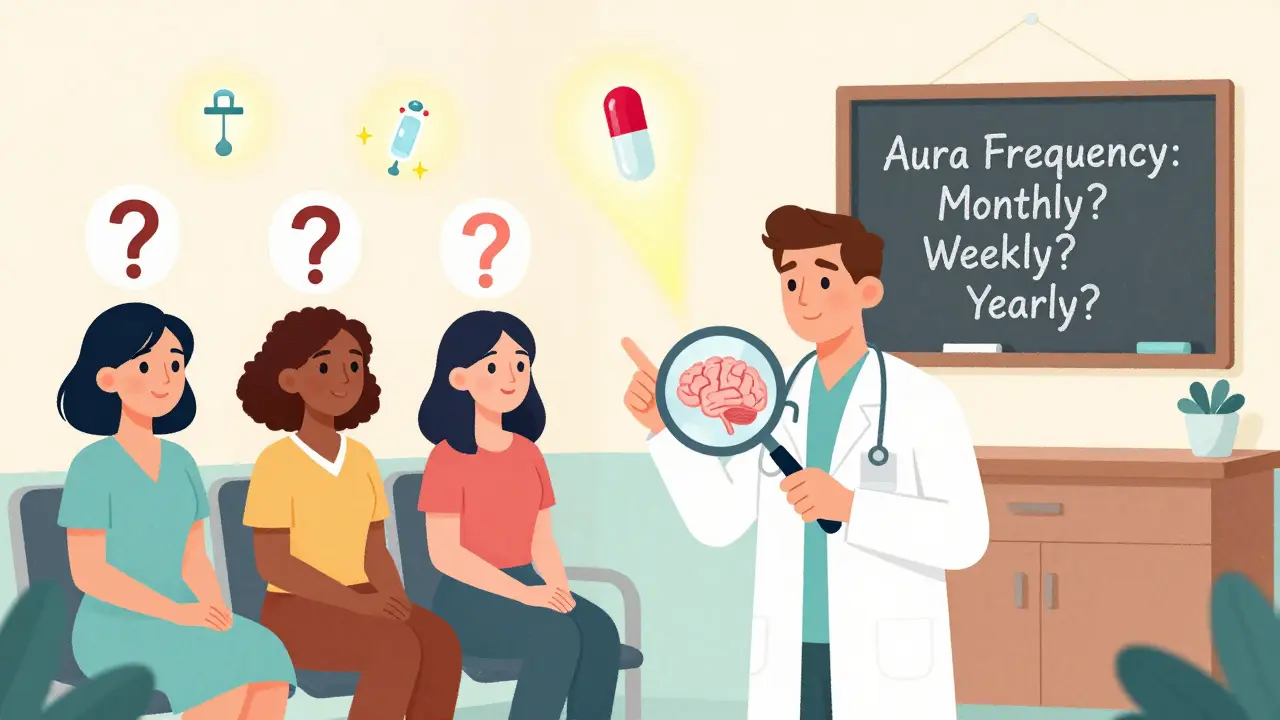
Here’s the truth: many doctors still don’t know the difference between migraine with aura and without. Some patients are told they can’t use any hormonal birth control - even if they only have migraine without aura. Others are given estrogen pills despite having aura, because their doctor didn’t ask the right questions.
And some women are stuck. They get severe menstrual migraines - the kind that hit right before or during their period. Estrogen pills can actually prevent these. But if they’re told they can’t use them, they’re left with fewer options. That’s why some experts argue we need more nuance.
Dr. Calhoun says: “Most women with migraine have menstrual-related migraine. Some CHCs can prevent this particularly severe migraine.” But she also knows the guidelines haven’t caught up.
What Should You Do?
You need to talk to your doctor - but not just any talk. Come prepared.
Ask yourself:
- Do I have true aura? (flashing lights, blind spots, numbness - not just nausea or fatigue)
- How often do I get aura? (less than monthly? weekly? more than 12 times a year?)
- Have I had an aura in the past year?
- Do I smoke? Is my blood pressure normal? Do I have a family history of stroke or blood clots?
If you have aura - especially if it’s frequent - avoid estrogen birth control. Period. The risk is real. But if you’re on the edge - occasional aura, no other risks, and you’re desperate for hormonal control - talk to your doctor about ultra-low-dose options. Some clinics are starting to offer them under close monitoring.
But here’s the bottom line: progestin-only methods are safe, effective, and widely available. They don’t carry the same risk. And for most women with migraine with aura, they’re the best choice.
What’s Next?
Researchers are working on bigger studies. We need large, long-term trials tracking women with migraine with aura who use modern low-dose estrogen pills. Until then, we’re guessing - and guessing wrong can cost lives.
For now, stick with what we know for sure: if you have migraine with aura, estrogen birth control increases your stroke risk. Progestin-only options don’t. And you have plenty of safe, reliable choices.
Your body knows your history. Your doctor should listen. Don’t settle for a one-size-fits-all answer. Ask for your options. Demand clarity. Your brain - and your future - are worth it.

Just had my first migraine with aura last month and was about to restart the pill until I read this. Holy crap. I’m switching to the implant tomorrow. No way I’m risking a stroke for birth control. Thanks for the clarity.
Did you know the WHO guidelines were influenced by Big Pharma lobbying? The real data is buried in paywalled journals. Estrogen isn’t the problem-it’s the synthetic additives and the way they interact with glyphosate in our food supply. You think this is about strokes? It’s about control.
It is imperative to underscore, with the utmost academic rigor, that the epidemiological correlation between estrogen-containing contraceptives and ischemic stroke in patients presenting with migraine with aura is not merely statistically significant-it is clinically profound. The World Health Organization’s 2019 classification, grounded in meta-analytic evidence from over 2.3 million patient-years, remains the gold standard. Deviation from this, absent longitudinal, prospective, randomized controlled trials, constitutes an affront to evidence-based medicine.
In India, we’ve got women on low-dose pills for decades with aura and no strokes. Maybe it’s the turmeric? Or the fact that most of us don’t smoke? Or maybe Western medicine is overcomplicating things? I’ve seen my aunt on the pill since ’98, aura once a year, no issues. One size doesn’t fit all. We need to stop treating women like lab rats.
If you're still debating this you're not thinking like an adult. The data is clear. Estrogen + aura = ticking time bomb. Stop playing Russian roulette with your brain. Go progestin-only. It's not hard. It's not expensive. It's not complicated. Do the right thing.
Isn’t it fascinating how medicine reduces women’s complex neurobiology to a binary risk matrix? We’re not data points. We’re sentient beings navigating hormonal landscapes shaped by trauma, culture, and circadian rhythms. The real issue isn’t estrogen-it’s the patriarchal assumption that our bodies need to be managed, not understood. Your aura is a language. Listen to it.
I’ve had aura since I was 18. I’m 32 now. Haven’t had one in 14 months. Should I still avoid estrogen? My doctor says yes. But I feel fine. I’m confused.
Wow. Just… wow. You actually believe a 2022 study with 127 people overturns decades of global consensus? You’re not a patient-you’re a liability. People like you give women with migraines a bad name. Don’t be that girl.
So let me get this straight: the same doctors who told me to take the pill for acne in 2015 are now telling me it’ll kill me? And I’m supposed to trust them? The only thing consistent here is the profit margin.
Progestin-only is the new standard of care. End of story. I’m a nurse practitioner and I’ve switched 87 patients with aura to IUDs. Zero adverse events. One woman said her migraines got better. That’s not anecdotal-it’s clinical. Stop overthinking. Just get the damn IUD.
People are dying because they want convenience. Birth control isn’t a right. It’s a privilege you earn by being responsible. If you can’t handle a hormone-free method, maybe you shouldn’t be sexually active. Your brain matters more than your comfort.
Why is it that every time someone writes a detailed medical article, the comments section turns into a cult of personality where people quote Dr. Calhoun like she’s the Pope? Can we just agree that the data is inconclusive and move on? Or are we all just here to perform moral superiority?
They’re lying. The stroke stats are fake. They’re hiding the real numbers because they want you on Depo-Provera so they can monitor you better. They’re tracking you. The implant has a chip. I know someone who got it and her phone started glitching. Coincidence? I think not.
I had my first aura last year and was terrified. Then I switched to the copper IUD and I haven’t had one since. Not because of the hormones-because I stopped stressing out about birth control. Maybe the answer isn’t just medical. Maybe it’s emotional too.