

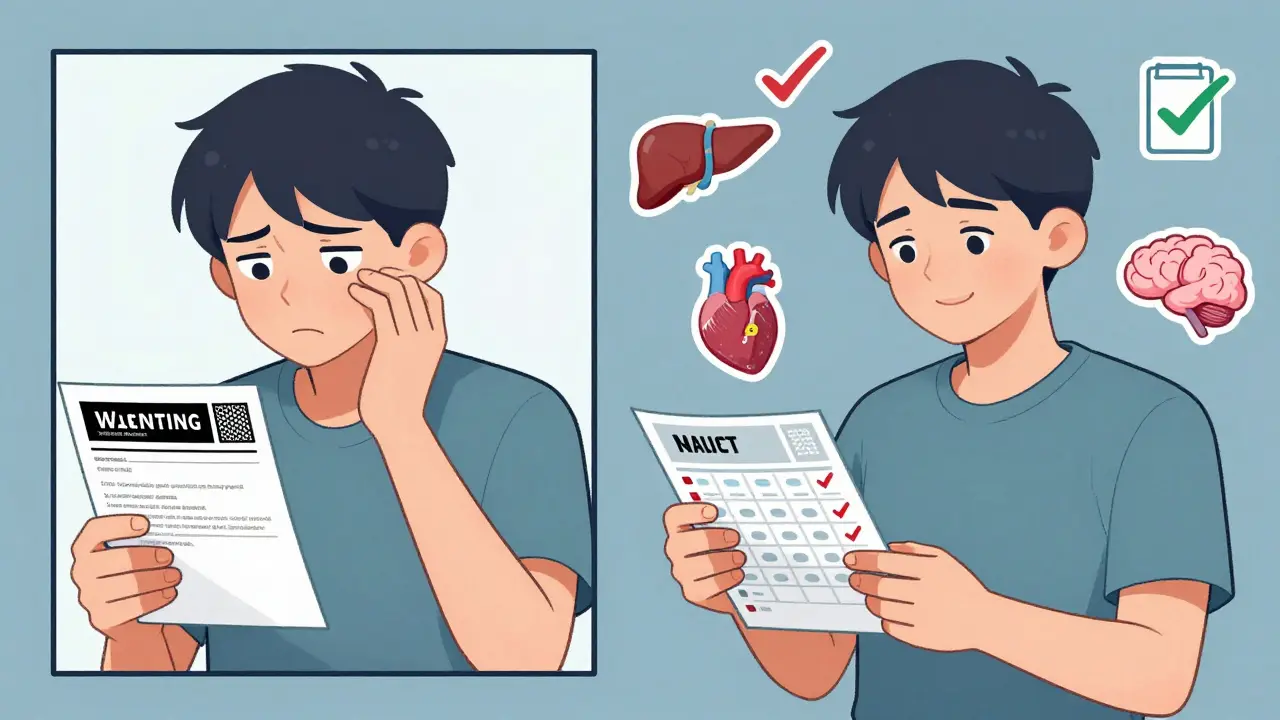
When your doctor hands you a prescription with a boxed warning, it’s easy to panic. You’ve seen it-the thick black border around the text on the pill bottle or the insert. It sounds scary. But here’s the truth: a boxed warning doesn’t mean you can’t take the medicine. It means you need to know exactly what you’re signing up for.
What Exactly Is a Boxed Warning?
A boxed warning, also called a black box warning, is the strongest safety alert the U.S. Food and Drug Administration (FDA) can require on a prescription drug. It’s not just a reminder. It’s a legal requirement built into the drug’s official labeling. The warning appears at the very top of the prescribing information, in a bold, black-bordered box, with text that’s large enough to be read without squinting. This isn’t marketing fluff-it’s a signal that the drug carries a risk of serious harm or death under certain conditions. These warnings exist because some drugs, while effective, can trigger life-threatening reactions. For example, antidepressants like fluoxetine and sertraline carry boxed warnings for increased suicide risk in young adults under 25. Diabetes drugs like rosiglitazone have them for heart failure. Cancer drugs like azathioprine warn about severe immune suppression. Over 400 medications in the U.S. carry these warnings today, and they cover about 10-15% of all prescription drugs.Why Do These Warnings Exist?
The system started after the thalidomide disaster in the 1960s, when thousands of babies were born with severe birth defects because the drug wasn’t properly tested for use in pregnancy. In response, Congress passed the Kefauver-Harris Amendments in 1962, forcing drugmakers to prove safety before approval. The black box format itself didn’t appear until the 1970s, as the FDA refined how to communicate danger clearly. Today, most boxed warnings are added after a drug is already on the market. Clinical trials involve only 1,000 to 5,000 people. Real-world use involves millions. That’s when rare but deadly side effects show up-like liver failure from methotrexate, or fatal infections from biologic drugs used for rheumatoid arthritis. About 70% of boxed warnings are added years after approval, based on data from real patients, not lab studies.What’s in a Boxed Warning?
It’s not just a scary headline. Every boxed warning includes specific details:- The exact danger (e.g., “increased risk of suicidal thoughts”)
- Which patients are most at risk (e.g., “patients under 25,” “those with history of heart disease”)
- What signs to watch for (e.g., “sudden chest pain, unexplained bruising, yellowing of skin”)
- What monitoring is required (e.g., “liver function tests every 4 weeks”)
- Whether the drug is completely off-limits (e.g., “contraindicated in pregnancy”)
How Do Boxed Warnings Compare to Other Alerts?
The FDA uses a hierarchy of safety messages:- Boxed warnings - legally binding, part of the drug’s approved label
- Drug Safety Communications - public alerts about new risks discovered after approval
- Label updates - minor changes to warnings or dosing
- Medication Guides - patient handouts, often less detailed
What Patients Often Get Wrong
A 2022 survey of 850 patients found that 41% thought a boxed warning meant they shouldn’t take the drug at all. That’s a dangerous misunderstanding. These warnings don’t say “don’t use.” They say, “use with extreme caution and awareness.” Many patients stop taking life-saving medications because they’re scared. A study of anticoagulants like warfarin showed that while 78% of patients continued treatment after a clear discussion, 10-20% avoided them entirely-even when their risk of stroke was far higher than their risk of bleeding. The warning saved lives by informing, but also cost lives by scaring people away from needed care. Another common mistake: ignoring monitoring. Methotrexate has had a boxed warning for liver damage since 1998. Yet, in a 2023 MedWatch report, a patient developed acute liver failure because they skipped their monthly blood tests. The warning was there. The monitoring plan was clear. But no one followed through.
What You Should Do If You’re Prescribed a Boxed Warning Drug
Don’t refuse the medication. Don’t panic. Do this:- Ask for the full explanation. Your doctor should walk you through the warning-not just hand you a pamphlet. Ask: “What’s the exact risk? How likely is it? What’s my personal risk?”
- Know your warning signs. Write them down. If you’re on an antidepressant, know what “new or worsening depression” looks like for you. If you’re on a diabetes drug, know the symptoms of pancreatitis or severe infection.
- Understand the monitoring. Will you need blood tests? Imaging? How often? Mark it on your calendar. Set phone reminders. These aren’t optional.
- Ask about alternatives. Is there another drug with fewer risks? Sometimes yes. Sometimes no. But you deserve to know.
- Report side effects. Use the FDA’s MedWatch system (form 3500) to report anything unusual. Your report helps others.
Are Boxed Warnings Working?
They’re not perfect. A 2019 study in JAMA Internal Medicine found that nearly half of all boxed warnings were added more than five years after the drug hit the market. That’s too long. Patients were exposed to risk while regulators waited for data. Some experts, like Dr. Jerry Avorn from Harvard, argue that warnings are too broad. Saying “all patients under 25 are at risk” might scare away young people who could benefit, while missing the real danger group-those with prior depression or family history of suicide. On the other hand, a 2021 report from the Institute for Clinical and Economic Review found that boxed warnings reduced inappropriate prescribing by 15-25%. That’s a win. But they also reduced appropriate use by 10-20%. That’s a loss. The FDA is trying to fix this. In 2023, they launched a pilot program to rewrite warnings in plain language. Instead of “risk of hepatotoxicity,” it might say “can cause serious liver damage.” They’re also using real-world data from the Sentinel Initiative-tracking 300 million Americans’ electronic health records-to catch dangers faster.What This Means for You
A boxed warning isn’t a death sentence. It’s a conversation starter. The most dangerous thing isn’t the drug-it’s not asking questions. Millions of people take medications with boxed warnings every day and live full, healthy lives. They just know the risks. They monitor. They report. They communicate. If your doctor prescribes a drug with a black box, don’t assume the worst. Assume they chose it because it’s the best option-for your body, your history, your needs. But don’t accept silence. Demand clarity. Ask for the warning to be explained in your own words. If they can’t do it, find someone who can. Your health isn’t about avoiding risk. It’s about managing it wisely.Does a boxed warning mean I shouldn’t take the medication?
No. A boxed warning doesn’t mean the drug is too dangerous to use. It means the risks are serious and require careful management. Many people safely take these medications with proper monitoring and guidance from their doctor. The warning exists so you and your provider can weigh the benefits against the risks for your specific situation.
How long have boxed warnings been around?
The FDA introduced the black box format in the 1970s, following the Kefauver-Harris Amendments of 1962, which were passed after the thalidomide tragedy. The system evolved over time as the FDA refined how to communicate serious risks. Today, it’s a standardized, legally required part of drug labeling.
Can a drug get a boxed warning after it’s already on the market?
Yes. In fact, about 70% of boxed warnings are added after a drug is approved and used by millions of patients. Clinical trials are too small to catch rare but serious side effects. Real-world use reveals risks like liver damage, heart problems, or severe infections that weren’t seen during testing.
What should I do if I experience a side effect from a drug with a boxed warning?
Contact your doctor immediately. Then, report the side effect to the FDA through their MedWatch program using form 3500. You can file online or by mail. Your report helps the FDA track patterns and may lead to updated warnings or safety actions that protect others.
Are boxed warnings the same in other countries?
No. The European Medicines Agency (EMA) uses a different system called “special warnings and precautions for use.” Other countries may have similar alerts but with different formats, wording, or requirements. If you’re traveling or using medication imported from outside the U.S., check local guidelines. The FDA’s warnings apply only to drugs sold in the United States.

So let me get this straight-we’re supposed to trust a system that approved thalidomide in the first place? 🤡
Boxed warnings are just the tip of the iceberg. The real issue is how little time doctors spend explaining them.
i read the whole thing and still dont know if im supposed to be scared or not
You think the FDA is protecting you? They’re just the front for Big Pharma’s PR machine. The real danger is the surveillance state tracking your prescriptions through the iPLEDGE program. They’re building a database of who’s taking what-then selling it to insurers. Wake up.
We treat medicine like a vending machine-pop a pill, get a result. But the body isn’t a machine. It’s a living, breathing paradox. The boxed warning isn’t a red flag-it’s a mirror. It reflects our collective refusal to accept uncertainty. We want guarantees. But life doesn’t work that way. The warning is the only honest thing left in this system.
I’ve been on methotrexate for six years. Monthly bloodwork. No liver damage. No drama. The warning exists because someone didn’t follow the rules-not because the drug is evil. People panic because they don’t understand monitoring. It’s not about fear. It’s about discipline.
My grandma took warfarin for 12 years. She danced at my wedding. Boxed warning? Yeah. But she knew her signs. She got her labs. She lived. Don’t let a black box scare you out of living.
i just got a black box rx for anitdepressants and now im scared to even look at my pill bottle omg what if i suddenly want to jump off a bridge like what even is this system
American medical arrogance at its finest. You think your FDA is the gold standard? In India, we don’t need black boxes-we have community pharmacists who actually talk to patients. Your system is bureaucratic theater. We save lives with conversation. You save liability with fonts.
In Nigeria, we call this 'government paper that looks scary but nobody reads.' My cousin took the same drug you're scared of-no black box, no problem. He’s alive, working, and laughing. The real problem? You’re reading the warning like it’s a death sentence instead of a checklist.
The system’s flawed, but it’s the best we’ve got. The fact that we’re even talking about this means we’re getting better. Most people don’t care until someone they love gets hurt. Maybe that’s the real warning.
The FDA’s 'plain language' initiative? Pathetic. You don't fix systemic failure by replacing 'hepatotoxicity' with 'liver damage.' You fix it by holding manufacturers accountable for post-market surveillance-instead of letting them bury adverse events in 400-page PDFs. And don't get me started on how the Sentinel Initiative is just a PR stunt with a fancy name.
I’m not saying the warning is wrong... but what if the real danger isn’t the drug? What if it’s the fact that we’re forced to take these drugs in the first place? What if our entire healthcare system is built on chemical band-aids? I’ve been researching… there’s a pattern. The same companies that make these drugs also fund the FDA’s advisory panels. Coincidence? Or... something else?
I just lost my sister to a reaction from a drug with a boxed warning. They told her it was 'rare.' They told her to 'monitor.' But no one told her how to scream for help when her skin started peeling. Now I read every warning like a funeral notice. And I still don’t know if I’m supposed to be angry or just... numb.
Thank you for writing this with such clarity. In my work as a community health advocate, I see patients terrified by these warnings every day. The most powerful tool isn’t the black box-it’s the doctor who sits down, explains it slowly, and asks, 'What are you most afraid of?' That’s where healing begins.