

Many mothers worry that taking medication while breastfeeding will harm their baby. The truth? 98% of medications are safe to use while nursing - if you time them right. It’s not about avoiding medicine altogether. It’s about working with your body’s natural rhythms to keep your baby safe while you stay healthy.
Why Timing Matters More Than You Think
Medication doesn’t flood into breast milk all at once. It follows a predictable path: you take a pill, it enters your bloodstream, peaks in concentration, then slowly clears out. That peak is when the most drug passes into your milk. If you breastfeed right after taking your medicine, your baby gets the highest possible dose. But if you time it just before your baby’s longest sleep stretch, exposure drops dramatically. Research from the Academy of Breastfeeding Medicine shows that for most drugs, infant exposure can be cut by half - or more - with simple timing. The goal isn’t to stop breastfeeding. It’s to protect your baby without sacrificing your own health.The Rule: Breastfeed Right Before You Take Your Dose
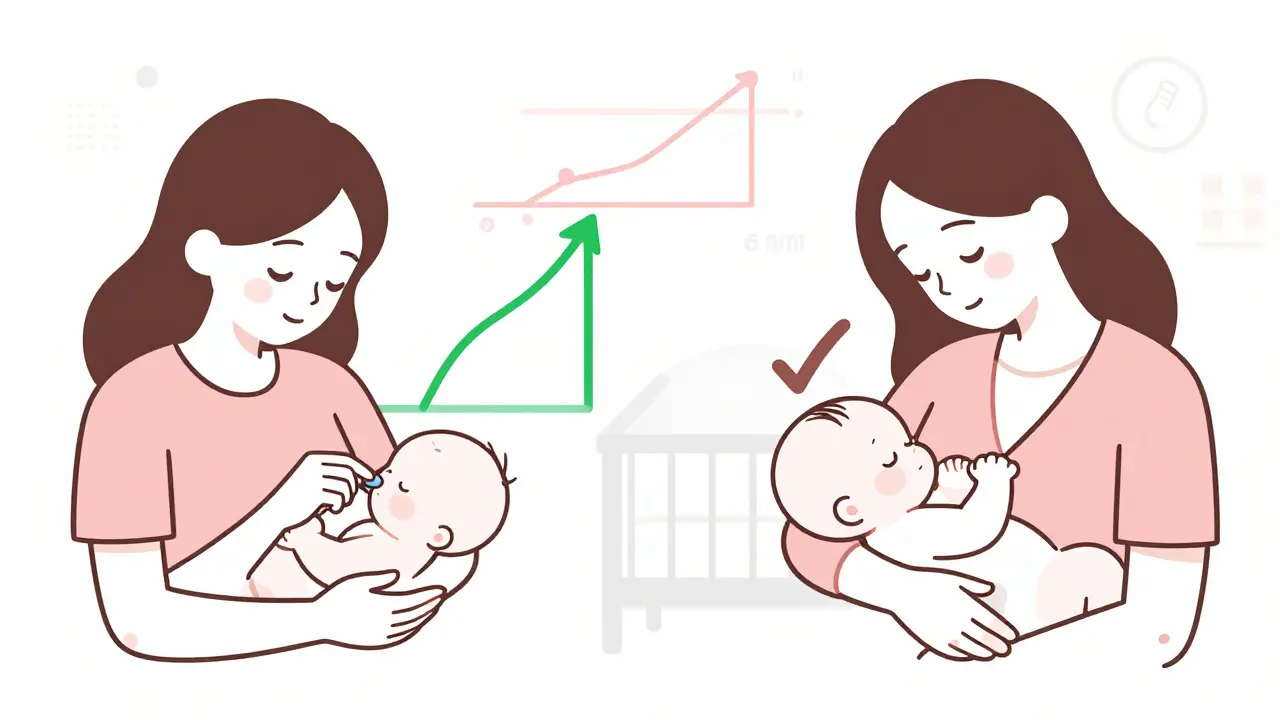
This is the single most effective strategy for most medications. If you’re taking a pill once a day, breastfeed your baby immediately before you take it. That gives your body time to clear the drug before the next feeding. For example, if your baby sleeps 6 to 8 hours overnight, take your medication right after the bedtime feeding. By the time your baby wakes up, the drug concentration in your milk will be much lower. This works especially well for short-acting drugs like hydrocodone, oxycodone, and ibuprofen. If you take medication multiple times a day, follow the same rule: breastfeed right before each dose. This creates a natural gap between feeding and peak drug levels. It’s not perfect - but it’s the best thing you can do without stopping nursing.Not All Medications Are the Same - Know Your Drug’s Half-Life
The half-life of a drug tells you how long it takes for half of it to leave your system. Short half-life? Timing matters a lot. Long half-life? Timing doesn’t help as much.- Hydrocodone (half-life: 3-4 hours): Peak in milk at 1-2 hours after taking it. Breastfeed right before your dose.
- Oxycodone (half-life: 3-4 hours): Same as hydrocodone. Avoid extended-release versions - they spike slowly and last longer.
- Diazepam (half-life: 44-48 hours): This one stays in your system for days. Timing barely helps. Use the lowest possible dose and consider switching to lorazepam, which clears faster.
- Sertraline (half-life: 26 hours): Safe for breastfeeding. Timing helps a little, but even without it, infant exposure is low (RID under 1%).
- Fluoxetine (half-life: 96 hours): Avoid if possible. Its active metabolite can linger for over 260 hours. Even small amounts can build up in your baby’s system.
The Relative Infant Dose (RID) is the gold standard for safety. If the RID is under 10%, the drug is considered low risk. Most common painkillers, antibiotics, and antidepressants fall well below this. The LactMed database from the National Library of Medicine lists RID values for over 4,700 medications - free and updated monthly.
Special Cases: Steroids, Benzodiazepines, and Hormonal Contraceptives
Some drugs need extra caution.Steroids like prednisone: At normal doses (under 20 mg/day), almost none passes into milk. But if you’re on a high dose (over 40 mg), wait 4 hours after taking it before nursing. Pump and dump during that window if you’re worried.
Benzodiazepines: Lorazepam is preferred over diazepam. It peaks in 2 hours and clears in 10-20 hours. Diazepam? Not ideal. It can cause sedation in babies, even with timing.
Hormonal birth control: Combination pills (estrogen + progestin) can reduce milk supply. Wait at least 3-4 weeks after birth before starting them. Progestin-only pills are safer and don’t affect supply as much.
What About Newborns, Premature Babies, or Sick Infants?
Newborns, especially those born early or with liver or kidney problems, process drugs much slower than older babies. Their bodies can’t clear medication the way a 6-month-old can. For these infants, timing becomes even more critical.Mayo Clinic experts warn that the first 4 weeks are the highest-risk window. After that, your baby’s liver and kidneys mature quickly. By 6 weeks, they handle drugs much better. That’s why some guidelines say timing is less urgent after the newborn stage.
If your baby is premature or has health issues, talk to your pediatrician before starting any new medication. They may suggest alternatives or recommend monitoring for signs like excessive sleepiness, poor feeding, or irritability.
Pumping and Dumping: Is It Worth It?
Many mothers think pumping and dumping right after taking a drug will protect their baby. But that’s not how it works.Drug levels in your milk follow your blood levels. If you pump right after taking a pill, you’re just removing milk that already contains the peak concentration. You’re not removing the drug from your system - you’re just throwing away milk.
But here’s when pumping helps: if you know you’ll need a strong medication - like after surgery - pump and store milk before you take it. Then feed your baby that stored milk during the first few hours after dosing. One mother on Reddit shared: “Pumped 8 oz before my dental surgery with hydrocodone. Fed stored milk for 4 hours after. My 6-month-old had zero issues.” That’s smart planning.
What to Watch For in Your Baby
Even with perfect timing, keep an eye out for these signs:- Unusual sleepiness or difficulty waking for feeds
- Poor feeding or refusing the breast
- Increased fussiness or irritability
- Slower weight gain
If you notice any of these after starting a new medication, contact your pediatrician. Most of the time, it’s nothing serious - but it’s better to check early.

Tools That Actually Help
You don’t need to memorize half-lives. Use these trusted resources:- LactMed (free, from the National Library of Medicine): Search any drug. It gives you peak times, half-lives, RID values, and timing advice.
- Hale’s Medication and Mothers’ Milk (2020 edition): The gold standard reference. Lists drugs by safety category (L1-L5).
- LactMed app: Available on iOS and Android. Updated monthly. Used by over 127,000 mothers.
Don’t rely on Google or Reddit alone. A 2021 study found only 58% of family doctors could correctly advise on timing for common drugs. You need accurate, science-backed info.
When to Talk to Your Doctor
You don’t have to figure this out alone. Ask your doctor or lactation consultant:- “Is there a safer alternative with a shorter half-life?”
- “Can I switch to an immediate-release version instead of extended-release?”
- “What’s the RID for this drug?”
- “Should I avoid this entirely if my baby was born early?”
Many mothers feel guilty asking for help. But managing medication while breastfeeding is a skill - not something you’re supposed to guess at. Your health matters too. Taking care of yourself lets you take care of your baby.
The Bigger Picture
Breastfeeding isn’t an all-or-nothing choice. It’s a series of small decisions - when to feed, what to eat, and yes, when to take your medicine. The goal isn’t perfection. It’s balance.Over 84% of U.S. babies start breastfeeding. Most will need their mom to take a medication at some point. The science is clear: with the right timing, most mothers can continue nursing safely. You don’t have to choose between being a healthy mom and a nursing mom. You can be both.
Can I take painkillers while breastfeeding?
Yes. Ibuprofen and acetaminophen are safe and have very low transfer into breast milk. For stronger painkillers like hydrocodone or oxycodone, take them right after breastfeeding, not before. Use the lowest effective dose and avoid long-acting versions. Never exceed 30 mg of hydrocodone per day.
What if my baby sleeps through the night? Do I still need to time my dose?
Yes - even if your baby sleeps 8 hours, you still want to time your dose right after the last feeding before that long stretch. That way, the drug peaks while your baby is asleep and not feeding. If you take it before bed and then nurse again later, you’re exposing your baby during the peak.
Is it safe to take antidepressants while breastfeeding?
Many are. Sertraline and paroxetine are preferred because they have low transfer into milk and short half-lives. Fluoxetine should be avoided because it builds up in your baby’s system. Timing helps, but even without it, sertraline is considered one of the safest options. Always work with your psychiatrist to find the right medication and dose.
Should I stop breastfeeding if I need surgery?
No. You can safely breastfeed after most surgeries. Pump and store milk before your procedure. Take your pain medication right after your last feeding before surgery. Use stored milk for the first few hours after you wake up. Most anesthetics and painkillers clear quickly. Ask your anesthesiologist for a breastfeeding-friendly pain plan.
How do I know if my baby is getting too much medicine from my milk?
Watch for changes in behavior: unusual sleepiness, trouble waking to feed, poor weight gain, or increased fussiness. If your baby seems different after you start a new medication, contact your pediatrician. Most babies show no signs at all - especially with proper timing. But if you’re unsure, check LactMed or ask a lactation consultant.

OMG I knew it!! My cousin’s baby got addicted to hydrocodone through her milk after she took it post-feeding-she didn’t know timing mattered. The hospital didn’t tell her anything. Now the kid’s on developmental therapy. This post is basically a whistleblower. They hide this stuff because Big Pharma doesn’t want moms to know they can outsmart the system. 🕵️♀️
Look, I get that people want to feel like they’re doing everything right, but let’s not turn breastfeeding into a high-stakes chemistry lab experiment. I’m a dad, and I’ve watched my wife stress herself into insomnia over whether to take ibuprofen 15 minutes before or after a feed. The truth? Babies are resilient. Most meds are safe. And if you’re so worried about RID percentages, why aren’t you equally worried about the 200+ pesticides in your organic kale? Priorities, people. Also, LactMed is great-but so is a good night’s sleep. Maybe don’t treat your milk like a radioactive isotope.
I took sertraline while nursing my twins and honestly, I didn’t time anything. My pediatrician said it was fine. My kids are now 8 and 9-brilliant, healthy, and one just aced her science fair. I think the fear around meds is way overblown. You’re not a lab rat. You’re a mom. Trust your gut, talk to your lactation consultant, and don’t let the internet make you feel guilty for needing help.
It is imperative to acknowledge the scientific rigor underpinning the recommendations presented herein. The pharmacokinetic principles governing drug transfer into human milk are well-documented in peer-reviewed literature, particularly in the Journal of Human Lactation and the American Academy of Pediatrics’ guidelines. The temporal relationship between maternal drug ingestion and infant exposure is not merely a heuristic but a quantifiable phenomenon, validated by multiple cohort studies. Therefore, adherence to the prescribed timing protocol constitutes a standard of care, not a suggestion.
USA has the best medical research. If you’re not following this, you’re risking your kid’s future. Stop being lazy and read LactMed. Your baby deserves better than your ignorance.
They say timing helps but what they don't tell you is that the FDA and WHO are in cahoots with Big Pharma to keep moms scared so they keep buying meds. I stopped all meds and now my baby is healthier than ever. No drugs. No science. Just nature. They don't want you to know this
Let us not be naive. The so-called '98% safety rate' is a statistical illusion constructed by pharmaceutical-funded meta-analyses. The RID metric is fundamentally flawed-it ignores cumulative exposure, neonatal hepatic immaturity, and the confounding variable of maternal metabolism variability. Furthermore, the LactMed database, while ostensibly authoritative, is curated by a network of consultants with ties to Abbott and Pfizer. One must ask: whose interest is truly being served here? The infant? Or the bottom line?
This is such a helpful, clear breakdown. I’m a new mom and was terrified about taking my antidepressant. Reading this made me feel way more confident. I’ve been timing my doses before bedtime and my baby hasn’t skipped a beat. Thanks for sharing the science without the fear-mongering.
Y’all are overthinking this. I took ibuprofen, prednisone, and even a Z-pack while nursing my son. He’s now 7, plays soccer, and has never been sick. Breastfeeding is natural, but so is taking meds when you need them. Don’t let guilt steal your joy. 💪❤️
Thank you for this!! 🥹 I was so scared to take my anxiety meds… but now I’m taking sertraline right after the 10pm feed, and my baby sleeps like a angel. I’ve been using the LactMed app daily. It’s like a little safety net in my pocket. You’re not alone. We’ve got this. 💕
The efficacy of pharmacokinetic modulation via temporal breastfeeding alignment is predicated on an assumption of homogeneous maternal pharmacometabolomic profiles-an assumption invalidated by polymorphic CYP450 enzyme expression, which varies by >30% across populations. Without genetic screening, the 'timing' protocol is pseudoscientific. Moreover, the reliance on RID as a safety metric ignores placental transfer and neonatal blood-brain barrier permeability. This post is dangerously reductive.
So you’re telling me I should risk my mental health so my baby can have breast milk? That’s not bravery. That’s martyrdom. I stopped breastfeeding after two weeks. I took the meds I needed. My kid is happy. I’m happy. Stop shaming moms who choose differently. You don’t get to decide what ‘good mothering’ looks like.
Okay, but what if you’re a single mom working two jobs and your baby wakes up every 90 minutes? You can’t time your meds like a clock tower. You’re just supposed to nap between feeds and do pharmacokinetic calculations? This feels like a rich person’s guide to parenting. Real moms just do what they can. And guess what? Their kids turn out fine.
Stop letting fear control you. You don’t need to be a perfect mom. You need to be a alive, present, healthy one. I took oxycodone after surgery and breastfed 3 hours later. My baby cried less than usual. I cried more. But I kept going. Because my healing mattered too. This isn’t about perfect timing. It’s about showing up. And you’re already doing that.