
Cyclosporine CYP3A4 Interaction & Dose Simulator
Projected Trough Level
Green band = typical target window (100–400 ng/mL). Bar shows projected level.
Recommended Cyclosporine Dose Adjustment
Clinical Guidance
Imagine a patient recovering from a kidney transplant who starts taking an antibiotic for a routine infection. Within three days, their kidney function deteriorates sharply. The culprit isn't the new infection; it's a silent chemical battle happening in their liver. This is the reality of managing Cyclosporine, a potent immunosuppressant that acts as both a victim and a perpetrator in the world of drug metabolism. Because Cyclosporine is heavily processed by the CYP3A4 enzyme and also inhibits that same enzyme, adding or removing other medications can swing blood levels dangerously high or low. For clinicians and patients, understanding this bidirectional relationship is not just academic-it is the difference between long-term graft survival and acute rejection or toxicity.
The Dual Role of Cyclosporine in Metabolism
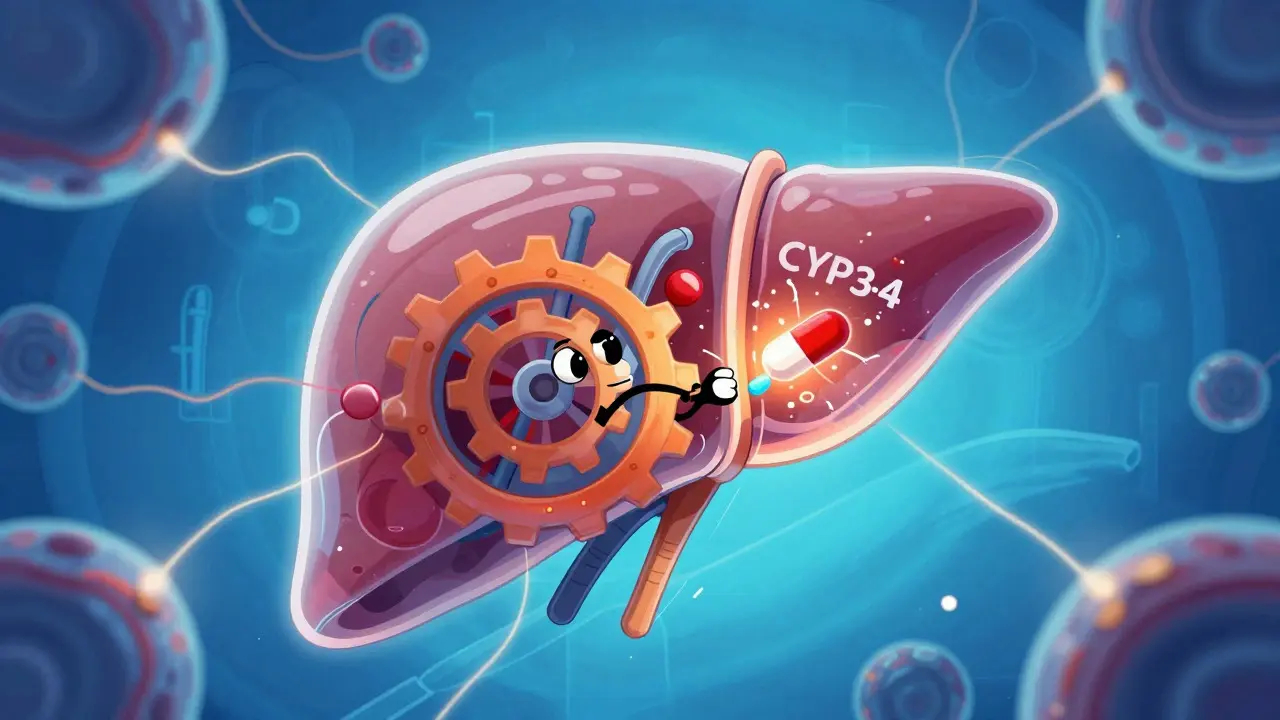
To understand why these interactions are so tricky, you have to look at how the body handles drugs. CYP3A4 is the most abundant cytochrome P450 enzyme in the human liver and intestine, responsible for metabolizing approximately 60% of all therapeutic drugs. Most people think of enzymes like CYP3A4 as simple factories that break down drugs. But Cyclosporine complicates this picture. It is a substrate, meaning CYP3A4 breaks it down. However, it is also an inhibitor, meaning it blocks CYP3A4 from breaking down other drugs. This dual role creates a feedback loop. If you add a drug that inhibits CYP3A4, Cyclosporine levels rise. If you add a drug that induces CYP3A4, Cyclosporine levels drop. But because Cyclosporine itself inhibits CYP3A4, it can also raise the levels of co-administered drugs that rely on that enzyme for clearance.
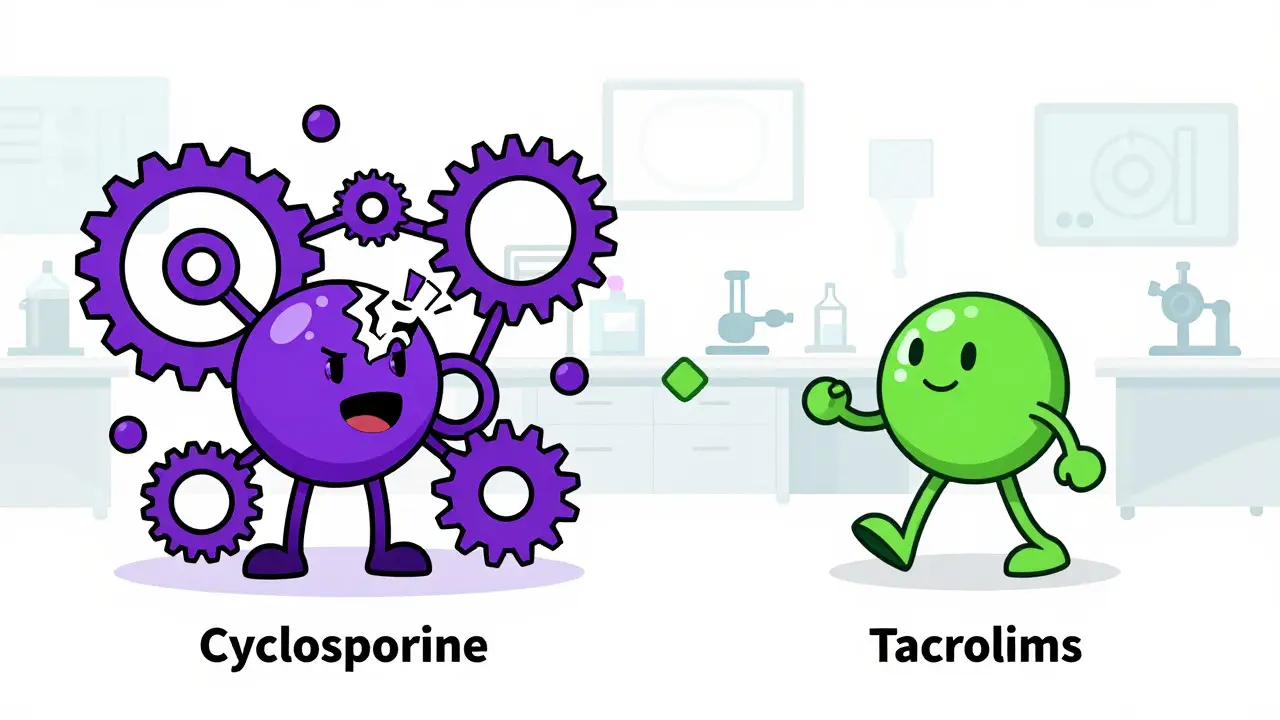
This is distinct from other calcineurin inhibitors like Tacrolimus. While structurally similar, Tacrolimus is primarily a sensitive substrate with minimal inhibitory effects on CYP3A4. This fundamental pharmacokinetic difference explains why Cyclosporine users face a more complex web of potential interactions. The FDA explicitly lists Cyclosporine as a CYP3A4 inhibitor in its official guidance tables, highlighting its active role in modifying the metabolic landscape of the patient's body.
Mechanisms of Inhibition: Competitive vs. Mechanism-Based
Not all inhibition is created equal. Some drugs bind to CYP3A4 temporarily (competitive inhibition), while others cause permanent damage to the enzyme (mechanism-based inhibition). Research indicates that Cyclosporine exhibits characteristics of mixed inhibition. Studies published in PMC databases show that Cyclosporine A exhibits time-dependent inhibition of both CYP3A4 and CYP3A5. This suggests that over time, the enzyme may become less efficient not just because the drug is sitting in the active site, but potentially through reversible conformational changes or mild mechanism-based effects. Unlike strong mechanism-based inhibitors such as Clarithromycin or Ritonavir, which require the liver to synthesize entirely new enzyme proteins to recover, Cyclosporine's effects are generally reversible once the drug is cleared. However, "reversible" does not mean "fast." The half-life of the interaction can linger, requiring careful monitoring during dose adjustments.
Genetics play a massive role here. CYP3A4 polymorphisms can reduce the enzyme's catalytic efficiency by up to 40% compared to the wild-type variant. For a patient with a less active CYP3A4 genotype, even standard doses of Cyclosporine might lead to higher baseline exposure. When you layer a moderate inhibitor on top of that genetic predisposition, the risk of toxicity spikes significantly. This is why personalized dosing based on pharmacogenetics is becoming a key focus in modern transplant care.
Clinical Consequences: From Rejection to Toxicity
What do these molecular shifts look like in a hospital ward? The consequences are tangible and often severe. On one end of the spectrum, if CYP3A4 activity is induced (for example, by Rifampin), Cyclosporine trough concentrations can plummet by 50-80%. This sub-therapeutic level leaves the immune system unchecked, leading to acute rejection episodes. Conversely, if CYP3A4 is inhibited (by drugs like Diltiazem or Grapefruit juice in large quantities), Cyclosporine levels rise. High levels of Cyclosporine are nephrotoxic. Case reports document serum creatinine increases of 40-60% in renal transplant patients within 72 hours of starting strong CYP3A4 inhibitors. This rapid decline in kidney function can be misdiagnosed as rejection, leading to unnecessary biopsies or pulse steroid treatments.
A multicenter study involving over 1,200 renal transplant patients found that nearly one-third experienced at least one clinically significant drug interaction involving Cyclosporine and CYP3A4 modulators within the first year post-transplant. Of those, about 8% required hospitalization due to complications directly linked to these interactions. These numbers underscore that drug interactions are not rare edge cases; they are a central part of daily management for transplant recipients.
| Feature | Cyclosporine | Tacrolimus |
|---|---|---|
| Primary CYP3A4 Role | Substrate and Inhibitor | Sensitive Substrate |
| Inhibition Type | Mixed / Time-dependent | Negligible |
| P-glycoprotein Effect | Inhibitor | Substrate |
| Risk Profile | Bidirectional (raises/lower own & other levels) | Unidirectional (levels raised by inhibitors) |
| Typical Trough Target | 100-400 ng/mL (varies by protocol) | 5-15 ng/mL (varies by protocol) |

Practical Strategies for Managing Interactions
So, how do we keep patients safe? The answer lies in structured vigilance. Clinical pharmacists and transplant teams use a specific algorithm when a new medication is introduced. First, they identify whether the new drug is a CYP3A4 substrate, inhibitor, or inducer. Second, they assess the strength of that effect. Third, they adjust the Cyclosporine dose proactively rather than waiting for blood tests to show a problem.
For moderate inhibitors like Diltiazem, guidelines typically recommend reducing the Cyclosporine dose by 25-50% upon initiation. Daily trough concentration monitoring is then required until levels stabilize. For strong inhibitors, the reduction may need to be 50-75%. When stopping an inhibitor, the reverse happens: the Cyclosporine dose must be increased gradually to prevent rejection. This titration process requires patience and frequent lab work. Electronic health record alerts have proven effective in this space. A 2022 study showed that implementing real-time interaction alerts in electronic records reduced Cyclosporine-related adverse events by 45% across multiple transplant centers. Technology helps, but clinical judgment remains paramount.
The Future: Personalized Pharmacogenomics
We are moving away from one-size-fits-all dosing toward precision medicine. Recent research highlights that CYP3A4 genotyping can predict initial dosing needs with high accuracy. Algorithms incorporating genotype, concomitant medications, and patient weight are now showing 85-90% predictive power for Cyclosporine exposure. Furthermore, point-of-care devices capable of measuring Cyclosporine levels in real-time are in late-stage trials. These tools aim to provide correlation coefficients as high as r=0.95 compared to standard laboratory testing, allowing for immediate dose adjustments during clinic visits. As these technologies mature, the burden of managing CYP3A4 interactions will shift from reactive crisis management to proactive, data-driven optimization. For now, however, the cornerstone of safety remains simple: know your drugs, monitor your levels, and never assume a new prescription is harmless.
Does grapefruit juice interact with cyclosporine?
Yes. Grapefruit juice contains furanocoumarins that inhibit intestinal CYP3A4. Since Cyclosporine is absorbed through the gut, drinking grapefruit juice can significantly increase blood levels of the drug, leading to potential toxicity. Patients are generally advised to avoid grapefruit and Seville oranges while on Cyclosporine therapy.
Why is tacrolimus considered safer regarding drug interactions than cyclosporine?
Tacrolimus is primarily a CYP3A4 substrate with negligible inhibitory activity. This means its levels are affected by other drugs, but it doesn't significantly alter the metabolism of those other drugs. Cyclosporine, being both a substrate and an inhibitor, creates a more complex, bidirectional interaction profile that raises the risk of affecting multiple medications simultaneously.
How often should I check my cyclosporine levels when starting a new medication?
If the new medication is a known CYP3A4 modulator, your doctor will likely request daily or every-other-day trough level checks for the first week to ten days. Once levels stabilize, monitoring may return to your regular schedule. Always follow the specific instructions provided by your transplant team.
Can I take antibiotics while on cyclosporine?
It depends on the type. Macrolide antibiotics like Clarithromycin are strong CYP3A4 inhibitors and can drastically raise Cyclosporine levels. Azithromycin has a weaker effect but still requires caution. Penicillins and cephalosporins generally have fewer CYP3A4 interactions. Always consult your pharmacist before starting any antibiotic to determine if a dose adjustment is needed.
What is the target trough concentration for cyclosporine?
Target levels vary depending on the type of organ transplanted and how far along you are in recovery. Generally, targets range from 100 to 400 ng/mL. Early post-transplant periods usually require higher levels to prevent rejection, while maintenance phases allow for lower levels to minimize toxicity. Your specific target is set by your treating physician.