
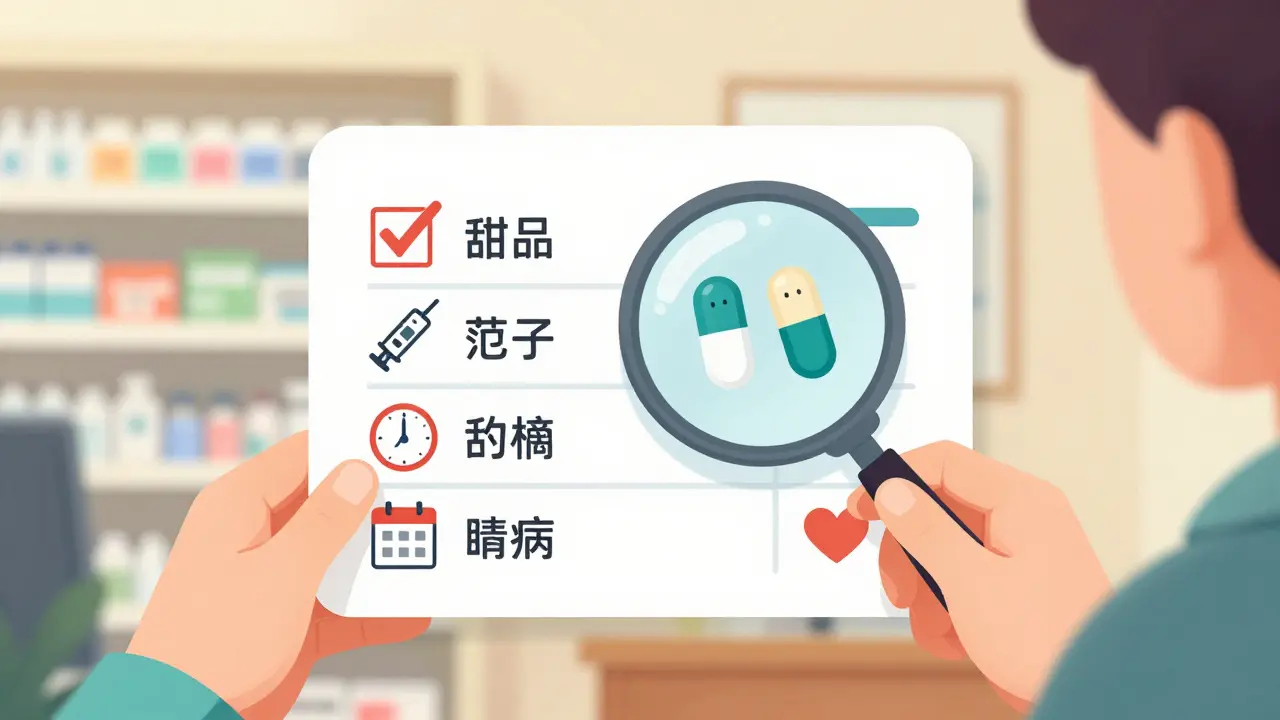
Every time you pick up a prescription, you’re handed a small piece of paper that holds critical information about your health. But do you really know what all those words, numbers, and symbols mean? Most people glance at the name of the drug, check the dosage, and walk away-only to forget how to take it, wonder why they’re taking it, or accidentally mix up pills. The truth is, your prescription label isn’t just a receipt. It’s a safety tool. And if you understand every part of it, you could avoid a dangerous mistake.
Your Name: The First Line of Defense
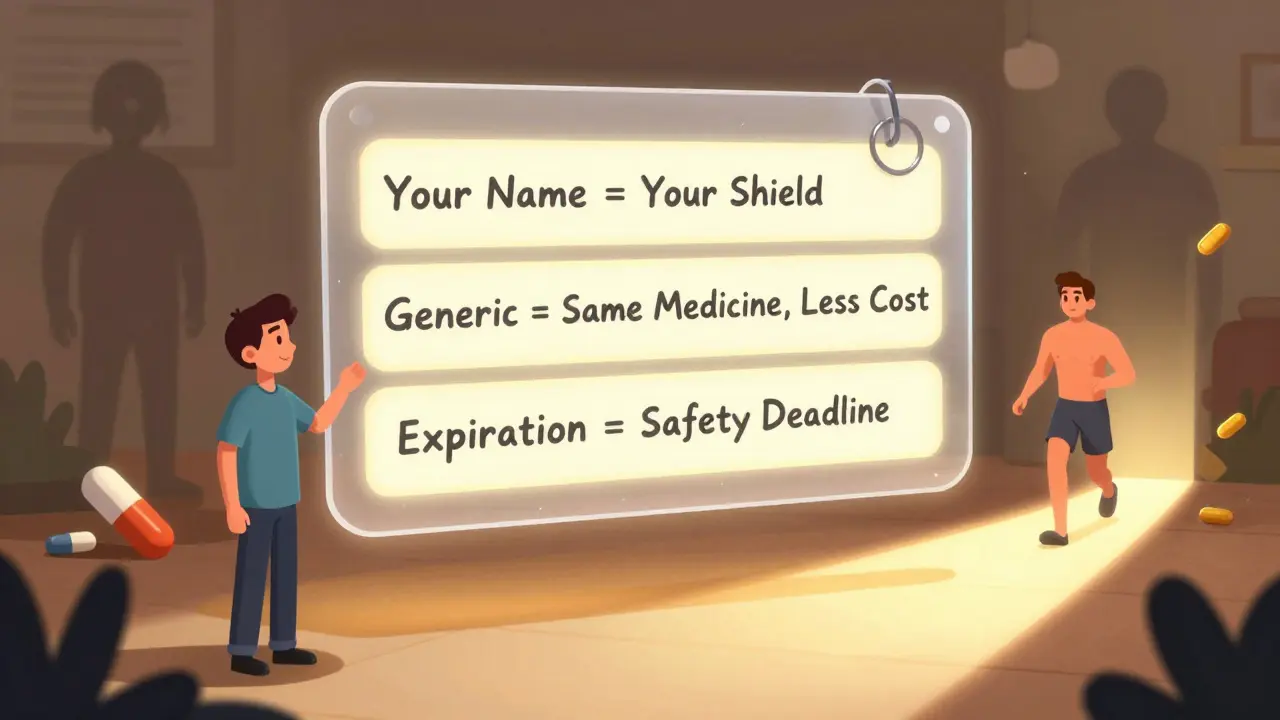
Right at the top, you’ll see your full name. It’s not there for paperwork. It’s there to keep you alive. Medication errors due to mix-ups happen more often than you think. The Institute of Medicine reported 1.5 million such errors every year in the U.S. That’s one error for every 100 prescriptions filled. Pharmacies put your name on every label so the pharmacist, nurse, or even you can double-check: Is this medicine really for me? If your name is misspelled or missing, don’t take the bottle. Go back and ask. It’s that simple-and that important.
Medication Name: Brand vs. Generic
You’ll see two names on the label. One is the brand name-like Abstral. The other is the generic name-fentanyl. The brand name is what the drug company calls it. The generic name is the actual medicine inside. They’re the same thing. Many people think brand-name drugs are stronger or better. They’re not. Generic drugs are required by law to work exactly the same way. Knowing the generic name helps you recognize the drug if you switch pharmacies or get a refill later. It also lets you compare prices. A brand-name pill might cost $80. The generic might cost $8. That’s not a typo.
Dosage Strength: How Much Is in Each Pill?
This tells you exactly how much active medicine is in each pill, liquid, or patch. For example: 100 micrograms per tablet. That number matters. Take too little, and the medicine won’t work. Take too much, and you could overdose. Some pills look identical but have different strengths. A 25 mg tablet of metoprolol looks just like a 50 mg one. If you don’t know the difference, you might accidentally double your dose. Always check this part. If it’s written as 5 mg/mL for liquid medicine, that means every teaspoon (5 mL) contains 25 mg. Always use the measuring cup that came with the medicine. Kitchen spoons? They’re not accurate.
Instructions: When and How to Take It
This section tells you how often to take the medicine and under what conditions. It might say: Take one tablet by mouth every 6 hours as needed for pain. Or: Take with food. Or: Take on an empty stomach. These details aren’t optional. Some drugs need food to be absorbed properly. Others can upset your stomach if taken with food. Some must be taken at the same time every day to keep a steady level in your blood. If it says at bedtime, don’t take it at noon. If it says every 8 hours, that means three times a day-not just morning, lunch, and night. Set phone alarms if you need to. Missing doses or taking them at the wrong time can make the medicine less effective-or even dangerous.
Expiration Date: When It’s No Longer Safe
That date on the label isn’t just a suggestion. It’s the last day the manufacturer guarantees the medicine will work as intended. After that, it might lose strength. In rare cases, it could break down into harmful chemicals. Most pills last 12 to 18 months after being filled. Liquid antibiotics? Often just 14 days. Eye drops? Usually 28 days after opening. Don’t take medicine past its expiration date, even if it looks fine. And don’t keep old meds in your medicine cabinet. Throw them out. The FDA recommends using drug take-back programs or mixing pills with coffee grounds or cat litter before tossing them in the trash.
Prescription Number and Pharmacy Info
The Rx number is your prescription’s ID. It’s how the pharmacy tracks your refill requests. If you call for a refill, they’ll ask for it. If you switch pharmacies, you’ll need it. Also, look at the pharmacy’s name and phone number. Keep this handy. If you have questions-like whether your medicine interacts with your multivitamin-you can call them directly. Pharmacists are trained to answer these questions. They’re not just filling bottles. They’re your safety net. And don’t ignore the prescriber’s name. If you’re unsure why you were given a certain drug, you can call your doctor and say, “I got this prescription from [Pharmacy] with Rx #12345. Can you confirm this is right?”
Visual Description: What Your Medicine Looks Like
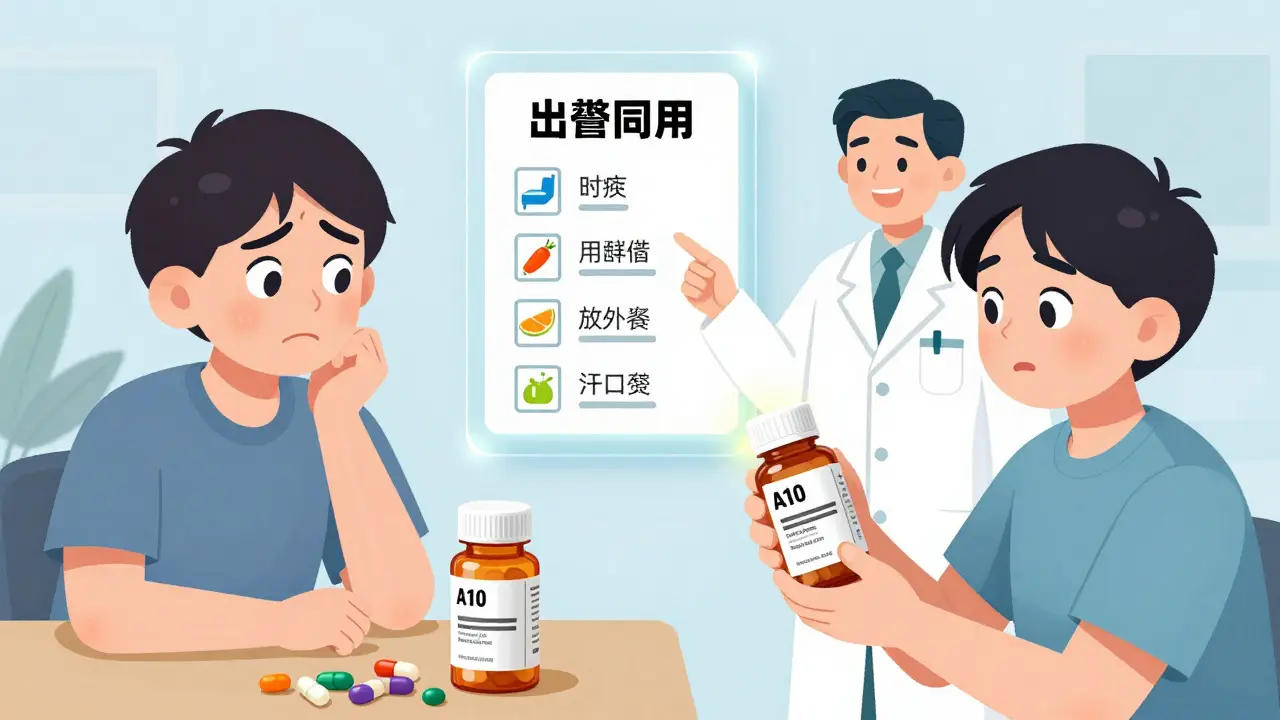
It might say: White, round, film-coated tablet, imprinted with “A10”. This seems trivial, but it’s crucial. If you get a new bottle and the pills look different, something might be wrong. Maybe the pharmacy gave you a generic version. Maybe they made a mistake. Either way, you should check. Many patients don’t realize that the same drug can come in different shapes or colors depending on the manufacturer. But if the imprint changes completely-or the color is off-you should call the pharmacy. A 2023 Cleveland Clinic study found that patients who checked the appearance of their pills were 40% less likely to take the wrong medicine.
National Drug Code (NDC): The Unique Barcode
This 10- or 11-digit number is like a fingerprint for your medicine. It tells you who made it, what it is, and how it’s packaged. It’s mostly used by pharmacies and insurance companies, but knowing it helps if you need to report a problem. For example, if you get sick after taking a batch of pills, the NDC helps trace exactly which lot you got. It’s also used to verify that your insurance is covering the right drug. You’ll find it printed in small text near the bottom of the label.
Storage Instructions: Keep It Safe
Some medicines need to be kept cold. Others must stay dry. If your label says Store at 20°-25°C (68°-77°F), that means room temperature. Don’t leave it in the bathroom-humidity ruins many pills. If it says Refrigerate, keep it in the fridge-not the freezer. Freezing can break down the medicine. Some insulin, for example, becomes useless if frozen. Others, like nitroglycerin, must be kept in their original glass bottle because light can weaken them. Follow these instructions. Your medicine’s effectiveness depends on it.
Warnings: What to Watch Out For
This section might say: Do not take if pregnant, May cause drowsiness, or Avoid alcohol. These aren’t suggestions. They’re safety rules. A 2022 FDA study found that 78% of patients didn’t know why they were taking their medicine-and that confusion led to dangerous choices. For example, someone on blood thinners might drink grapefruit juice because they like the taste. But grapefruit can cause serious bleeding. Or someone might take sleeping pills and then drive. The warning is there to stop that. If you see a warning you don’t understand, ask. Don’t assume it’s not important.
Why the Indication Matters More Than You Think
Here’s the biggest upgrade in modern labeling: the reason you’re taking the medicine. It might say: For high blood pressure or For anxiety. This wasn’t required on most labels until recently. But now, experts say it’s one of the most important changes. A 2022 study by the Institute for Safe Medication Practices showed that when the reason for the drug was printed on the label, wrong-drug errors dropped by 55%. Imagine this: A patient gets a bottle labeled “Metoprolol.” They think it’s for their headaches. So they take it every time they get a headache. But it’s actually for heart rhythm. They’re not treating the right thing-and they’re risking side effects. If the label says Metoprolol-For irregular heartbeat, they’d know not to take it for headaches. That’s life-saving.
What You Should Do Every Time You Get a New Prescription
Before you leave the pharmacy, do this quick checklist:
- Check your name-is it spelled right?
- Confirm the drug name-brand and generic.
- Read the dosage-how many milligrams or micrograms?
- Understand the instructions-how often, with or without food?
- Look at the expiration date.
- Find the indication-why are you taking this?
- Check the pill’s appearance-color, shape, imprint.
- Ask: “Is there anything I should avoid while taking this?”
That’s it. Seven minutes. It could save your life.
What Pharmacies Are Doing Better-and What’s Still Missing
Many pharmacies now include the indication on labels. Some use larger fonts. Some add pictograms-like a picture of a bed for “take at bedtime.” The FDA and USP have pushed for these changes. But not every pharmacy does it yet. A 2022 survey found that 62% of independent pharmacies still don’t include the reason for the medication because their computer systems don’t support it. If your label doesn’t have it, ask for it. You have the right to know why you’re taking a drug. And if you’re not comfortable reading the label, ask the pharmacist to explain it out loud. Use the “teach-back” method: “So, just to make sure I got it-you’re saying I take this twice a day with food because it’s for my blood pressure. Is that right?” If you can say it back correctly, you’ve understood it.
Final Thought: Your Label Is Your Power
You don’t need a medical degree to read your prescription label. You just need to pay attention. Every number, word, and symbol on that label is there for a reason. It’s not meant to confuse you. It’s meant to protect you. And when you understand it, you take control. You stop being a passive recipient of medicine. You become an active partner in your own care. That’s the real power of knowing what each part of your Rx label means.
Why does my prescription label have two names for the same medicine?
The two names are the brand name (like Lipitor) and the generic name (like atorvastatin). The brand name is what the drug company calls it. The generic name is the actual active ingredient. They’re the same medicine. Generic versions are cheaper and just as effective. The label includes both so you can recognize the drug no matter which version you get.
What should I do if my pill looks different this time?
Don’t take it until you check. Pills can look different if you switched pharmacies or got a generic version. But if the color, shape, or imprint (the letters/numbers on the pill) changed completely, call the pharmacy. It could be a mistake. Always compare the label’s description of the pill to what’s in the bottle.
Can I still take medicine after the expiration date?
It’s not recommended. Most pills lose strength after expiration. Some, like liquid antibiotics or insulin, can become unsafe. The FDA says to dispose of expired meds properly-don’t flush them. Use a drug take-back program or mix them with coffee grounds or cat litter before throwing them away.
Why is the reason for the medicine (indication) now on the label?
Including the reason-like “for high blood pressure” or “for anxiety”-helps prevent errors. A 2022 study found it reduced wrong-drug mistakes by 55%. If you know why you’re taking a pill, you’re less likely to take it for the wrong reason or stop it too soon.
What does “take with food” really mean?
It means eat something before or while taking the pill-not just a sip of water. A small snack or full meal helps your body absorb the medicine properly. Some drugs can upset your stomach if taken on an empty stomach. Others won’t work well without food. Always follow the label. If you’re unsure, ask your pharmacist what counts as “food.”
How do I know if my medicine needs to be refrigerated?
Look for phrases like “Refrigerate” or “Store between 36°F and 46°F.” If it doesn’t say that, store it at room temperature. Don’t freeze it unless the label says to. Some medicines, like insulin or certain eye drops, can break down if frozen. Always check the storage instructions on the label before storing it.
Next Steps: What to Do If You’re Still Confused
If you’re still unsure after reading your label, call your pharmacist. They’re paid to answer these questions. You can also ask your doctor for a printed handout about your medicine. Many clinics now give them. Use the FDA’s “5 Questions to Ask About Your Prescription” as a guide. And if you’re helping an older parent or child with their meds, write down the instructions in big letters and stick them on the fridge. Simple changes like that reduce mistakes. Your health is too important to guess.

Look, I get it - labels are 'safety tools' and all that. But let's be real: most people don't read them. I've been on the same med for five years and I still don't know if it's for my 'anxiety' or 'high blood pressure' - I just know it stops the panic attacks. The pharmacy gave me a new bottle last month and the pills were a different color. I took 'em anyway. Turned out it was a generic. Same stuff. Same results. Why do we turn simple things into bureaucratic nightmares? You don't need a PhD to swallow a pill. Just don't mix it with alcohol and you'll be fine. Stop overthinking it.
Also - 'teach-back method'? Who the hell came up with that? Sounds like a corporate buzzword invented by someone who's never held a medicine bottle in their hand. Just ask the pharmacist. They're not robots. They'll tell you. No need for roleplay.
And for the love of god, stop putting 'Take with food' on labels. What does that even mean? A cracker? A burrito? A full Thanksgiving dinner? I take mine with coffee. Works fine. Stop policing people's breakfasts.
I appreciate the detailed breakdown, but I’ve noticed something odd - many labels still don’t include the indication, even though it’s been recommended for years. I’m from Ireland and my local pharmacy here started adding it last year, but my cousin in the States got her prescription last week and it was missing. Why is this still inconsistent? Is it a tech issue? Cost? Or just apathy? I’ve started asking pharmacists to write it by hand if it’s not printed - and they’ve all been happy to do it. It’s not hard. It’s not expensive. It’s just common sense. If we can track a package across the globe, we can print two extra words on a label.
I dont get why this is even a thing anymore like who cares what the generic name is if the pill works right its the same damn thing and if you cant read the label maybe you shouldnt be taking meds at all
Just one sentence: If your label doesn’t say why you’re taking the drug, demand a new one. Period.
Man, I love this. Seriously. I used to be the guy who tossed pills into a jar and hoped for the best. Then my grandma had a near-miss because she took her blood pressure med for 'headaches.' Turns out, she didn't even have high blood pressure - she was on it because her doctor had prescribed it for a past issue and she just kept taking it. Scary stuff.
Now I keep a little notebook next to my meds. I write: what it's for, when to take it, what to avoid. I even draw little stick figures. One’s a sun for 'take in morning,' one’s a moon for 'at night.' My friends laugh. But I haven’t missed a dose in two years. And I’ve talked three of my buddies into doing the same. Small changes, big saves. You don’t need a medical degree - just a pen and a brain that’s willing to pay attention.
India has been doing this right for decades why do western countries make everything so complicated we have barcoded labels with the indication printed in three languages and the pharmacist explains everything in person before handing over the medicine you people overthink everything and then complain when things go wrong
I just want to say - thank you for writing this. I’ve been a caregiver for my dad for the last three years. He’s got dementia. He forgets what he’s taking. He forgets why. I used to spend hours sorting pills, calling pharmacies, cross-checking. This article? It’s a roadmap. I printed it out. Laminated it. Taped it to the fridge next to his pill organizer.
And guess what? He started asking questions. Not because he remembers - but because the label says ‘For heart rhythm’ and he says, ‘Oh. That’s why I feel dizzy sometimes.’
Knowledge isn’t power. It’s dignity. And for people like him - and for all of us - it’s a lifeline. Keep doing this work.
Wow. A whole article about reading a label. How revolutionary. Next up: ‘The Shocking Truth About Washing Your Hands After Using the Bathroom.’
Look, I’ve been on 12 different prescriptions in the last decade. I’ve never once checked the NDC. Or the imprint. Or the expiration date. And I’m still alive. I take what’s handed to me. I swallow it. I go about my day. If it makes me feel better - great. If not - I stop. It’s not rocket science. It’s a pill. Not a nuclear launch code.
Also - ‘teach-back method’? Who’s your therapist? I need their number.
As an Indian woman who’s seen her mom take 12 pills a day without knowing what any of them did - I’m so glad this exists. We don’t talk about meds here. It’s taboo. ‘Why are you asking questions? The doctor knows.’
But last year, I sat down with her. Printed out the label. Pointed to the indication. Said: ‘This is for your sugar. Not your knee.’ She cried. Not because she was upset - but because she finally understood.
So thank you. Not just for the info - but for giving us permission to ask. Even in cultures that tell us to stay quiet - we deserve to know why we’re taking what we’re taking.
OH MY GOSH I JUST REALIZED I’VE BEEN TAKING MY ANTIBIOTIC AT NOON INSTEAD OF MIDNIGHT FOR THREE WEEKS?? I’M SO STUPID. I THOUGHT ‘EVERY 12 HOURS’ MEANT MORNING AND NIGHT. I DIDN’T EVEN KNOW WHAT ‘12 HOURS’ MEANT. I’M SO EMBARRASSED. BUT THANK YOU FOR THIS - I JUST CALLED MY PHARMACY AND THEY SAID IT WAS FINE BUT NEXT TIME I’LL SET ALARMS. I’M CRYING. I’M SO GRATEFUL.
This is the kind of post that makes me believe in humanity again.
I work in a pharmacy. I’ve seen people cry because they didn’t know why they were taking a pill. I’ve seen people take the wrong dose because the label was too small. I’ve seen grandparents give their grandkids the wrong medicine because the bottle looked familiar.
But I’ve also seen the moment someone reads the indication for the first time - and their whole face changes. ‘Oh. So THAT’S why I’m dizzy.’
It’s not about being smart. It’s about being heard. And this? This is how we start listening.
Keep pushing for clearer labels. Keep asking questions. And if you’re a pharmacist - don’t just hand out pills. Say the words out loud. Say: ‘This is for your heart. Not your back.’
That’s the real medicine.
Wow. You spent 1500 words explaining something most people learn by trial and error - and the ones who need it most? The elderly, the ill, the non-English speakers - they’re the least likely to read it.
Meanwhile, the real problem? Pharmacies that don’t train staff to explain. Insurance companies that force generic switches without notice. Doctors who scribble prescriptions in Latin.
This article is a beautiful, well-researched distraction from the broken system.
But hey - at least we can all feel good about reading labels while the real failures keep happening.