
Black Box Warning Knowledge Quiz
Quiz Results
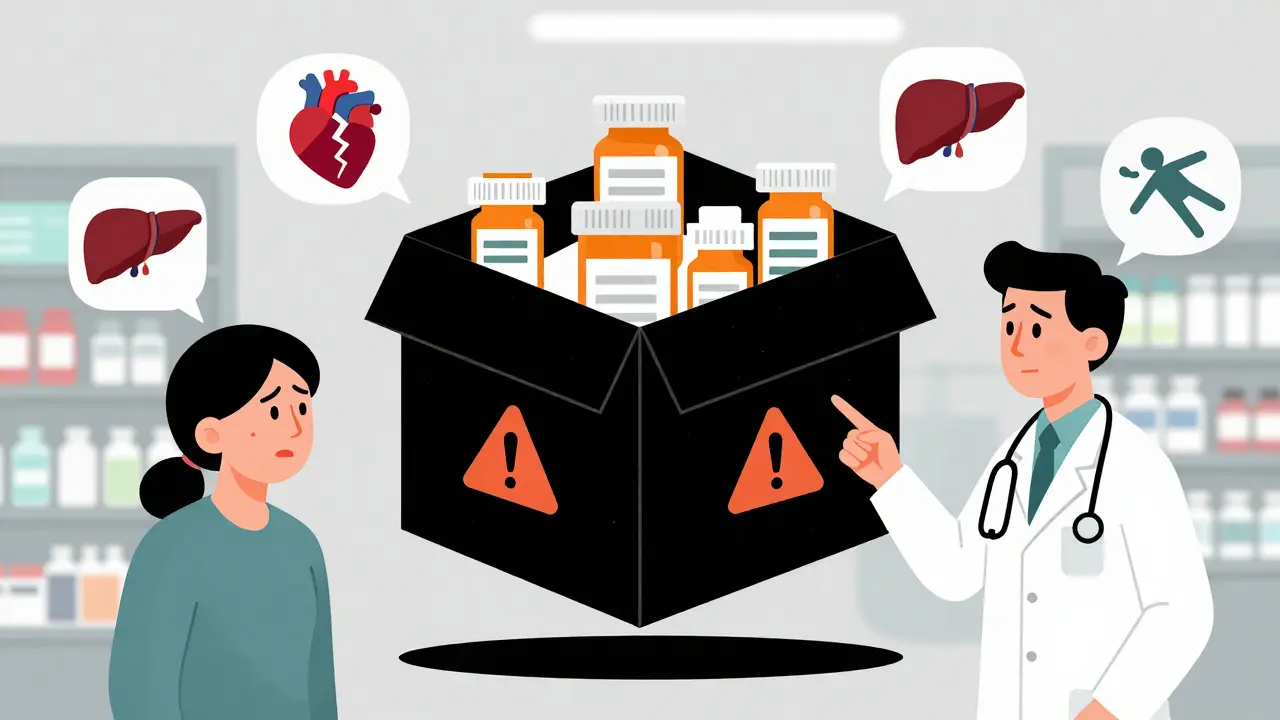
When you pick up a prescription, you might notice a bold, black-bordered box on the medication label or insert. It’s hard to miss. And that’s the point. This is a black box warning - the strongest safety alert the U.S. Food and Drug Administration (FDA) can require for a drug. It doesn’t mean the medication is dangerous for everyone. But it does mean that for some people, the risks are serious enough to warrant a direct, unmistakable warning: this drug can cause life-threatening side effects.
What Exactly Is a Black Box Warning?
A black box warning, officially called a boxed warning, is a legal requirement from the FDA. It appears as a rectangular box with bold black borders surrounding text that highlights the most dangerous risks tied to a medication. These aren’t vague cautionary notes. They’re based on real-world evidence gathered after a drug is already on the market. Clinical trials can’t always catch rare but deadly side effects - that’s why the FDA waits until hundreds of thousands of people have taken the drug before acting.
As of 2023, more than 400 prescription medications carry a black box warning. That’s about 15% of all prescription drugs in the U.S. The warning doesn’t just appear on the pill bottle. It’s also printed in the patient information leaflet and the prescribing guide doctors use. The goal? To make sure both providers and patients see it before the drug is even prescribed.
Why Do These Warnings Exist?
The FDA doesn’t slap on a black box warning lightly. It only happens when there’s clear proof that a drug can cause:
- Death or life-threatening reactions
- Permanent disability
- Severe harm that could have been avoided with proper use
- Extreme risk for specific groups - like pregnant women, children, or the elderly
For example, some antidepressants carry black box warnings because they can increase suicidal thoughts in young adults under 25. Certain diabetes drugs warn of heart failure risk. Blood thinners like warfarin have warnings about uncontrolled bleeding. These aren’t hypothetical concerns. They’re backed by thousands of real patient reports submitted through the FDA’s MedWatch system - which gets about 1.2 million reports every year.
Once a black box warning is added, it rarely disappears. The FDA requires overwhelming evidence that the risk is lower than originally thought. Since 2000, only 12 black box warnings have been fully removed. That shows how seriously the agency takes these alerts.
How Do These Warnings Get Added?
Drugs go through five stages before approval: lab research, animal testing, human clinical trials, FDA review, and then post-market monitoring. The black box warning almost always comes during that last stage.
Here’s how it works:
- The FDA notices a pattern of serious side effects from reports submitted by doctors, pharmacists, or patients.
- They investigate - looking at data from hospitals, insurance claims, and national health databases.
- If the evidence is strong enough, the FDA contacts the drugmaker and asks them to propose warning language.
- The company submits wording. The FDA reviews, edits, and approves it.
- The warning is printed on all future packaging and inserts.
Since 2008, the FDA’s Sentinel Initiative has made this process faster. By analyzing electronic health records and insurance data across millions of patients, they can spot danger signals in months instead of years. In 2022 alone, the FDA added or updated 37 black box warnings.
Do Black Box Warnings Mean I Shouldn’t Take the Drug?
This is the biggest question patients ask - and the most misunderstood.
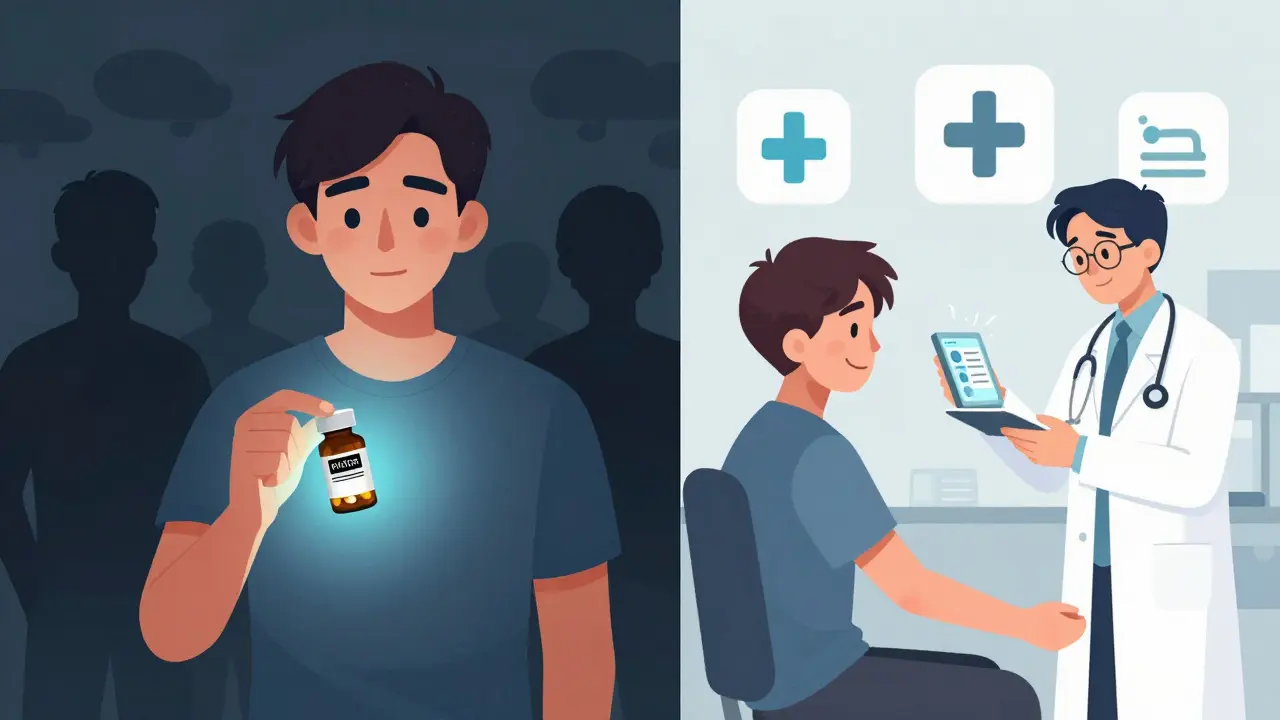
No, a black box warning doesn’t mean you should stop taking the medication. It means you and your doctor need to carefully weigh the risks versus the benefits.
Take HIV medications. Many carry black box warnings for liver damage or severe skin reactions. But without them, HIV can be fatal. The warning isn’t there to scare you off - it’s there to make sure you’re monitored closely. Your doctor might order regular blood tests. They might check your liver function before and during treatment.
Same with certain cancer drugs. Some have warnings about heart damage or severe infections. But for many patients, they’re the only option left. The warning doesn’t change that - it just ensures the treatment is given with full awareness of the risks.
As pharmacists often tell patients: “A black box warning doesn’t mean ‘don’t take this.’ It means ‘take this with eyes wide open.’”
What About My Doctor? Did They Tell Me?
Here’s the problem: most patients don’t hear about these warnings from their doctors.
A 2023 survey found that 78% of patients said they’d want to know if their medication had a black box warning. But only 42% recalled their doctor ever mentioning it. That’s a huge gap.
Why? Time. Pressure. Assumptions. Doctors might assume patients will read the insert. Or they might think the warning doesn’t apply to their specific case. Or they’re rushed and forget.
But here’s the truth: if your drug has a black box warning, your doctor is legally required to review the risks and benefits with you. That means they should explain:
- What the specific danger is
- How likely it is to happen
- What signs to watch for
- What alternatives exist
- How you’ll be monitored
If they didn’t, ask. Don’t wait. Bring up the warning yourself. Say: “I saw the black box warning on my pill bottle. Can we talk about what that means for me?”
Who Is Most at Risk?
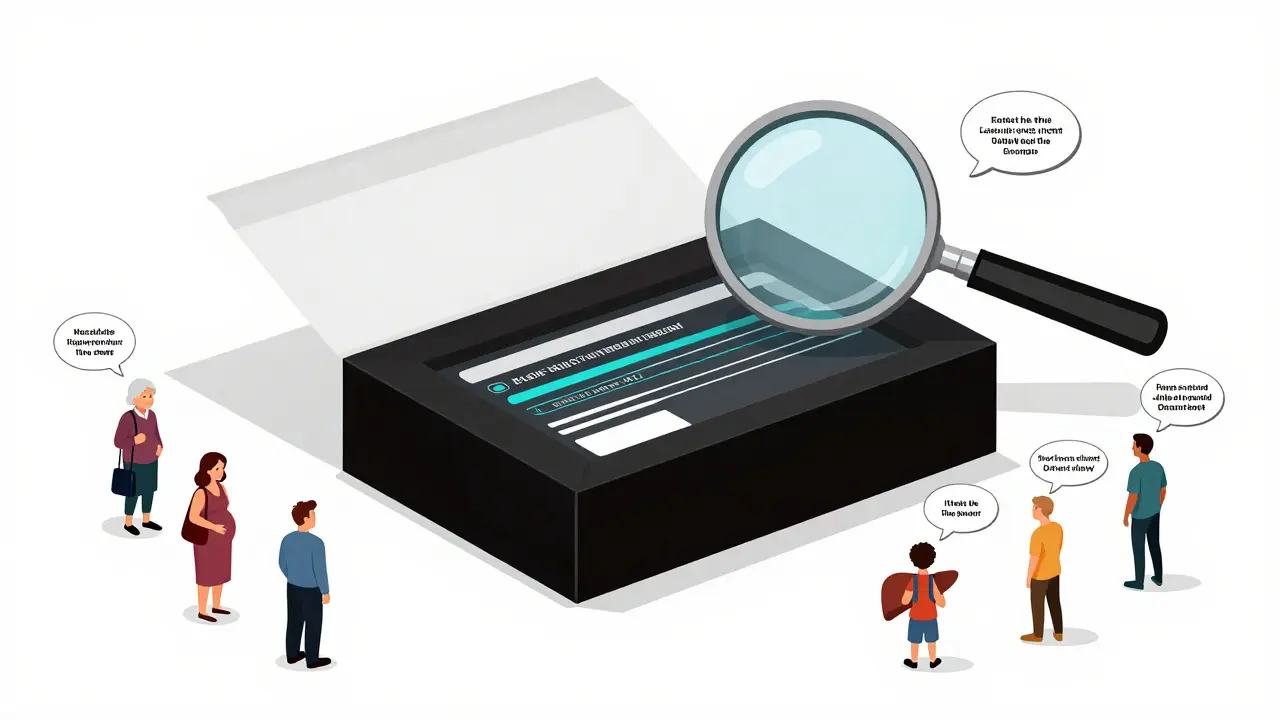
Black box warnings often target specific populations. For example:
- Children and teens: Some ADHD and antidepressant drugs increase suicide risk in this group.
- Pregnant women: Certain epilepsy and acne medications can cause severe birth defects.
- Older adults: Blood thinners and sedatives can lead to falls, bleeding, or confusion.
- People with other health conditions: Liver disease, heart failure, or kidney problems can make side effects worse.
That’s why the warning isn’t one-size-fits-all. Your doctor shouldn’t just read it - they should tailor your treatment based on your personal health history.
What Should I Do If My Drug Has a Black Box Warning?
If you find a black box warning on your medication, here’s what to do:
- Don’t panic. Many people take these drugs safely every day.
- Read the warning. Look at the exact language. What side effect is it warning about? How often does it happen?
- Ask your doctor. “What does this mean for me? Am I at higher risk? What signs should I watch for?”
- Know the red flags. If the warning mentions liver damage, watch for yellow skin or dark urine. If it mentions blood clots, watch for swelling or chest pain. Don’t ignore symptoms.
- Keep all follow-up appointments. Blood tests, scans, or check-ins aren’t optional. They’re part of staying safe.
- Don’t stop cold turkey. Stopping suddenly can be dangerous. Always talk to your doctor first.
Are These Warnings Effective?
Yes - but not perfectly.
When the diabetes drug rosiglitazone got a black box warning for heart failure in 2007, prescriptions dropped by 70%. But even then, over 3 million people still took it. Why? Because for many, it was still the best option.
Studies show black box warnings reduce risky prescribing by 20-40%. They also lead to more monitoring and better patient education. But they don’t stop all harm. That’s why the FDA now pairs them with something called Risk Evaluation and Mitigation Strategies (REMS). REMS programs require extra steps - like special training for doctors, mandatory patient education, or restricted distribution. There are now 68 active REMS programs in the U.S.
And the system is evolving. The FDA is testing real-time digital labeling. Imagine your medication app updating the warning the moment new data comes in - no waiting months for a label change. AI tools are also being rolled out in 2025 to detect safety signals 40% faster.
Final Thought: Knowledge Is Power
A black box warning isn’t a death sentence. It’s a red flag - and red flags exist to keep you safe. The most dangerous thing isn’t taking a drug with a black box warning. It’s taking it without understanding why it’s there.
If you’re on a medication with one, you’re not alone. Millions are. But you have more control than you think. Ask questions. Read the fine print. Speak up. Your life might depend on it.
Does a black box warning mean the drug is unsafe?
No. A black box warning means the drug carries serious, potentially life-threatening risks that must be carefully managed. Many people take these medications safely because the benefits outweigh the risks - especially when used under close medical supervision. The warning exists to ensure informed decisions, not to ban the drug.
Can a drug have a black box warning and still be the best treatment option?
Yes. For conditions like cancer, HIV, severe depression, or epilepsy, drugs with black box warnings are often the only effective treatments available. Doctors choose them because the risk of not treating the condition is greater than the risk of the side effect. The warning helps ensure the drug is used only when necessary and with proper monitoring.
Why don’t I hear about black box warnings from my doctor?
Doctors are often pressed for time and may assume patients will read the warning label. But studies show most patients don’t recall being told about these warnings. If your medication has one, it’s your right - and your responsibility - to ask. Say: “I saw the black box warning. Can you explain what it means for me?”
Can I stop taking a drug with a black box warning on my own?
No. Stopping suddenly can cause serious harm - including withdrawal symptoms, rebound illness, or worsening of your condition. Always talk to your doctor before making any changes. They may recommend tapering off slowly or switching to a safer alternative.
Do black box warnings appear on over-the-counter drugs?
No. Black box warnings are only required for prescription drugs. Over-the-counter medications may have warning labels, but they don’t use the FDA’s formal boxed warning system. That’s because prescription drugs are used under medical supervision and often carry higher risks.
How long does it take for a black box warning to be added after a drug is approved?
It can take years - sometimes over a decade. Clinical trials involve only a few thousand people, but real-world use involves millions. Serious side effects often only show up after long-term use or in specific populations. The FDA waits for enough reports to confirm a pattern before acting. Since 2022, the process has gotten faster thanks to AI and electronic health data, but it still takes time.

Black box warnings are scary to see, but they’re not there to scare you off. They’re there so you and your doctor can make a smart call. I’ve seen people panic and quit life-saving meds because of them. That’s worse than the risk. Stay calm, ask questions, and trust your provider. You’re not alone in this.
Let’s be real-doctors don’t tell you about these because they don’t want to deal with the panic. They’d rather you just take it and not ask. I read my warning after the fact and nearly had a heart attack. Turns out my anxiety med could’ve caused suicidal ideation. No one mentioned it. I’m lucky I googled it. This system is broken.
Don’t stop meds because of a black box. Talk to your doctor. Get the facts. Monitor. Follow up. That’s all. No drama. No fear. Just smart action.
Been on a black box drug for 5 years. No issues. My doc checks my liver every 3 months. That’s how it’s supposed to work. The warning’s not a stop sign. It’s a speed bump. Slow down, check the map, keep going.
As someone who’s worked in clinical pharmacology for over a decade, I’ve seen the evolution of these warnings firsthand. The FDA’s Sentinel Initiative was a game-changer-real-time data mining from EHRs and claims databases lets us catch signals faster than ever. But the real bottleneck? Human behavior. Providers still undercommunicate. Patients still assume silence means safety. We need structured, mandatory patient counseling protocols built into EHR workflows. Not optional. Not ‘when time allows.’ Mandatory. And yes, AI-driven risk stratification is coming in 2025. We’re moving from reactive to predictive. But until then, vigilance is your best tool.
Just got my prescription filled today. Saw the black box. Did what the post said-read it. Looked up the exact side effect. Called my pharmacist. They explained it in 2 minutes. No panic. Just clarity. 🧠💊
Oh MY GOD. I just found out my antidepressant has a BLACK BOX WARNING for SUICIDAL IDEATION?? I’ve been on this for THREE YEARS and NO ONE TOLD ME?? My therapist never mentioned it. My doctor just handed me the script like it was aspirin. I almost didn’t make it last winter. I’m lucky I’m here. This is a SYSTEMIC FAILURE. The FDA should be sued. The pharmaceutical companies are PROFITING off our suffering. And now I have to live with this knowledge… I’m not okay.
Let’s be honest-this entire system is orchestrated. The FDA doesn’t act until millions are exposed. Why? Because the pharmaceutical industry funds the very agencies that regulate them. The black box warning isn’t safety-it’s damage control. By the time it appears, the drug has already generated billions. The real question isn’t ‘what does this warning mean?’ It’s ‘who benefits from the delay?’ And don’t tell me it’s for patient safety. If it were, the warning would appear before approval-not after 12 million prescriptions.
It’s fascinating how we treat medical risk as binary-either safe or dangerous. But the black box warning exists precisely because life is not binary. It’s a probabilistic landscape. The drug may be life-saving for one, lethal for another. The warning is not a verdict; it’s a threshold of uncertainty. It forces us to confront the limits of knowledge, the ethics of intervention, and the responsibility of informed consent. Perhaps the true purpose of the black box is not to warn-but to remind us that medicine is not a science of absolutes, but of cautious, human judgment.