
Opioid Sleep Apnea Risk Calculator
This tool estimates your risk of opioid-induced central sleep apnea using data from clinical studies. Central sleep apnea occurs when opioids suppress the brain's breathing control centers, causing dangerous pauses in breathing during sleep. Unlike obstructive sleep apnea, you may not snore or gasp.
How This Works
Studies show that at 100+ MME daily, apnea events average 15.7 per hour (compared to 4.2 for non-users). The calculator uses these medical benchmarks to estimate your risk based on key factors:
- 1 High opioid doses significantly increase risk
- 2 Benzodiazepines increase risk by 300-500%
- 3 Age, lung disease, and genetic factors amplify risk
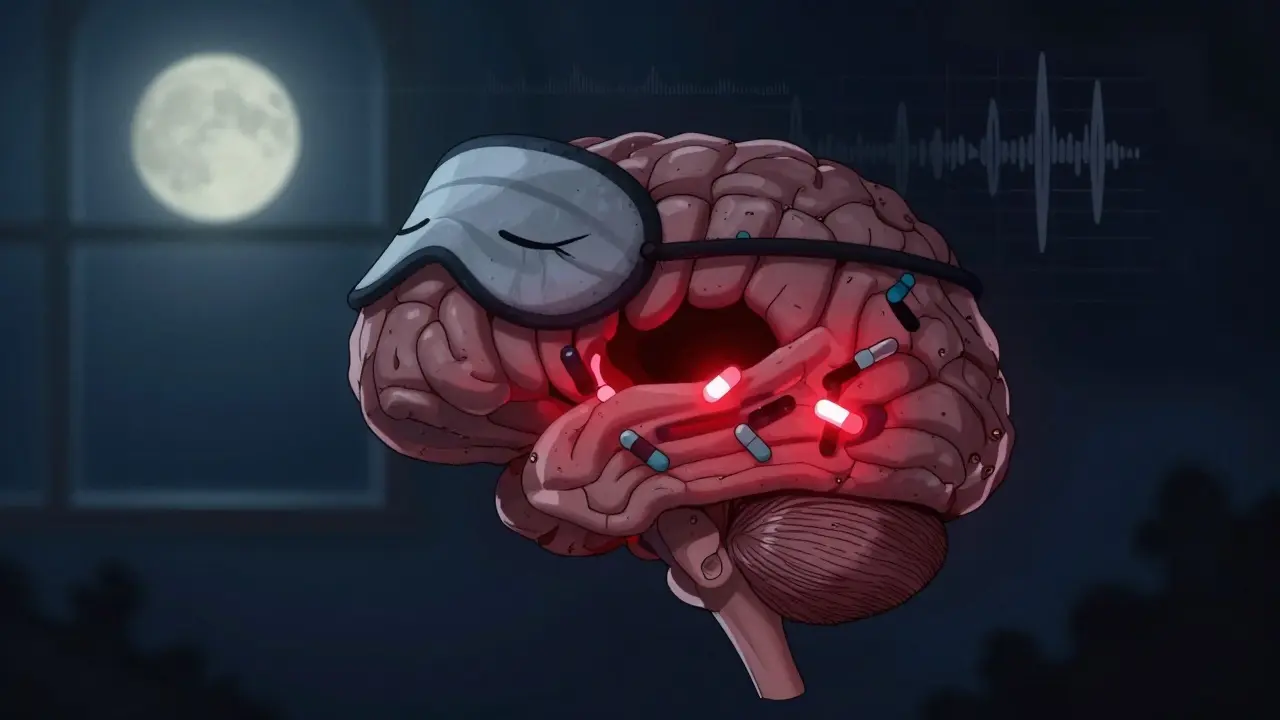
When you take opioids for pain, you might not think about your breathing-especially while asleep. But for many people, opioids quietly shut down the body’s natural drive to breathe during sleep, turning a restful night into a life-threatening event. This isn’t rare. About 30-40% of people on long-term opioid therapy develop serious breathing problems at night, including pauses in breathing that last 10 seconds or longer. These aren’t just snoring episodes-they’re central sleep apnea, caused by opioids silencing the brain’s breathing command center.
How Opioids Kill Your Breathing at Night
Opioids don’t just dull pain. They also hit the brain’s breathing control hubs hard. Two key areas-the parabrachial complex and the pre-Bötzinger complex-are packed with receptors that opioids latch onto. When they bind, they slow down or even stop the signals that tell your lungs to inhale and exhale. The parabrachial complex, in particular, is the main culprit behind the most dangerous pauses: prolonged, deep breath-holds that can last 20-30 seconds or more.Here’s what happens in real time: your brain normally keeps your breathing steady, even while you sleep. But opioids increase the length of your exhale by up to 200%, making each breath feel heavier and longer. Then, instead of switching back to inhale, your brain just… stops. No signal. No breath. This isn’t a blocked airway like in obstructive sleep apnea. This is your brain forgetting to breathe.
And it gets worse. Opioids also weaken the muscles that hold your airway open. In animal studies, the genioglossus muscle-the main tongue muscle that keeps your throat from collapsing-loses 40-60% of its activity under opioid influence. So even if your brain tries to breathe, your airway may be too floppy to let air through. You’re caught between two failures: your brain doesn’t send the signal, and your throat won’t open even if it does.
Why Sleep Makes It Worse
Sleep isn’t just a passive state-it’s a vulnerable one for breathing. When you fall asleep, your body naturally reduces the drive to breathe. That’s normal. But opioids amplify that drop. At sleep onset, the brain’s alertness signals that help keep breathing going vanish. Without them, opioids push you into full respiratory arrest more easily.Studies show opioids also wreck your sleep architecture. They cut deep, restorative slow-wave sleep by 20-30% and flood your night with light, unstable stage 1 sleep. This means you’re not just breathing poorly-you’re not sleeping well either. The result? Morning headaches, crushing fatigue, and a brain too foggy to notice you’re gasping for air at night.
One study found patients on high-dose opioids (100+ morphine milligram equivalents daily) had an average of 15.7 apnea events per hour. For comparison, people not on opioids averaged just 4.2. That’s nearly four times worse. And in some cases, the number jumped past 30 events per hour-classic severe sleep apnea.
The Silent Danger: No Snoring, No Warning
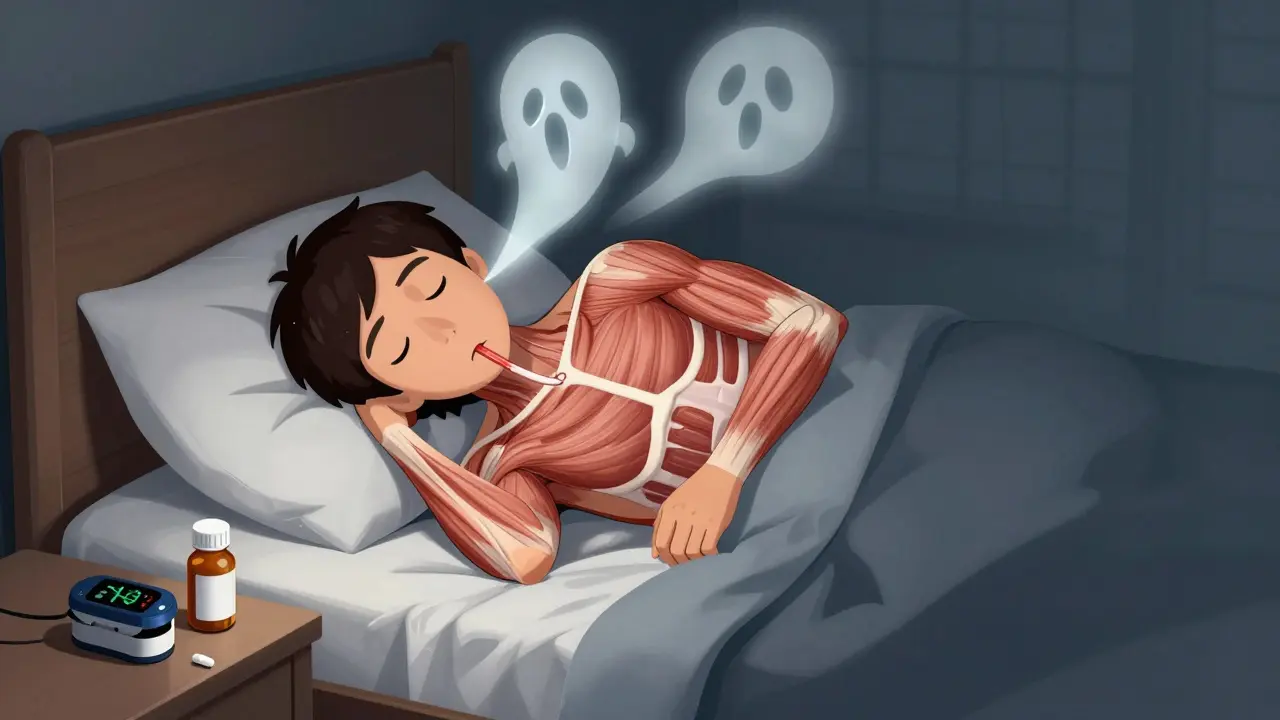
Unlike obstructive sleep apnea, where loud snoring and choking gasps are obvious, opioid-induced central apnea often flies under the radar. You might not snore. You might not wake up feeling suffocated. You just feel tired all day. Your partner doesn’t hear you stop breathing-they just think you’re a deep sleeper. But your blood oxygen drops. Your heart races. Your brain wakes you up-not fully, but just enough to gasp and restart breathing. Over and over. All night.Pulse oximeters, the devices that measure oxygen levels, often miss early signs. Your body compensates at first-breathing harder, faster, deeper-so oxygen stays normal until it’s too late. By the time your SpO2 drops, you’re already in respiratory distress. That’s why many opioid-related deaths happen quietly, in bed, without witnesses.
Who’s at Highest Risk?
Not everyone on opioids gets severe breathing problems. But certain factors make it far more likely:- Using high doses-100+ morphine milligram equivalents daily
- Taking opioids with benzodiazepines (like Xanax or Valium)-this combo increases overdose risk by 300-500%
- Already having sleep apnea, even mild
- Being older than 65
- Having lung disease, heart failure, or obesity
- Having genetic variations in the OPRM1 gene, which affects how opioids bind to brain receptors
Some people have naturally low sensitivity to rising CO2 levels-the body’s main trigger to breathe. For them, opioids can be deadly even at low doses. Researchers estimate 10-15% of the population falls into this high-risk group, and most don’t know it until it’s too late.
What Doctors Should Be Doing
The American Society of Anesthesiologists and the FDA both recommend screening for sleep apnea before starting long-term opioid therapy. But in practice, only 15-20% of primary care doctors do it. Most rely on patient self-reports-“Do you snore?”-which misses central apnea entirely.Here’s what should happen:
- All patients on chronic opioids should get a sleep study, especially if they report daytime fatigue, morning headaches, or unrefreshing sleep
- Continuous capnography (measuring CO2 levels) should be used in high-risk cases, not just pulse oximetry
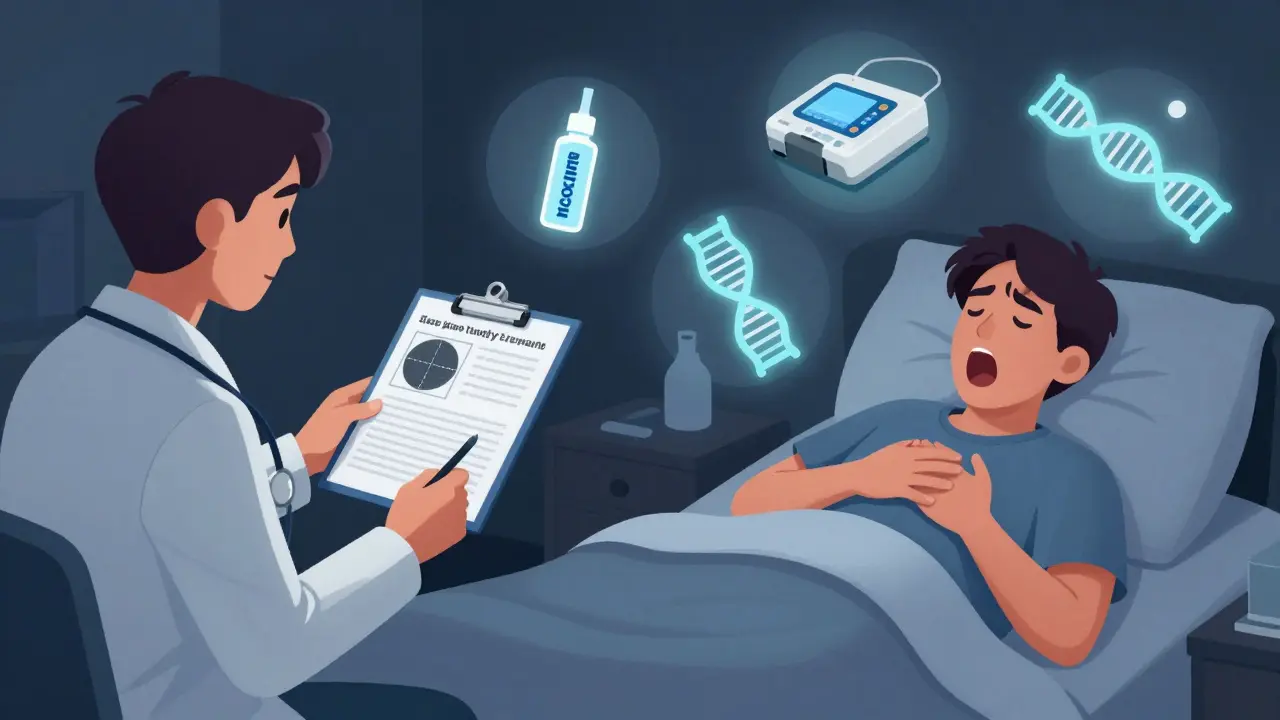
- Naloxone should be prescribed alongside opioids for home use-especially if the patient lives alone or takes other sedatives
- Patients should be warned: if you wake up gasping, feeling like you can’t breathe, or have chest tightness at night, call your doctor immediately
Even then, naloxone isn’t a perfect fix. It reverses respiratory depression-but too much can trigger violent withdrawal. Too little won’t work. Dosing must be precise: 0.04 to 0.4 mg IV, repeated every 2-3 minutes if needed. Most people don’t know how to use it correctly. That’s why education is just as important as the drug itself.
What’s Coming Next
Scientists are working on smarter opioids. New experimental drugs called MOR-biased agonists are designed to activate pain-relief pathways while avoiding the ones that shut down breathing. In early tests, they deliver 70-80% of the pain relief of traditional opioids with only 20-30% of the respiratory depression.Other promising targets include drugs that stimulate serotonin receptors (5-HT4a agonists) or ampakines, which boost breathing signals in the brainstem. In animal models, these increased breathing by 40-60% without reducing pain relief.
Looking ahead, genetic testing may become standard. If you have a specific variant in the OPRM1 gene, your doctor might avoid opioids entirely-or prescribe much lower doses. The NIH has poured $1.5 billion into this research since 2018. The goal: no more opioid deaths from breathing failure.
What You Can Do Right Now
If you’re on opioids and sleep poorly:- Ask your doctor for a sleep study-don’t wait for symptoms to get worse
- Never mix opioids with alcohol, benzodiazepines, or sleep aids
- Keep naloxone at home and teach someone how to use it
- Track your sleep: Do you wake up with headaches? Are you exhausted despite sleeping 8 hours? These are red flags
- Consider non-opioid pain options-physical therapy, nerve blocks, or non-addictive meds like gabapentin or duloxetine
Opioids save lives in acute pain. But for chronic pain, the risks often outweigh the benefits. And when sleep is involved, the danger isn’t just theoretical-it’s measurable, preventable, and deadly. The next time you or someone you care about fills an opioid prescription, ask: What’s this doing to my breathing at night? That question could save a life.
Can opioids cause sleep apnea even if I don’t snore?
Yes. Opioids cause central sleep apnea, which is different from obstructive sleep apnea. You don’t need to snore. Central apnea happens when your brain stops sending signals to breathe, often without any noise or gasping. You might just wake up feeling like you couldn’t breathe, or feel exhausted all day despite sleeping through the night.
Is naloxone safe to use at home for opioid-related breathing problems?
Yes, if used correctly. Naloxone can reverse opioid-induced respiratory depression and is safe for home use. It won’t harm someone who hasn’t taken opioids. But it can cause sudden withdrawal in people dependent on opioids-symptoms like nausea, sweating, and agitation. That’s why it’s critical to call emergency services even after giving naloxone. Always have it on hand if you’re on high-dose opioids or take them with other sedatives.
How do I know if my opioid dose is too high for my breathing?
A dose of 100 morphine milligram equivalents (MME) per day or higher significantly increases risk. But even lower doses can be dangerous if you’re older, have other health conditions, or take other sedatives. If you feel unusually tired during the day, wake up with headaches, or notice you’re breathing shallowly or stopping briefly during sleep, talk to your doctor. Don’t wait for a crisis.
Can I still use opioids if I have sleep apnea?
It’s possible, but risky. If you have diagnosed sleep apnea and need opioids, your doctor should first treat the apnea with CPAP therapy. Then, they should use the lowest effective opioid dose and monitor you closely. Many experts recommend avoiding opioids entirely in people with moderate to severe sleep apnea unless no other pain options exist.
Are there non-opioid alternatives for chronic pain?
Yes. Many people find relief with physical therapy, acupuncture, cognitive behavioral therapy (CBT), nerve blocks, or non-opioid medications like gabapentin, pregabalin, duloxetine, or NSAIDs (if safe for you). These don’t carry the same breathing risks. Talk to a pain specialist about alternatives-especially if you’re already struggling with sleep or fatigue.

Opioids don't just kill your breathing-they kill your autonomy. The brain’s breathing center isn’t some optional feature. It’s the core firmware. And we’re letting Big Pharma reprogram it with a painkiller. This isn’t medicine. It’s a silent coup.
Did you know the FDA knew about this since 2012? They even had a black box warning draft. But the opioid lobby buried it. Now they’re pushing ‘MOR-biased agonists’ like it’s a miracle cure. Same players. New name. Same dead people. Wake up. This is a manufactured crisis designed to keep you dependent. They don’t want you breathing better-they want you buying more pills.
So… let me get this straight. We’re told opioids are dangerous at night… but we’re also told to take them for chronic pain? And now we’re supposed to get a sleep study? Who’s paying for that? My insurance denied my last one because I ‘didn’t snore.’ Funny how central apnea doesn’t come with a soundtrack.
It is imperative to recognize that the pathophysiological mechanism underlying opioid-induced central sleep apnea involves a profound suppression of chemoreceptor sensitivity to hypercapnia and hypoxia. The pre-Bötzinger complex, as referenced, is a rhythmogenic kernel in the ventral respiratory column, and its inhibition via mu-opioid receptor agonism results in a loss of respiratory drive independent of airway patency. This distinction from obstructive etiologies is clinically paramount.
Furthermore, the use of pulse oximetry as a primary screening tool is inadequate, given its delayed response to evolving hypoventilation. Capnography, by contrast, detects rising CO₂ levels in real time-often before desaturation occurs. The absence of routine capnographic monitoring in outpatient settings represents a critical gap in patient safety protocol.
It is also worth noting that genetic polymorphisms in the OPRM1 gene, particularly the A118G variant, significantly alter receptor binding affinity and may predispose individuals to respiratory depression at lower opioid doses. Preemptive genotyping, while not yet standard, holds considerable promise for personalized risk stratification.
Until systemic screening is mandated, the burden of detection falls disproportionately on patients who are often too fatigued to recognize their own symptoms. This is not merely a medical oversight-it is an ethical failure.
I’ve been on 60 MME for years. Never snored. Always woke up exhausted. Thought it was just aging. Then I got a sleep study on a whim. 22 apneas/hour. Zero snoring. Just… silence. My doctor said ‘it’s common.’ That’s not reassuring. It’s terrifying.
There’s something deeply human about how we ignore the quiet deaths. We notice the car crash, the overdose in the alley-but not the guy who just stopped breathing in his bed, because he didn’t scream, didn’t flail, didn’t leave a note. He just… didn’t wake up. We treat opioids like a tool, not a conversation with death. But every pill you take at night is a whispered negotiation with your own brainstem.
Maybe the real question isn’t ‘how do we fix this?’ but ‘why did we ever think this was acceptable?’
So let me get this straight-you want me to stop my pain meds because I might… forget to breathe? Cool. So what’s the alternative? Pain so bad I can’t hold my kid? Thanks for the life advice, Doc. I’ll just keep my meds and my nightmares. At least the nightmares I can control.
As a registered nurse who has witnessed three opioid-related respiratory arrests in the ICU, I can attest: this is not theoretical. The silence before the crash is the most chilling sound in medicine. We rush. We give naloxone. We stabilize. But we rarely prevent it. Screening is not optional. It is non-negotiable. If your provider refuses a sleep study, find another. Your life depends on it.
I’m from India, and here, opioids are still seen as last-resort stuff. But I’ve seen older folks on them for back pain-no monitoring, no sleep studies. Just pills and prayers. The fact that this is even a debate in the US? Wild. We need global awareness. This isn’t just an American problem. It’s a human problem.
Also, if you’re on opioids and feel tired all day? Don’t blame stress. Don’t blame coffee. Ask for a sleep study. It’s easier than you think. And it might save you.
my dr told me to get a cpap but i dont snore so why would i need it?? i just feel tired all the time but i guess thats normal right??
Central apnea isn't rare. It's inevitable with chronic opioid use. The science is settled. The denial is corporate. The deaths are predictable. Stop pretending this is about pain management. It's about profit margins disguised as care.
Wow. Groundbreaking. Opioids suppress respiration. Who knew? Next you’ll tell me water is wet.