

When you're pregnant and stuck in a cycle of nausea that won't quit, the question isn't just "What can I take?" It's "What's actually safe?" Around 67% of pregnant people experience nausea and vomiting-some mild, others so severe they can't keep food or water down. That’s not just discomfort; it’s a medical issue that can lead to dehydration, weight loss, and hospitalization. The good news? There are proven, safe options. The bad news? Not all medications are created equal. Some carry hidden risks you might not hear about until it's too late.
First-Line Treatments: What Works Without the Risk
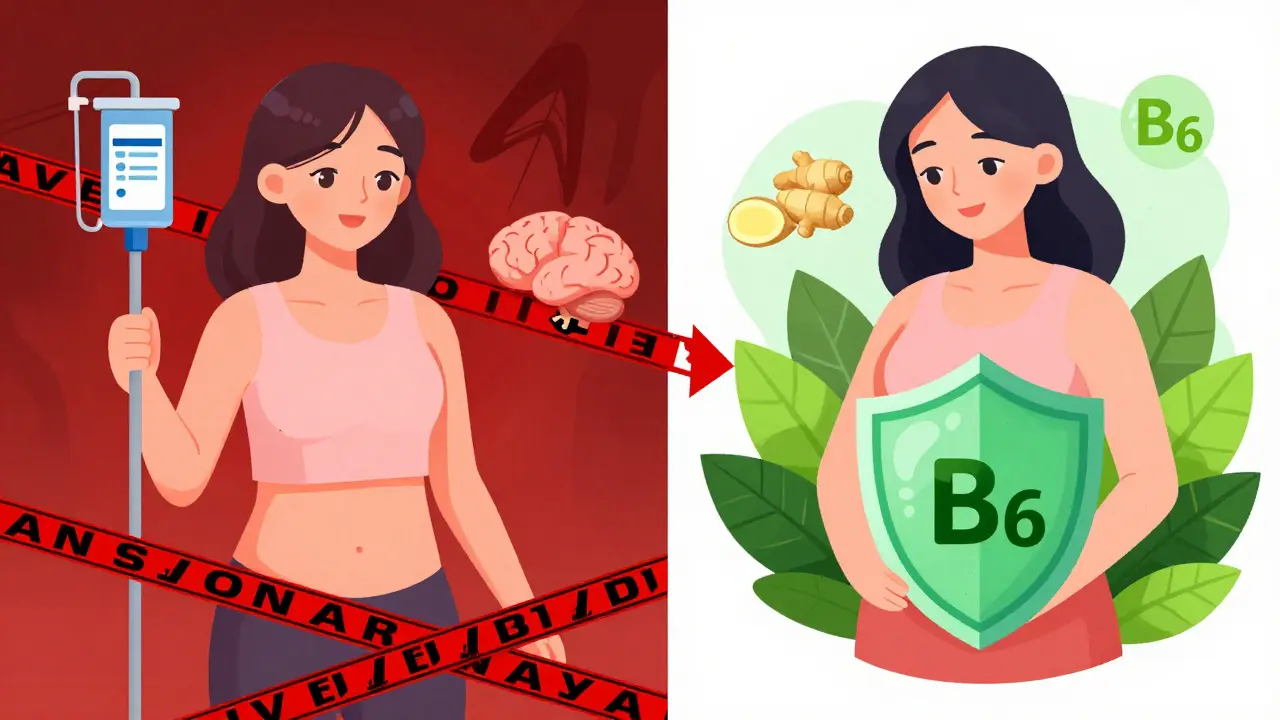
The safest place to start isn't with a prescription-it's with ginger. The American College of Obstetricians and Gynecologists (ACOG) recommends 250 mg of ginger, taken four times a day. That’s about four capsules or a teaspoon of powdered ginger in tea. A 2023 meta-analysis in Frontiers in Public Health found ginger was as effective as prescription drugs for nausea, with fewer side effects. One study of 77 pregnant women showed ginger worked better for nausea, while vitamin B6 (pyridoxine) was stronger for stopping vomiting. Neither caused harm to the baby.
Pyridoxine (vitamin B6) is another first-line option. You take 25 mg three times a day-totaling 75 mg daily. It’s inexpensive, widely available, and has been used for decades. Studies show it’s significantly better than placebo. When combined with doxylamine (the sleep aid in Unisom), it becomes the FDA-approved medication Diclegis. Diclegis was pulled from the market in the 1980s due to lawsuits, not safety issues, and was re-approved in 2013 after rigorous testing. It’s now the only medication specifically designed and approved for nausea in pregnancy.
Both pyridoxine and doxylamine have no evidence of causing birth defects. In fact, a 2012 NIH study analyzing over 4,500 pregnancies found no increased risk of cerebral palsy, neural tube defects, or heart problems with either drug. Many women report drowsiness from doxylamine-so it’s best taken at night. That’s not a flaw; it’s a feature. You sleep better, and the nausea fades by morning.
Second-Line Options: When Ginger and B6 Aren’t Enough
If you’re still struggling after a week of ginger and B6, your provider may suggest antihistamines. These include meclizine (Antivert), dimenhydrinate (Dramamine), and diphenhydramine (Benadryl). They’re dosed at 25-50 mg every 4-6 hours as needed. Studies from the American Academy of Family Physicians show they’re more effective than placebo and carry no clear risk of birth defects. Meclizine was once thought to be dangerous, but newer data disproved that. Many women find these helpful for motion sickness too, which often overlaps with pregnancy nausea.
Antacids like Tums (calcium carbonate) are another underrated tool. If your nausea is tied to heartburn or acid reflux, they can help. A 2012 study found calcium carbonate was linked to a reduced risk of cleft lip or palate (adjusted odds ratio of 0.58). That’s not just symptom relief-it might be protective. Proton pump inhibitors (PPIs) like omeprazole are sometimes used if antacids fail. But here’s the catch: the same study found PPIs were linked to a 4.36-fold increase in hypospadias (a birth defect in male infants). That’s rare, but real. So PPIs should be a last resort, not a go-to.
The Risky Ones: What to Avoid Unless Absolutely Necessary
Ondansetron (Zofran) is the most commonly prescribed medication for severe nausea in pregnancy-and the most controversial. It works. For many, it’s the only thing that stops vomiting. But a 2012 NIH study found a 2.37-fold increased risk of cerebral palsy in babies exposed to ondansetron during the first trimester. That’s not a small risk. It’s a red flag. The study didn’t prove causation, but it did show a strong, consistent association. Other studies have flagged possible heart defects, though those findings are still debated.
On Drugs.com, 32% of users reported severe side effects: headaches (42%), dizziness (37%), and constipation (29%). One woman wrote: "I took it for three days. My baby’s heartbeat dropped during the ultrasound. I never took it again." That’s anecdotal, but it’s not rare. Many OB-GYNs now reserve ondansetron for cases of hyperemesis gravidarum-when a woman is losing weight, dehydrated, and can’t keep anything down.
Corticosteroids like prednisone are sometimes used for stubborn cases. But they come with a 3.4-fold increased risk of oral clefts when taken in the first trimester. That’s not worth it unless you’re in the hospital and nothing else works. Even then, experts recommend trying everything else first.

What Doesn’t Work (And Why)
Acupressure bands (like Sea-Bands) are marketed heavily. You’ve seen them-those wristbands that press on a pressure point. A 2023 meta-analysis found they had the same effect as placebo. The relative risk was 1.25, with no statistical significance. That means if 100 women tried them, 50 would feel better, 50 wouldn’t. Same as if they did nothing. Same as if they took sugar pills. It’s not harmful, but don’t rely on it.
Similarly, vitamin B1 (thiamine) and CBD are sometimes suggested. But there’s no solid evidence for either. CBD is not approved in pregnancy, and thiamine hasn’t been proven to reduce nausea. Stick to what’s been studied: ginger, B6, doxylamine, and antihistamines.
How to Use These Medications Right
Timing matters more than you think. Taking medication after you’re already nauseous? That’s too late. The goal is to take it before symptoms peak. For Diclegis, that means taking the doxylamine at night so it works overnight and into the morning. For B6, take it with meals, not on an empty stomach. For antihistamines, take them every 4-6 hours-don’t wait until you’re throwing up.
Also, don’t ignore your prenatal vitamins. Many contain iron, which can make nausea worse. If you’re struggling, ask your provider about switching to an iron-free version for the first trimester. Iron can be added back later, when your body is more tolerant.
What the Experts Say
ACOG’s official stance is clear: "The benefits of safe and effective NVP treatment predominantly outweigh any potential or theoretical risks to the fetus." That’s why they recommend starting early. Waiting until you’re dehydrated or losing weight makes everything harder.
Dr. William Hartmann, lead author of the landmark NIH study, said the risks linked to ondansetron, PPIs, and steroids "could be chance findings," but they warrant caution. He’s not saying they’re dangerous-just that we need more data. Meanwhile, 71% of obstetricians in the U.S. follow ACOG’s stepped-care model. And 92% recommend ginger as a first step.
The market tells a story too. In 2022, the prescription market for pregnancy nausea was $285 million. But the supplement market-mostly ginger-was $142 million. And 73% of that was ginger. Sixty-four percent of OB-GYNs recommend it. That’s not a fad. That’s evidence.
Real Stories, Real Outcomes
On Reddit’s r/pregnancy forum, 78% of 1,245 women said ginger capsules gave them "moderate to complete" relief. One wrote: "I tried everything. Diclegis made me too sleepy. Ginger? I felt human again by day two."
On Drugs.com, 84% of Diclegis users said it worked-but 67% said they needed a nap by 10 a.m. That’s the trade-off. For some, it’s worth it. For others, ginger is enough.
One woman shared: "I had hyperemesis. I was in the ER twice. Ondansetron stopped the vomiting, but I had migraines for weeks. My baby’s head ultrasound was normal. But I’ll never take it again." That’s the kind of story that changes practice.
What’s Coming Next
The FDA is drafting new guidance for testing antiemetics in pregnancy, with stricter safety monitoring. ACOG is updating its guidelines in mid-2024, and it’s likely ondansetron will be moved to third-line status-only for the most extreme cases. Research is also looking into genetic factors that make some women more prone to severe nausea. That could lead to personalized treatment down the road.
For now, the path is clear: Start with ginger. Add B6. If you need more, try doxylamine. Then antihistamines. Save ondansetron and steroids for when you’re at your worst. And never start a new medication without talking to your provider-even if it’s "just" a supplement.
Is ginger safe during pregnancy for nausea?
Yes, ginger is considered safe and effective for nausea in pregnancy. The American College of Obstetricians and Gynecologists (ACOG) recommends 250 mg of ginger taken four times daily. Studies show it reduces nausea with no increased risk of birth defects. A 2023 meta-analysis found ginger to be as effective as prescription medications like pyridoxine, with fewer side effects like drowsiness.
Is Diclegis the best medication for morning sickness?
Diclegis (a combination of pyridoxine and doxylamine) is the only FDA-approved medication specifically for nausea and vomiting in pregnancy. It has a strong safety profile with no evidence of birth defects. In clinical studies, it’s effective for 84% of users. However, 67% report drowsiness, so it’s best taken at night. For many, it’s the best option when non-drug treatments like ginger don’t work.
Can ondansetron (Zofran) cause birth defects?
A 2012 NIH study of over 4,500 pregnancies found a 2.37-fold increased risk of cerebral palsy in babies exposed to ondansetron during the first trimester. Other studies have raised concerns about heart defects. While causation hasn’t been proven, the association is strong enough that most experts now reserve ondansetron for severe cases of hyperemesis gravidarum, after safer options have failed.
Are antacids safe during pregnancy?
Antacids containing calcium carbonate, like Tums, are not only safe-they may reduce the risk of cleft lip or palate. A 2012 study found a 42% lower risk (aOR=0.58) in women who used them. They’re a good first step if nausea is tied to heartburn. Avoid antacids with aluminum or magnesium unless recommended by your provider.
Should I stop taking prenatal vitamins if they make me nauseous?
Not necessarily, but you can switch. Many prenatal vitamins contain iron, which can worsen nausea. Ask your provider about switching to an iron-free prenatal during the first trimester. You can add iron back later, once your nausea improves. This simple change helps many women tolerate their vitamins again.

ginger is fine I guess but honestly if you're that sick you should just suck it up and eat crackers
everyone's so dramatic these days like it's a medical emergency to feel queasy for a few weeks
Let me break this down for you like you're a confused toddler with a pregnancy test
ginger works because it's literally just a root you grind up and throw in tea not magic
diclegis is just b6 + doxylamine which you can buy separately for 10 bucks and not get billed $400
zofran? yeah it works but so does a shotgun to the face and I'm sure you'd try that too if you were desperate
the real story here is pharma making billions off fear and confusion while real solutions sit on amazon for $8
also side note: if you're vomiting so hard you need a hospital you probably shouldn't be scrolling reddit at 3am
Just wanted to say thank you for this. I was terrified when I got morning sickness last year. Tried ginger and it helped a little but I felt guilty taking anything. Then my OB said Diclegis is safe and I cried because I finally felt like I could breathe again.
It made me sleepy but honestly? I slept better than I had in months. My baby is now 11 months old and healthy as a horse.
You're not weak for needing help. You're smart for asking and doing the research. Keep going.
Zofran saved my life 😭 I had hyperemesis and was in the hospital 3x. My kid is 2 now and has 20/10 vision and plays soccer. Don't listen to fearmongers. 🇺🇸💪 #TrustScience
Oh how quaint. A 2012 study? How delightfully archaic. We're in 2024 and you're still clinging to data that predates the invention of TikTok.
And ginger? Please. That's what your great-aunt used when she had morning sickness while smoking three packs a day and drinking moonshine.
The real question isn't what's safe-it's what's *elegant*. Ondansetron is a *pharmaceutical symphony*. You're not just treating nausea-you're composing a cure.
Meanwhile, the rest of you are out here with your herbal teas and wristbands like you're at a yoga retreat in Sedona.
It’s fascinating how we’ve reduced the profound, terrifying, beautiful chaos of pregnancy into a checklist of pharmaceutical tiers.
Start with ginger. Add B6. Then doxylamine. Then antihistamines. Then Zofran. Then steroids.
As if nausea is a staircase you climb with a clipboard and a pharmacy receipt.
But what about the silence between the doses? The fear? The loneliness? The way your body becomes a foreign country you no longer recognize?
We treat symptoms like they’re problems to be solved. But maybe they’re messages.
Or maybe I’m just overthinking it. Again.
Who funded that 2012 NIH study? Who owns the patents on Diclegis? Who profits from your fear?
Big Pharma doesn't want you taking ginger. Ginger doesn't have a trademark. Ginger doesn't pay lobbyists.
And what about the 32% of Zofran users with severe side effects? Why aren't they on the news?
They're not. Because the system is designed to keep you buying.
I'm not saying don't take meds. I'm saying question everything. Even this post.
Appreciate the breakdown. I went with ginger + B6 and it worked fine. No drama. No meds. No guilt.
Just me, a bowl of crackers, and a lot of naps.
Everyone's body is different. Do what works for you. No need to compare.
Iron-free prenatal made all the difference. Took me three months to figure that out. If you're nauseous, ask for one. Simple.
Also-yes to ginger. Yes to Diclegis. No to shame.