

Switching from one generic levothyroxine to another might seem like a simple pharmacy swap - same drug, same dose, same pill color. But for millions of people taking thyroid hormone replacement, it’s not that simple. Even though the FDA says these generics are interchangeable, some patients experience real changes in how they feel - fatigue, heart palpitations, weight shifts - after a switch. And their TSH levels often tell the story. So, when should you check your TSH after switching levothyroxine brands? The answer isn’t one-size-fits-all.
Why Levothyroxine Is Different
Levothyroxine isn’t like taking an ibuprofen or a statin. It’s a narrow therapeutic index (NTI) drug, meaning tiny changes in blood levels can have big effects. Your thyroid-stimulating hormone (TSH) is the most reliable way to measure if your dose is right. The goal? Keep TSH between 0.4 and 4.0 mIU/L for most adults. For older people, the upper limit might stretch to 6.0 mIU/L. Go outside that range - even slightly - and you risk symptoms like brain fog, weight gain, or heart rhythm issues.
The active ingredient in every levothyroxine pill is the same: C15H11I4NNaO4, molecular weight 798.86 g/mol. But the fillers, dyes, and binders? Those vary by manufacturer. Mylan, Teva, Pfizer, and Sandoz each make their own version. One brand might use cornstarch; another uses lactose. For most people, this doesn’t matter. But for a small group - maybe 8-12% - those differences trigger a reaction.
The FDA’s Stance: Switching Is Fine
The FDA says approved generics are bioequivalent. That means, in clinical trials, the amount of hormone absorbed into your blood (AUC and Cmax) must fall within 80-125% of the brand-name version. In 2022, a massive study of over 15,000 patients found no meaningful difference in TSH levels between those who switched generics and those who didn’t. The average TSH was 2.7 mIU/L in both groups. The FDA updated its labeling in January 2024 to say: “For most patients, switching between different levothyroxine products does not require additional TSH monitoring beyond routine follow-up.”
This isn’t just theory. Kaiser Permanente, which manages care for over 12 million people, stopped routine TSH checks after switches in 2023. Their data showed no spike in abnormal TSH levels among switchers. Pharmacy benefit managers like Express Scripts pushed for generic substitution to cut costs - and it worked. In 2023, 89% of levothyroxine prescriptions were filled with generics, saving an estimated $2.1 billion a year in the U.S.
But Why Do Some People Still Struggle?
Real-world stories contradict the data. On Reddit’s r/Hashimotos, patients share stories like: “Switched from Mylan to Teva - my TSH jumped from 1.8 to 7.2 in 8 weeks. Had to up my dose by 12.5 mcg.” Another wrote: “Three different generics in two years. Zero changes. My doctor says I’m in the 70% who don’t react.”
The UK’s Medicines and Healthcare products Regulatory Agency (MHRA) tracked 1,247 reports of side effects after switching between 2015 and 2021. Fatigue showed up in 327 cases. Palpitations in 289. Weight changes in 215. Paloma Health’s survey of 1,500 users found 18.7% noticed symptoms after a switch - and 6.2% needed a dose change.
Why the disconnect? The science suggests a small subset of people are sensitive. Factors include:
- Very low thyroid reserve - your body can’t compensate if the hormone level dips even a little (affects about 3.2% of patients).
- Excipient intolerance - lactose, dyes, or fillers causing gut absorption issues (seen in 1.7% of switchers).
- Genetic differences - variants in the DIO2 gene affect how your body converts T4 to active T3 (present in 0.8% of people).
- Thyroid receptor sensitivity - your cells respond differently to the same hormone level (2.1% of the population).
These aren’t theoretical. They’re measurable. And they explain why one person feels fine switching brands while another crashes into hypothyroid symptoms.

Who Needs a TSH Check After a Switch?
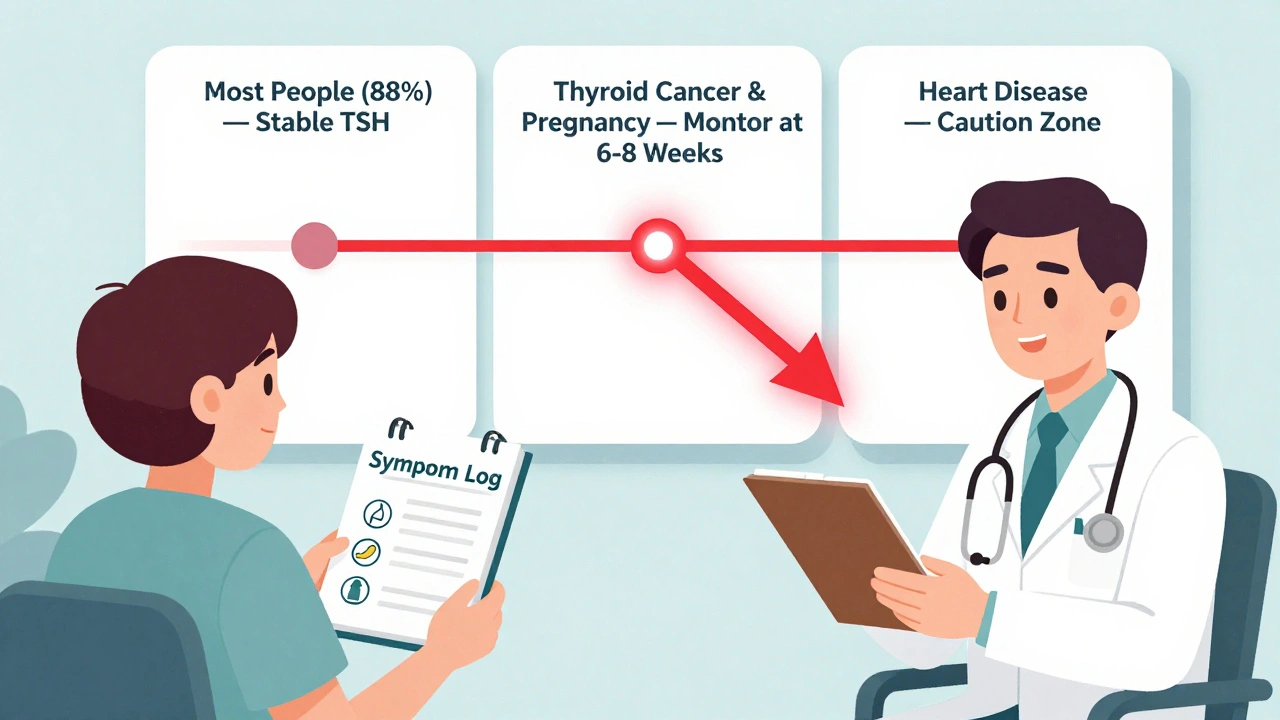
Not everyone. But you should get tested if you fall into one of these groups:
- Thyroid cancer survivors - TSH suppression is critical. Even a 0.5 mIU/L shift can matter. Guidelines recommend checking TSH 6-8 weeks after any change.
- Pregnant women - thyroid needs rise during pregnancy. A switch could throw off fetal development. Monitor every 4-6 weeks after any change.
- People with severe heart disease - too much thyroid hormone can trigger arrhythmias. If you’ve had a heart attack or have atrial fibrillation, play it safe.
- Those with prior TSH instability - if your levels bounced around before, you’re more likely to react again.
- Anyone who feels different after a switch - fatigue, brain fog, palpitations, unexplained weight gain or loss? Don’t wait. Get a TSH test.
For everyone else - healthy adults with stable TSH, no symptoms, no other health issues - routine monitoring isn’t needed. Your next scheduled check-up is enough.
What Doctors Are Doing Now
Guidelines are shifting. The American Thyroid Association (ATA) and American Association of Clinical Endocrinologists (AACE) used to say: “Always monitor TSH six weeks after switching.” That was in 2014. Now, the 2023 AACE position paper says: “Routine TSH monitoring after generic-to-generic switching is not necessary for most patients.” The ATA’s new guidelines, due in late 2024, are expected to reflect this change.
But practice varies. The Veterans Health Administration still requires TSH testing within 60 days of any product change. The NHS in the UK says: “If a patient reports symptoms after switching, test thyroid function.” And if symptoms persist? “Consider consistently prescribing the same product.”
The bottom line? Your doctor’s approach depends on their training, their patient population, and how much weight they give to real-world patient reports versus population-level data.
What You Can Do
If you take levothyroxine, here’s what works:
- Know your brand - When you pick up your prescription, check the pill imprint and manufacturer name. Write it down. Keep a note in your phone.
- Don’t panic if it changes - Most people won’t notice a thing. Your TSH will stay stable.
- Track how you feel - Keep a simple log: energy levels, sleep, weight, heart rhythm. If something shifts after a switch, note it.
- Ask for a TSH test if you’re concerned - You don’t need a doctor’s order in all states. Some labs let you order your own thyroid panel.
- Request a specific brand if needed - If you’ve had a bad reaction, ask your doctor to write “Dispense as written” or “Do not substitute.” Most insurers will approve it if there’s documented history.
There’s no shame in needing consistency. If you’re one of the 8-12% who reacts, your experience is valid - and your doctor should listen.
Bottom Line: One Size Doesn’t Fit All
Levothyroxine generics are safe and effective for the vast majority. The FDA, large health systems, and cost-saving programs are right to push for substitution. But medicine isn’t just about averages. It’s about the person sitting in the chair.
If you’ve switched and feel off - get your TSH checked. Don’t wait. Don’t assume it’s “all in your head.” The data says most people are fine. But the stories - the real, lived experiences - tell us that a small group needs more attention. And that’s okay.
For now, the best advice is simple: Know your dose. Know your brand. Know your body. And if something feels wrong - test it.
Do I need to get my TSH checked every time I switch generic levothyroxine brands?
No - not for most people. If you’re healthy, stable, and feel fine, your next routine check-up is enough. But if you have thyroid cancer, are pregnant, have heart disease, or notice symptoms like fatigue or palpitations after a switch, get a TSH test 6-8 weeks later. The data shows most people don’t need it - but if you’re one of the minority who reacts, testing is essential.
Can I ask my pharmacist to give me the same brand every time?
Yes. Ask your doctor to write “Dispense as written” or “Do not substitute” on your prescription. Most insurance plans will cover it if you’ve had a documented reaction to a switch. Keep a record of your brand name and any symptoms - this helps your doctor justify the request.
Are brand-name levothyroxine (like Synthroid) better than generics?
For most people, no. The FDA and large studies show no meaningful difference in TSH control. But brand-name Synthroid costs about 10 times more than generics. If you’re stable on a generic and feel fine, there’s no medical reason to pay extra. If you’ve had problems with generics, then yes - staying on one brand may be worth the cost.
What if I switch and my TSH is out of range - do I need a dose change?
Maybe. A TSH above 4.0 or below 0.4 doesn’t always mean you need a dose adjustment. Your doctor will look at your symptoms, your history, and whether this is a one-time blip or a trend. Sometimes, just switching back to your old brand fixes it. Other times, a small dose change - like 12.5 mcg - brings you back in range.
Is there a test to find out if I’m one of the people who reacts to generic switches?
Not yet in routine practice. Research has identified possible genetic markers (like DIO2 variants) and immune responses to excipients, but these tests aren’t widely available or covered by insurance. For now, the best predictor is your own experience. If you’ve reacted before, you’re likely to react again. Track your symptoms and stick with what works.

Okay but let’s be real - if your body screams at you after a switch, who cares what the FDA says? I had a friend go from Teva to Mylan and suddenly she couldn’t get out of bed. TSH jumped to 9.2. Her doctor dismissed it as ‘anxiety’ until she brought the lab results. Now she’s on Synthroid and finally sleeps through the night. Data doesn’t feel fatigue. Your body does.
Stop gaslighting patients. If you’re one of the 10% who reacts, you’re not broken - the system is just lazy.
So the FDA says ‘it’s all good’ and the pharmas say ‘save money’ and the doctors say ‘trust the data’… but my thyroid says ‘i hate this pill’ and my heart says ‘i’m gonna die’? Cool cool cool. Guess I’ll just keep my 2021 Teva bottle in a velvet box and pray the pharmacist doesn’t swap it again.
Also ‘bioequivalent’ sounds like a word they made up to make people stop asking questions. Like ‘gluten-free’ but for your hormones.
Also also: I misspell things on purpose. It’s a vibe.
Consistency matters in thyroid care. The science supports broad substitution. But individual variation is real. A patient’s lived experience is not anecdotal - it is clinical data in motion.
Doctors should listen. Pharmacies should honor ‘do not substitute.’ Insurance should cover stability over savings when health is at stake.
This isn’t about brand loyalty. It’s about physiological precision.
Bro I switched from Mylan to Sandoz last year and my brain turned to mush for 3 weeks. Felt like I was underwater. My doc laughed until I showed him my TSH - 6.8. He immediately switched me back. Now I keep a sticky note on my pill bottle with the manufacturer name.
Also - lactose intolerance? Yeah that’s a thing. One of my Indian cousins switched and got bloated like a balloon. Turns out her body just hates the filler. Not her thyroid. Just her gut.
TLDR: Your body isn’t a spreadsheet. Don’t let anyone tell you otherwise. 🙏
So I switched twice last year. Felt fine both times. No symptoms. TSH stayed at 2.1.
But I’ve got a cousin who cried for three days after switching. Said she felt like her soul was shrinking. TSH went to 8.5. She’s now on Synthroid and says she’s ‘alive again.’
So… yeah. I’m not saying everyone needs testing. But if you feel off? Don’t wait. Don’t doubt yourself. Test it. Even if it’s just to shut up the doctor.
Also I’m not mad. Just… concerned. 😅
Ugh. I’m so tired of people acting like their ‘thyroid sensitivity’ is some magical superpower. It’s not. The FDA tested 15,000 people. 89% of prescriptions are generic. The numbers don’t lie. You’re not special. You’re just lazy about tracking your own labs.
Get a TSH test every 6 months. Period. Stop blaming the pill. Take responsibility.
And stop crying about ‘excipients.’ You’re not allergic to cornstarch. You’re just scared of change.
Hey - I’ve been on levothyroxine for 12 years. Switched brands 7 times. Felt fine every time. But I’ve got a buddy who had a panic attack after switching. His TSH went nuts. He’s now on Synthroid and happier than I’ve ever seen him.
So yeah - most people are fine. But if you’re not? That’s not weakness. That’s biology.
Be kind to your body. And if someone tells you it’s ‘all in your head’? Tell them to go read the MHRA report. Then buy them coffee.
Peace out 🌱
I switched from Teva to Mylan last month. Felt a tiny bit more tired for a week. Then it went away.
I checked my TSH anyway - still perfect.
So I get why some people freak out. But for me? It’s just another pill. I don’t need drama.
Maybe we need better education - not fear. Like… ‘hey, here’s what to watch for’ instead of ‘DON’T SWITCH EVER.’
Just sayin’.
OMG I switched and my heart was doing backflips 😱 I thought I was having a heart attack. TSH was 7.4. My doctor was like ‘maybe it’s stress’ - I said ‘nope, it’s the pill’ and switched back. Now I’m fine. 🙌
Also I keep a photo of my pill on my phone. Don’t judge. It’s my thyroid security blanket 💊❤️
Levothyroxine is a narrow therapeutic index drug. That means bioequivalence in clinical trials does not guarantee clinical equivalence in all individuals. The FDA’s 80-125% range is statistically acceptable for population-level outcomes, but not for individual physiological stability.
Patients with thyroid cancer, pregnancy, cardiac conditions, or prior instability require monitoring. For others, it’s prudent to track symptoms and consider testing if changes occur.
Pharmacists should be trained to flag high-risk patients. Prescribers should honor ‘dispense as written.’ Insurance policies must reflect clinical nuance, not cost optimization alone.
This isn’t about brands. It’s about precision medicine.
My sister switched generics and developed severe hair loss. No one believed her until her TSH hit 11. She’d been stable for years. Now she’s on Synthroid and her hair is growing back. She’s not ‘sensitive’ - she’s one of the 8-12% who react to excipients.
There’s no genetic test yet. No easy answer. But we know this: consistency saves lives.
Doctors: Listen. Pharmacies: Honor the request. Patients: Document everything. And if you feel off? Test it. No apology needed.
This isn’t hype. It’s physiology. And it’s real.