

Have you ever noticed a strange red patch on your leg that won't go away? Or maybe your child came home from school with a crusty sore near their nose? These aren't just minor annoyances. They could be signs of bacterial skin infections, which are far more common than most people realize. In fact, millions of cases occur every year worldwide. The problem isn't just the infection itself-it's knowing how serious it is and what to do about it.
Two of the most frequent culprits are impetigo and cellulitis. While they both involve bacteria invading the skin, they behave very differently. Impetigo stays on the surface and spreads easily among kids. Cellulitis digs deeper into the tissue and can become dangerous quickly if ignored. Getting the diagnosis right matters because the treatments differ significantly. Using the wrong antibiotic might not work at all, thanks to rising drug resistance.
What Exactly Are Bacterial Skin Infections?
To understand these conditions, we first need to look at how bacteria get in. Your skin is your body's first line of defense. It keeps germs out. But when that barrier breaks-through a scrape, an insect bite, or even dry, cracked skin-bacteria have an open door. The two main types of bacteria responsible for these infections are Staphylococcus aureus (often called Staph) and Streptococcus pyogenes (Group A Strep).
These bacteria live on many people's skin without causing harm. But once they enter through a break, they multiply rapidly. The type of infection depends largely on how deep the bacteria penetrate. If they stay in the top layer of skin (the epidermis), you likely have impetigo. If they push down into the dermis and subcutaneous fat, you're dealing with cellulitis. This difference in depth explains why one looks like a scab and the other feels like hot, swollen flesh.
Spotting Impetigo: The Contagious School Sore
Impetigo is often nicknamed "school sores" because it spreads so easily in classrooms and daycare centers. It primarily affects children between ages 2 and 5, though adults can get it too. You'll usually see it on the face, especially around the nose and mouth. About 75% of cases appear there.
How does it look? It starts as small red spots or blisters. Within a day or two, those blisters burst. What's left is a raw area covered by a thick, golden-yellow crust. This honey-colored crust is the classic sign doctors look for. There are two main forms:
- Nonbullous impetigo: This is the most common type, making up about 70% of cases. It presents with those characteristic honey-colored crusts.
- Bullous impetigo: More common in infants under 2 years old. It causes larger, thin-walled blisters (2-5 cm wide) that rupture easily, leaving moist, denuded areas.
The key thing to remember is that impetigo is highly contagious. It spreads through direct skin-to-skin contact or by sharing towels, clothing, or toys. If your child has it, they should stay home from school until 24 hours after starting antibiotic treatment. Without treatment, the sores can last 2-3 weeks. With proper care, they usually heal within 7-10 days, sometimes leaving temporary light spots where the pigment was lost.

Identifying Cellulitis: The Deep Tissue Threat
If impetigo is a surface issue, Cellulitis is a deep tissue emergency waiting to happen. It involves the layers beneath the skin. Unlike impetigo, cellulitis is not contagious. You can't catch it from someone else. Instead, it happens when bacteria enter through a break in your own skin-like a cut, a bite, or even athlete's foot cracks between toes.
The symptoms are distinct and alarming. Look for a spreading area of redness that feels warm to the touch. The skin will be tender, swollen, and painful. One major clue is that the borders are poorly defined. It doesn't have a sharp edge like a rash; it fades gradually into normal skin. Most cases affect the legs, particularly in adults over 65.
Why is this dangerous? Because the infection can spread to your blood (bacteremia) or deeper tissues. Signs that you need immediate medical attention include:
- Fever above 38.3°C (101°F)
- Red streaks extending from the infected area
- Rapid expansion of the redness (more than 2 cm per day)
- Nausea, vomiting, or confusion
About 65% of cellulitis cases start from minor trauma like insect bites or abrasions. People with diabetes, obesity, or chronic venous insufficiency are at much higher risk. Diabetes alone increases the risk by 3.2 times. If you fall into these categories, watch your feet and legs closely.
| Feature | Impetigo | Cellulitis |
|---|---|---|
| Depth | Superficial (Epidermis) | Deep (Dermis & Subcutaneous) |
| Contagious? | Yes, highly | No |
| Main Cause | Staphylococcus aureus (80-90%) | Streptococcus pyogenes (60-80%) |
| Typical Location | Face (nose/mouth) | Legs/Lower Extremities |
| Primary Treatment | Topical antibiotics (Mupirocin) | Oral or IV Antibiotics |
| Healing Time | 7-10 days | 5-14 days (may require hospitalization) |
Antibiotics: Why Choice Matters Now More Than Ever
This is where things get tricky. Decades ago, penicillin worked for almost everything. Today, that's no longer true. Nearly all modern strains of Staphylococcus aureus produce an enzyme called penicillinase. This enzyme destroys penicillin before it can kill the bacteria. As a result, traditional penicillin fails in about 68% of impetigo cases.
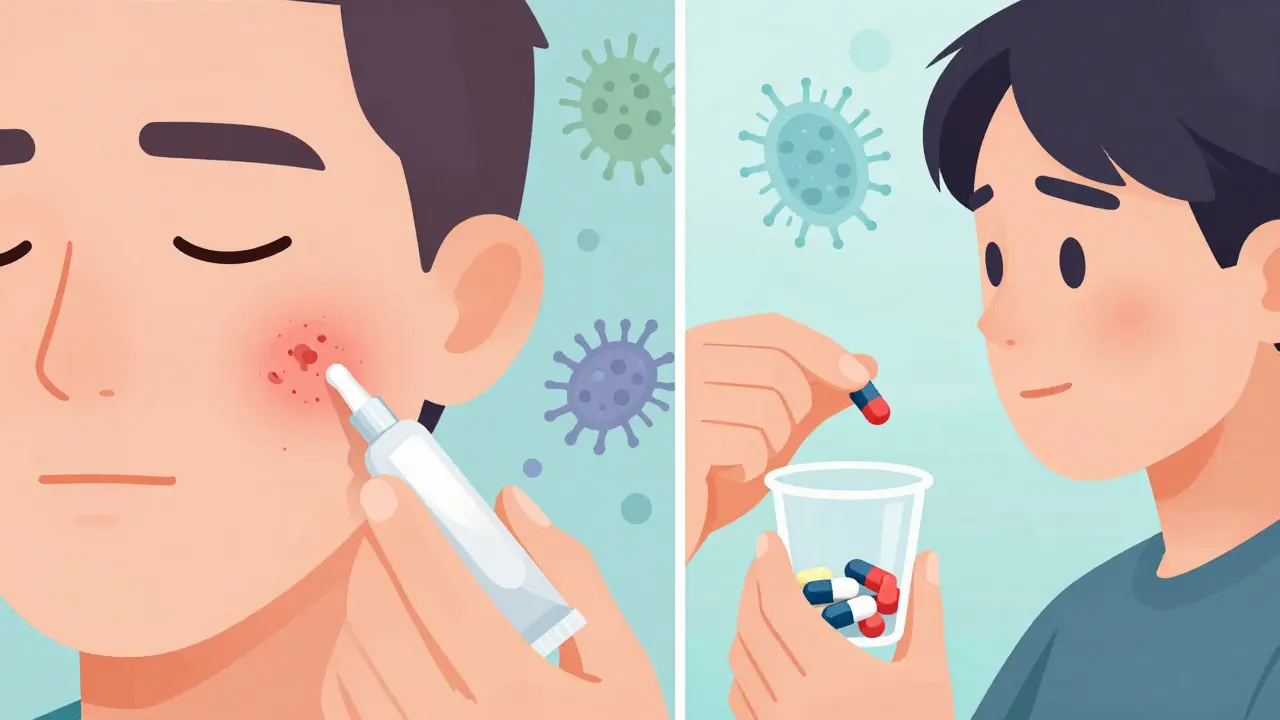
For localized impetigo, doctors often prescribe topical mupirocin (brand name Bactroban). You apply it three times a day for five days. Studies show it cures about 92% of localized cases. It's effective because it stays concentrated right where the infection is.
But if the infection is widespread, or if it's cellulitis, you need systemic antibiotics-pills or injections. For mild cellulitis caused by Strep, oral cephalexin or dicloxacillin works well. However, we must consider Methicillin-resistant Staphylococcus aureus (MRSA). In the US, about 50% of community-acquired Staph skin infections now involve MRSA. Standard antibiotics won't touch it.
If MRSA is suspected, guidelines recommend different drugs like doxycycline or trimethoprim-sulfamethoxazole. These have cure rates of 85-90% over 7-10 days. Never self-medicate. Taking the wrong antibiotic doesn't just fail to help-it contributes to global antibiotic resistance, making future infections harder to treat.
Prevention and Daily Care Tips
You can't control everything, but you can reduce your risk. Hygiene is your best friend here. Wash your hands frequently, especially after touching any skin sores. During outbreaks in schools or childcare centers, daily washing with antibacterial soap helps stop the spread.
Don't share personal items. Towels, razors, and clothing should be kept separate. If you have athlete's foot, treat it aggressively. Those tiny cracks between your toes are perfect entry points for cellulitis-causing bacteria. Keep cuts clean and covered. Use antiseptic solutions on minor wounds immediately after they happen.
If you have diabetes or poor circulation, check your feet every single day. Look for redness, swelling, or warmth. Early detection saves limbs and lives. If you notice a sore that isn't healing, or redness that's spreading, don't wait. See a doctor within 24 hours.
When to Seek Emergency Help
Most bacterial skin infections are manageable with prompt care. But some situations require immediate action. Call emergency services if you or your child experiences:
- Skin that looks scalded or is peeling off in sheets (signs of Staphylococcal Scalded Skin Syndrome)
- High fever accompanied by severe pain and redness
- Rapidly worsening condition despite taking prescribed antibiotics
- Signs of sepsis: rapid heartbeat, shallow breathing, extreme lethargy
Staphylococcal Scalded Skin Syndrome (SSSS) is rare but serious, mostly affecting young children. It has a mortality rate of 2-5% in vulnerable groups if not treated urgently. Don't gamble with these symptoms.
Is impetigo painful?
Not usually. Impetigo is more itchy than painful. The discomfort comes from the itching and the crusting, but it rarely causes deep pain unless it becomes complicated by another infection.
Can cellulitis spread to other parts of the body?
Yes. If untreated, cellulitis can spread to the bloodstream (bacteremia) or lymph nodes, leading to life-threatening conditions like sepsis. This is why early antibiotic treatment is critical.
How long does it take for impetigo to become non-contagious?
Patients typically become non-contagious within 24 hours of starting appropriate antibiotic therapy. This applies to both topical and oral antibiotics.
Why doesn't penicillin work for most skin infections anymore?
Most Staphylococcus aureus bacteria now produce penicillinase, an enzyme that breaks down penicillin. This makes traditional penicillin ineffective in roughly 68-85% of cases, necessitating stronger or alternative antibiotics.
Can adults get impetigo?
Yes, although it is less common. Adults are more likely to get it if they have compromised immune systems, live in crowded conditions, or participate in contact sports. Children aged 2-5 are the primary demographic.