
Side Effect Detection Probability Estimator
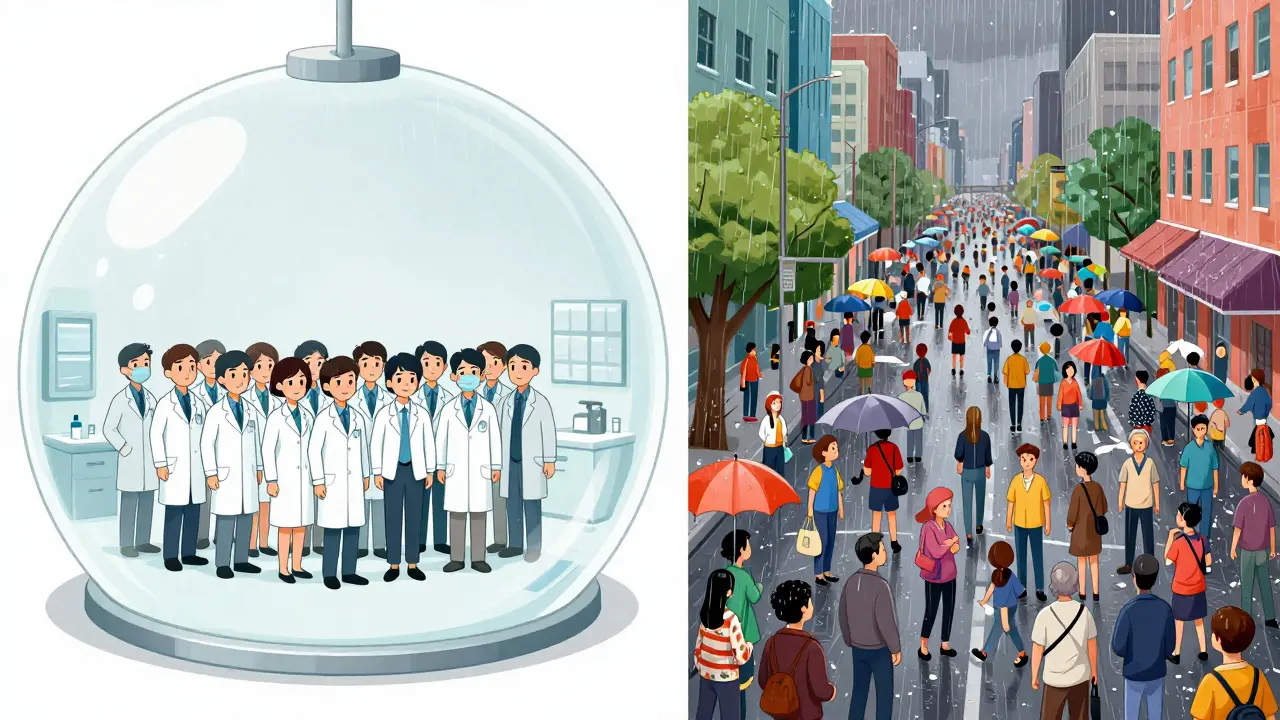
Clinical trials are like simulators, while real-world data is like rush hour. Use this tool to see why rare side effects (e.g., 1 in 1,000 people) often go undetected until a drug hits the general market.
Probability of Detection: 0%
Quick Comparison:
Ever wonder why a medication seems fine in the brochure but feels different once you actually start taking it? Or why some side effects only seem to pop up years after a drug hits the market? It isn't usually a conspiracy; it's a fundamental difference in how we collect data. There is a massive gap between the sterile, controlled environment of a medical study and the messy reality of daily life. Understanding clinical trial data versus real-world side effects is the key to knowing what to actually expect from your treatment.
To put it simply: clinical trials are designed to see if a drug can work under perfect conditions. Real-world evidence (RWE) tells us what actually happens when millions of people with different diets, ages, and other health issues start using that same drug. If a trial is like a driving simulator, real-world data is like driving in rush hour during a rainstorm.
The Controlled World of Clinical Trials
Before a drug gets the green light from the FDA, it goes through a rigorous series of tests. These are designed to eliminate as many variables as possible. This is great for proving a drug works, but it creates a "bubble" that doesn't always reflect reality.
In these trials, researchers use a system called the Common Terminology Criteria for Adverse Events (CTCAE). This is basically a giant dictionary of 790 specific terms that grade a side effect from 1 (mild) to 5 (death). Everything is tracked on a strict schedule-you might visit the clinic weekly for a month, then monthly. Because the monitoring is so intense, these trials are amazing at catching common, serious reactions quickly.
But there's a catch: the sample size is often tiny. In oncology, for example, a typical phase 3 trial might only enroll around 381 patients. If a side effect only happens to 1 in 1,000 people, there is a very high chance the trial will miss it entirely. This is why some drugs are approved and only later found to have rare but dangerous risks.
How Real-World Side Effects Emerge
Once a drug leaves the lab, it enters the wild. Real-World Evidence is gathered from routine clinical practice. This comes from Electronic Health Records (EHR), insurance claims, and spontaneous reports from doctors and patients.
The scale here is astronomical. While a trial has a few hundred people, systems like IBM MarketScan cover 200 million lives. This massive reach allows us to find those "needle in a haystack" side effects. For instance, the drug rosiglitazone was approved in 1999, but real-world data later revealed a 43% increased risk of heart attacks-something the smaller trials simply couldn't detect.
However, real-world data is "noisy." Unlike a trial, where every single pill is tracked, RWE relies on people remembering to report a symptom. The FDA Adverse Event Reporting System (FAERS) is a huge resource, but it's estimated that only 2% to 5% of actual adverse events ever get reported. Many doctors are simply too busy to spend 20 minutes filling out a form for every mild reaction their patients experience.
| Feature | Clinical Trial Data | Real-World Data |
|---|---|---|
| Population | Strictly selected, homogeneous | Diverse, all-comers |
| Environment | Controlled, scheduled visits | Daily life, routine care |
| Sample Size | Small (hundreds to thousands) | Massive (millions) |
| Detection Strength | Common, severe reactions | Rare, long-term effects |
| Data Quality | High (standardized grading) | Variable (inconsistent notes) |

Why Your Experience Might Differ from the Label
If you've ever looked at a medication's side-effect list and thought, "I'm feeling something that isn't even on here," you aren't alone. A survey by the National Patient Advocate Foundation found that 63% of patients experienced side effects not listed on the official FDA label. Why does this happen?
- Patient Diversity: Trials often exclude people with multiple chronic illnesses or those taking five other medications. In the real world, most people are "complex" patients.
- Timing of Reports: Trials often ask about symptoms during an office visit. But as one patient noted regarding immunotherapy, they felt the worst fatigue at home in the evening-a detail missed because it didn't happen during the 15-minute clinic check-up.
- Long-Term Exposure: Most trials last a few months. Real-world data can track a drug for a decade. The risk of heart failure with pioglitazone, for example, was only fully understood after 10 years of observational data.
The Move Toward "Hybrid" Safety Monitoring
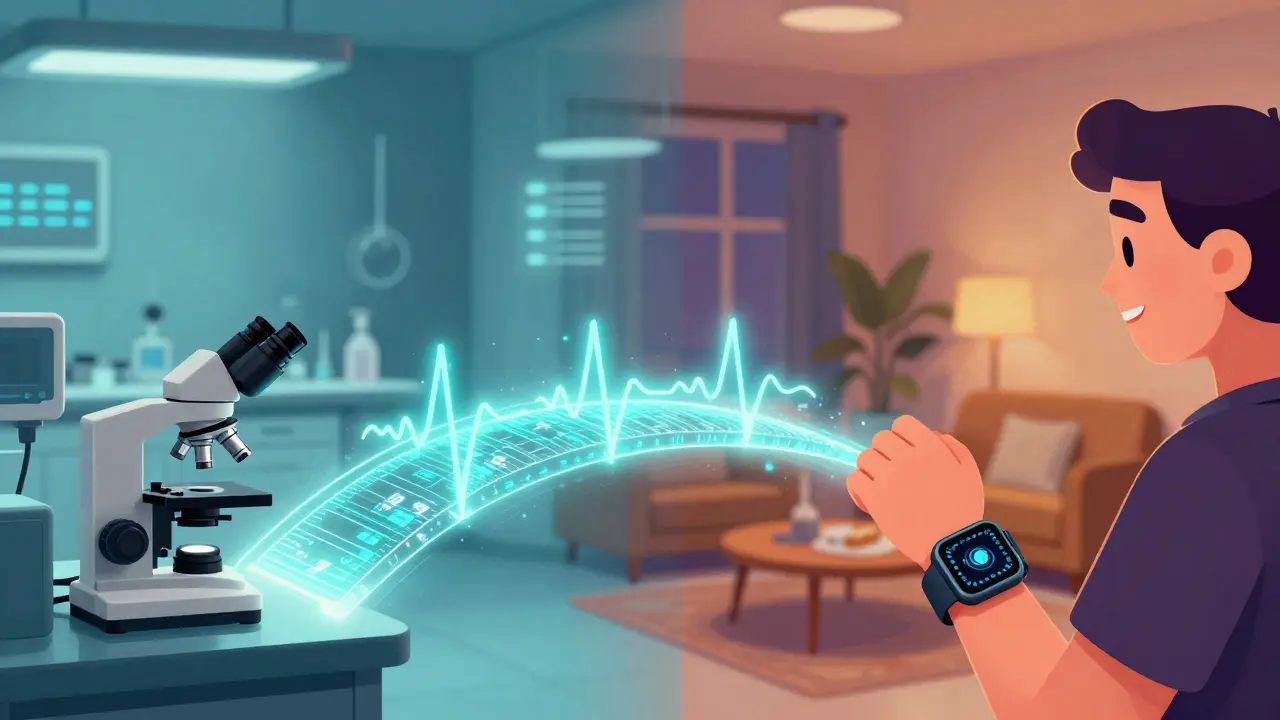
The medical community is realizing that choosing one over the other is a mistake. Instead, they are merging them. We're seeing the rise of Pharmacovigilance-the science of detecting and preventing adverse effects-using high-tech tools.
The Sentinel Initiative is a great example. It's an FDA program that monitors 300 million patient records in near real-time. Instead of waiting for a doctor to file a report, the system scans data for patterns, potentially flagging safety issues 6 to 12 months faster than old methods.
We're also seeing the influence of wearable tech. Apple's Heart Study showed that mobile devices can capture real-world data at a scale and precision that rivals clinical trials, providing a bridge between the "perfect" lab and the "messy" home.
Practical Tips for Patients and Caregivers
Knowing these differences helps you have better conversations with your doctor. You don't have to rely solely on the pamphlet that comes with your medicine.
First, keep a simple log. Note not just what the symptom is, but when it happens. Since real-world data often misses the "timing" of side effects, your personal data is the most accurate record of your experience. Second, ask your provider if there are recent "post-marketing" updates for your drug. This is the professional way of asking, "What has the real world discovered about this drug since the trials ended?"
Finally, don't hesitate to report side effects. Whether it's through your doctor or directly to the FDA, your report contributes to the RWE that protects future patients. It transforms your personal struggle into a data point that could trigger a label change or a safety warning.
Why are some side effects not listed in clinical trials?
Clinical trials usually have a limited number of participants and strict entry criteria, meaning they often exclude elderly patients, people with multiple health conditions, or those on other medications. Rare side effects (occurring in less than 1% of people) often require millions of users to become statistically visible, which only happens after the drug is released to the general public.
Is real-world data as reliable as a clinical trial?
It depends on what you're looking for. For establishing that a drug causes a specific effect, clinical trials are the gold standard because they use randomization and controls. Real-world data is less reliable for proving causality because of "confounding factors" (other things that might be causing the symptom), but it is far superior for monitoring long-term safety and rare reactions across diverse populations.
What is the FDA's Sentinel Initiative?
The Sentinel Initiative is an active surveillance system that allows the FDA to proactively monitor the safety of approved medical products using a massive database of electronic health records and insurance claims. This allows them to detect safety signals much faster than relying on spontaneous reports from doctors.
What should I do if I experience a side effect not on the label?
First, contact your healthcare provider to determine if the symptom is related to the medication and how to manage it. Then, consider reporting the event to the FDA Adverse Event Reporting System (FAERS). Your report helps regulators identify new safety signals that might lead to updated warnings for everyone.
How long does it take for real-world data to change a drug's label?
It varies. While early signals can be detected on social media or in EHRs within weeks, the FDA usually requires months of rigorous validation. For example, the Sentinel Initiative's validation process typically takes 3 to 9 months to ensure a signal is actually caused by the drug and not a coincidence.

Right, because the "sterile environment" is just a convenient excuse for the pharma giants to hide the bodies until the patents are almost up. It's almost too convenient that we only find out about the heart risks after millions of us have been the actual guinea pigs. Total joke.
This is actually really helpful to know!
The analogy about the driving simulator versus rush hour is spot on. I've always wondered why my reactions to certain meds were so different from the pamphlets. It makes a lot of sense that the diversity of a real-world population would uncover things that a small, curated group simply can't.
The intersection of biological variability and systemic observation... is quite a paradox!!!
Oh man, the absolute tragedy of it all! Imagine being the one person in a million to have a reaction that nobody saw coming because you weren't in the "bubble"! It's just wild how the system works.
lol imagine actually keeping a log of your symptoms like a little diary... who has time for that just take the pill and see if you feel weird
We really need to push for more transparency in those early phases. If the sample sizes are consistently too small to catch rare events, then the industry needs to shift its funding toward larger, more diverse cohorts before a drug hits the general public. It's not enough to just monitor the "wild" after the damage is already done to thousands of people.
The sheer inadequacy of the reporting system is a testament to the systemic failure of modern medicine. To suggest that a mere 2% to 5% of adverse events are recorded is an absolute catastrophe of data integrity. It is an affront to the very concept of scientific rigor!
I think it's so great that we have wearables now to help bridge that gap. It's a small step, but it definitely helps the doctors get a better picture.
The mention of the Sentinel Initiative provides a reassuring perspective on the proactive measures being taken by regulatory bodies to ensure public safety.