
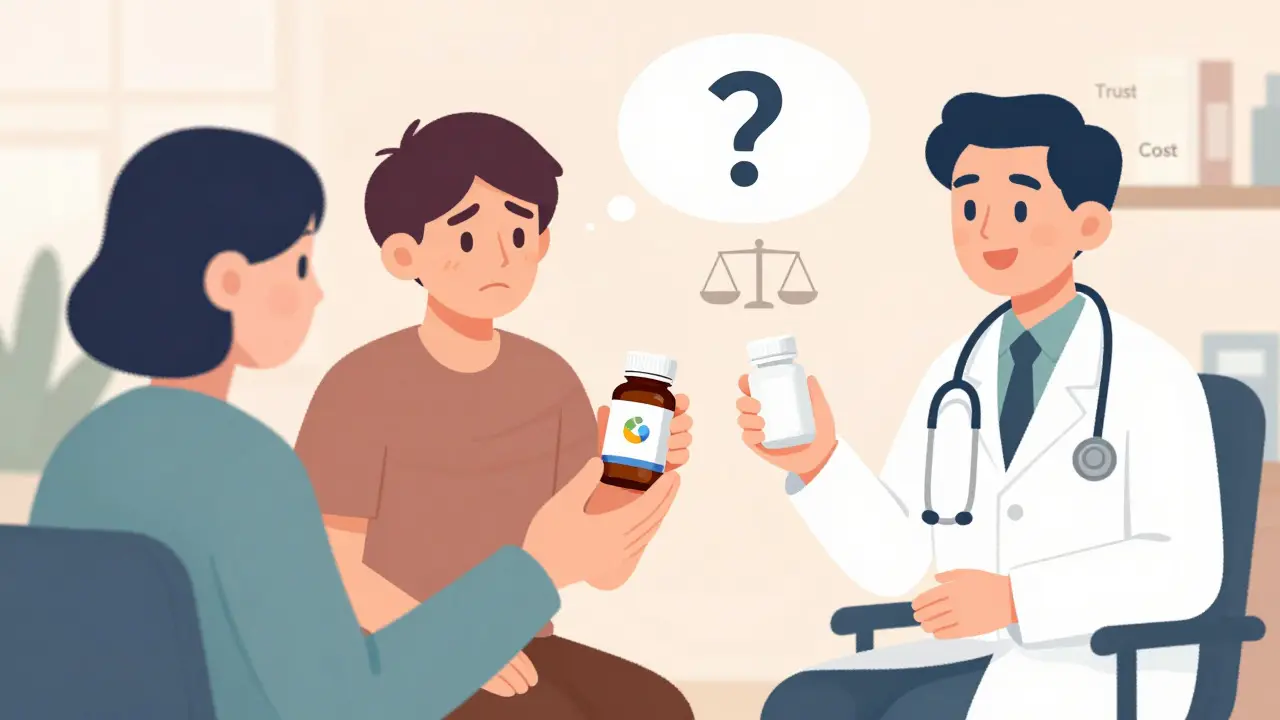
Imagine this scenario: You’ve been taking a specific blood pressure medication for years. It works. You feel fine. Then, your doctor writes a new prescription, but the pharmacist hands you a pill that looks completely different-maybe it’s a different color or shape. Suddenly, you wonder if it will still work. This hesitation isn’t just about chemistry; it’s about medical authority and how we perceive the value of what our doctors tell us.
Generic medications are identical to their brand-name counterparts in active ingredients, strength, and dosage form. Yet, despite overwhelming evidence supporting their efficacy, patients often resist switching. Why? Because medicine is not just science-it’s also psychology. When a doctor recommends a generic drug, they’re relying on their professional authority to overcome deep-seated beliefs about brand quality. Understanding this dynamic can help both healthcare providers and patients navigate one of the most common conflicts in modern healthcare.
The Science Behind Generic Medications
To understand why there’s so much debate around generics, we first need to look at the facts. A generic medication is a pharmaceutical product containing the same active ingredient as a brand-name drug, approved after demonstrating bioequivalence through rigorous testing. In simple terms, if Brand X contains 50mg of Drug Y, its generic version must deliver that exact amount into your bloodstream within the same timeframe.
The foundation for regulating these drugs was laid by the Hatch-Waxman Act of 1984, which created an abbreviated approval pathway for generic drugs while protecting innovation incentives for original manufacturers. Today, according to the FDA, generics account for approximately 90% of all prescriptions dispensed in the United States-but only 23% of total drug spending. That’s a massive saving potential right there.
Here’s where things get interesting: Studies show that patients who take generic medications have about a 6% higher adherence rate compared to those sticking with brand names. Higher adherence means better health outcomes and fewer hospital visits. So why do some people still hesitate?
How Doctor Recommendations Shape Patient Behavior
Doctors play a pivotal role in shaping whether patients accept generic alternatives. Their recommendation carries weight because of something called medical authority, defined as the perceived expertise and credibility of healthcare professionals influencing patient decisions.
A study conducted by Tamuno Raymond George found no significant correlation between physicians’ personal cost concerns and their prescribing patterns. Instead, factors like specialty, practice setting, and even cultural influences determine how likely a doctor is to recommend generics. For instance, primary care physicians prescribe generics far more frequently than specialists working in hospitals or private practices.
This disparity highlights an important point: Not all doctors approach generic prescribing equally. Some may prioritize convenience, others might focus on cost savings, while others simply stick to familiar brands out of habit. But when a trusted physician explicitly endorses a generic option, patients are significantly more likely to comply.
Patient Perceptions vs. Reality
Let’s talk openly about perceptions. Many patients view generic drugs skeptically-not necessarily due to lack of information, but because of ingrained biases. Research shows that mixed feelings about efficacy, safety, and quality stem largely from uncertainties about how generics differ visually or functionally from branded versions.
Take inhalers, for example. A 2015 qualitative study revealed that asthma sufferers expressed strong preferences regarding design and usability differences between generic dry powder inhalers and their branded equivalents. Even though the active ingredient remains unchanged, subtle variations in delivery mechanisms can create doubts among users accustomed to specific devices.
Then there’s the issue of appearance. Pills come in various colors, shapes, and sizes depending on the manufacturer. These cosmetic changes don’t affect performance, yet they trigger psychological responses tied to familiarity and trust. Patients associate consistency with reliability-and seeing a differently colored pill shakes that confidence.

Cost Savings Without Compromising Quality
One undeniable advantage of choosing generics lies in affordability. On average, generic medications cost 80-85% less than their brand-name equivalents. According to the Congressional Budget Office, increased adoption could save Medicare beneficiaries billions annually.
| Feature | Brand-Name Drug | Generic Drug |
|---|---|---|
| Active Ingredient | Same | Same |
| Dosage Form | Identical | Identical |
| Bioequivalence Standard | N/A (Reference Product) | 80-125% Confidence Interval |
| Average Cost Reduction | $0 baseline | 80-85% |
| Patient Adherence Rate | Baseline | +6% improvement |
But here’s the catch: While financial benefits are clear, emotional barriers remain stubbornly high. People equate price with value-a cognitive bias known as the "halo effect." If something costs less, it must be inferior, right? Wrong. Yet overcoming this mindset requires education, transparency, and reassurance-all areas where doctors shine brightest.
Building Trust Through Education
Educating patients about generic medications doesn’t mean lecturing them-it means having honest conversations tailored to individual needs. Physicians who explain bioequivalence standards clearly tend to see improved acceptance rates. They address questions head-on: What makes two pills equivalent? Are inactive ingredients safe? Will my body react differently?
Dr. Sarah Ibrahim from the FDA emphasizes the importance of discussing transitions proactively. She notes that patients are more likely to stop taking generics when unexpected changes occur during therapy switches. By anticipating these moments, doctors can preemptively alleviate fears before they escalate.
Additionally, leveraging resources like the FDA’s “Look Alike Sound Alike” program helps reduce confusion caused by visual discrepancies. Since its implementation, this initiative has reduced patient mix-ups by nearly 40%. Small steps like ensuring consistent packaging designs go a long way toward building trust.
Addressing Common Concerns
No discussion about generics would be complete without addressing lingering worries. Let’s tackle three frequent objections:
- "Will it work as well?" Yes. Bioequivalence ensures therapeutic equivalence across virtually all cases.
- "What about side effects?" Rare exceptions exist, particularly with narrow therapeutic index drugs requiring close monitoring. However, such instances represent less than 1% of prescribed medications.
- "Does cheaper mean lower quality?" Absolutely not. Manufacturing facilities undergo identical inspections regardless of product type.
By acknowledging concerns upfront, doctors demonstrate empathy alongside expertise-an essential combination for fostering genuine rapport.

The Role of Healthcare Systems
Beyond individual interactions, systemic factors influence generic adoption. Insurance policies heavily favor generics through tiered pricing structures designed to encourage utilization. Meanwhile, regulatory bodies continuously refine guidelines to streamline approvals without compromising safety.
Under GDUFA III (2023-2027), funding allocated to research initiatives supports ongoing efforts to enhance communication strategies targeting both providers and consumers. With $15.2 million dedicated annually, expect clearer messaging campaigns aimed at dispelling myths surrounding complex formulations like inhalers or topical treatments.
Finding Balance Between Innovation and Accessibility
Innovation drives progress-but accessibility sustains populations. Striking balance involves recognizing legitimate reasons for preferring certain brands while promoting widespread use of proven alternatives. Biosimilars emerging alongside traditional generics offer exciting possibilities ahead, expanding options beyond small molecules into biologics territory.
As residency programs increasingly incorporate mandatory modules on generic prescribing practices, future generations of physicians stand poised to champion evidence-based approaches confidently. Change takes time, but momentum builds steadily each year.
Taking Action Toward Better Outcomes
If you’re considering transitioning to generic medications-or advising someone else doing so-keep these tips in mind:
- Talk openly with your doctor about any reservations you hold.
Ultimately, embracing generics empowers individuals to manage chronic illnesses affordably without sacrificing peace of mind. And isn’t that exactly what good healthcare should achieve?
Are generic medications really as effective as brand-name ones?
Yes, generic medications meet strict bioequivalence standards set by agencies like the FDA, ensuring they perform identically to brand-name counterparts in delivering active ingredients into your system.
Why do some doctors prefer prescribing brand-name drugs?
Preferences vary based on specialties, habits, and occasional patient requests. Additionally, certain narrow therapeutic index drugs warrant cautious consideration due to potential variability impacts.
Can I switch back to a brand-name drug after trying a generic?
Absolutely. Discuss options openly with your provider, keeping insurance coverage implications in mind since coverage levels may shift accordingly.
Do inactive ingredients matter in generic drugs?
While generally harmless, rare allergies or sensitivities could arise. Always inform your doctor about known reactions beforehand to mitigate risks effectively.
How much money can I save using generics instead of brands?
On average, expect savings ranging from 80-85%, translating to substantial reductions over extended treatment periods especially beneficial for managing chronic conditions long-term.