

Blood Thinner Dose Recovery Calculator
Missing a dose of your blood thinner might seem like a small mistake-maybe you were busy, forgot because of a change in routine, or just didn’t feel like taking it that day. But for someone on anticoagulants, skipping even one pill can be dangerous. Blood thinners aren’t optional supplements. They’re life-saving medications that stop dangerous clots from forming in your heart, brain, or legs. If you miss a dose, you’re not just breaking a habit-you’re tipping the balance between safety and serious risk.
Why Blood Thinners Are So Precise
Blood thinners don’t actually make your blood thinner. They work by slowing down your body’s ability to form clots. That’s exactly what you need if you have atrial fibrillation, a replaced heart valve, or a history of deep vein thrombosis or stroke. But this same mechanism means your body is more vulnerable to bleeding. The goal isn’t to stop clotting completely-it’s to keep it just low enough to prevent clots but not so low that you bleed uncontrollably. There are two main types: traditional anticoagulants like warfarin, and newer direct oral anticoagulants (DOACs) like apixaban (Eliquis), rivaroxaban (Xarelto), and dabigatran (Pradaxa). Warfarin requires regular blood tests (INR checks) to make sure your dose is right. Most people aim for an INR between 2.0 and 3.0. DOACs don’t need routine blood tests, but they have shorter half-lives. That means they leave your system faster. If you miss a dose, the protection drops more quickly.What Happens When You Miss a Dose
Missing one dose doesn’t automatically cause a clot-but it raises your risk. Studies show that patients who miss more than 20% of their doses have up to a 57% higher chance of stroke when on DOACs. For warfarin, the threshold is lower-missing just 35% of doses can increase risk. In real life, about 1 in 8 patients miss at least one dose per month. The biggest danger? A clot forming where it shouldn’t. That could mean:- A pulmonary embolism-a clot traveling to your lungs, causing sudden shortness of breath or chest pain
- A stroke-clot blocking blood flow to your brain, leading to slurred speech, weakness, or confusion
- Deep vein thrombosis-a clot in your leg, causing swelling, redness, or pain
What to Do If You Miss a Dose
The rule is simple: never double up. That’s the biggest mistake people make. Taking two pills at once doesn’t give you better protection-it just increases your bleeding risk. Here’s what to do based on the medication:For Warfarin (Coumadin, Jantoven)
- If you remember within 12 hours of your usual time: take the missed dose.
- If it’s been more than 12 hours: skip it. Don’t take it the next day.
- Take your next scheduled dose at the normal time.
For Apixaban (Eliquis), Rivaroxaban (Xarelto), Dabigatran (Pradaxa)
- If you remember within 6 hours of your missed dose: take it right away.
- If it’s been more than 6 hours: skip it.
- Don’t take two doses at once. Take your next dose at the regular time.

When to Call Your Doctor or Go to the ER
You don’t need to panic every time you miss a dose. But there are times when you should act fast:- You’ve missed more than one dose in a row
- You’re experiencing unexplained bruising or large purple patches on your skin
- Your urine is red or brown
- Your stools are black, tarry, or bloody
- You have sudden dizziness, confusion, or trouble speaking
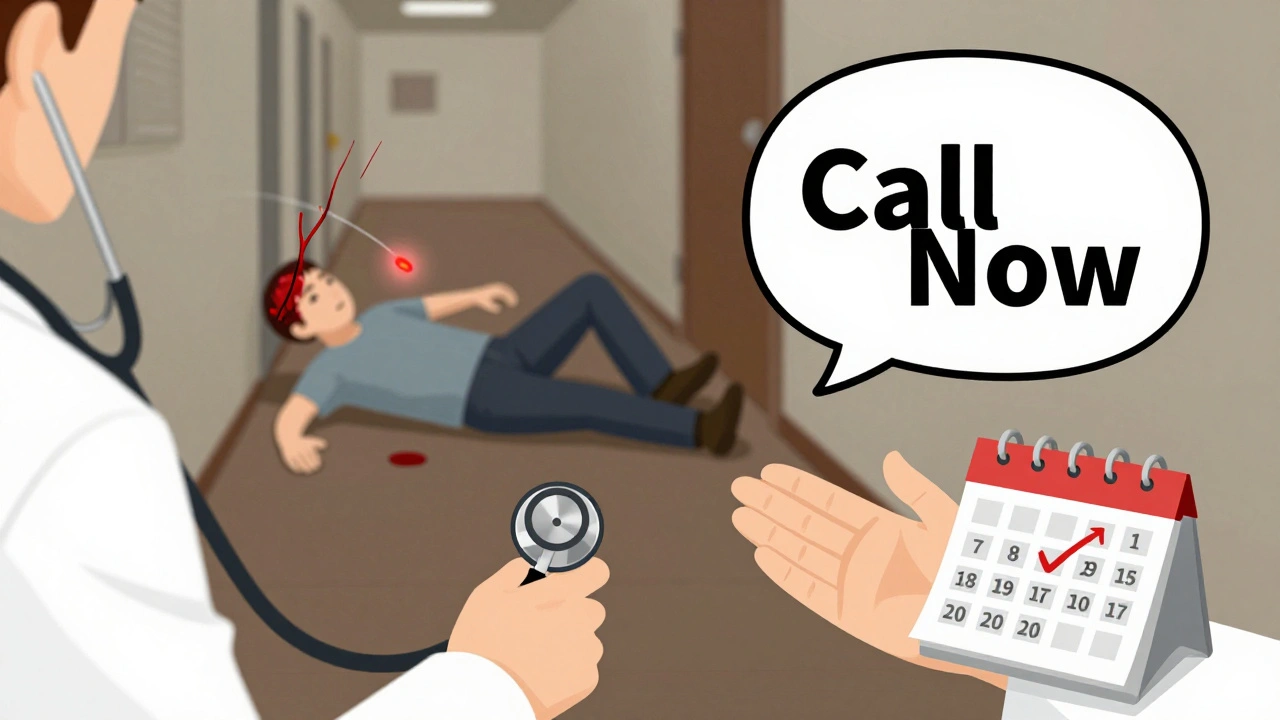
- You have a severe headache, especially after a fall or head injury
- You’re having trouble breathing or chest pain
How to Prevent Missed Doses
The best way to handle a missed dose is to avoid it altogether. Here’s what works:- Use a pill organizer-one with compartments for morning and night. Fill it weekly.
- Set phone alarms-two alarms, one for each dose. Label them: “Eliquis AM” and “Eliquis PM.”
- Link it to a habit-take your pill right after brushing your teeth or with breakfast.
- Refill early-don’t wait until you’re out. Order refills at least 3 days before you run out.
- Keep your yellow book-if you’re on warfarin, write down every dose you take and every one you miss. Bring it to every appointment.
What Your Doctor Needs to Know
Always tell your healthcare provider if you’ve missed doses-even if you think it’s no big deal. They need to know because:- It affects your INR results if you’re on warfarin
- It changes your risk profile for clotting or bleeding
- It helps them decide if you need a different medication
What Not to Do
- Never take two doses at once-it’s not safer, it’s riskier.
- Never stop taking your blood thinner without talking to your doctor. Stopping suddenly can cause a stroke within days.
- Never change your dose based on how you feel. Blood thinners don’t cause symptoms when they’re working right.
- Never rely on memory-use tools. Your brain is not a pill tracker.
Final Thought: It’s Not About Perfection
No one is perfect. You might forget once. Maybe twice. That’s okay-as long as you know what to do next. The goal isn’t to be flawless. It’s to be informed. To know the signs. To call your doctor when you need to. To use the tools that help you stay on track. Your blood thinner isn’t just a pill. It’s your protection. Treat it like one.What should I do if I miss a dose of Eliquis?
If you miss a dose of Eliquis and remember within 6 hours of your usual time, take it right away. If it’s been more than 6 hours, skip the missed dose. Do not take two doses at once. Take your next dose at the regular time the following day.
Can I take two warfarin pills the next day to make up for a missed dose?
No. Never take a double dose of warfarin. If you miss a dose and remember within 12 hours, take it. If it’s been more than 12 hours, skip it. Taking extra warfarin increases your risk of serious bleeding, including internal bleeding in the brain or stomach. Just resume your regular schedule the next day.
What are the warning signs I’m bleeding because of a missed or doubled dose?
Watch for: unexplained bruising, red or brown urine, black or tarry stools, dizziness, sudden headaches, trouble breathing, or chest pain. These could mean internal bleeding. If you notice any of these, contact your doctor immediately or go to the emergency room.
Do I need to get blood tests if I miss a dose of a DOAC like Xarelto?
No, DOACs like Xarelto don’t require routine blood tests. But if you miss multiple doses or have symptoms like bleeding or clotting, your doctor may order tests to check your clotting status. Always report missed doses to your provider-they need that info to manage your care.
Is it safe to stop taking my blood thinner if I feel fine?
No. Feeling fine doesn’t mean you don’t need the medication. Blood thinners work silently to prevent clots. Stopping them-even for a few days-can cause a stroke or pulmonary embolism. Only stop if your doctor tells you to.
How often do people miss blood thinner doses?
About 1 in 8 patients miss at least one dose per month. People on warfarin miss doses more often than those on DOACs, partly because warfarin requires more frequent dosing and monitoring. But even DOAC users miss doses, especially around weekends or holidays. Adherence is a common challenge-use reminders to stay on track.
Can alcohol affect my blood thinner if I miss a dose?
Yes. Alcohol can increase bleeding risk, especially if you’ve missed a dose or taken too much. It can also interfere with how warfarin works. If you drink, do so in moderation and always tell your doctor. If you miss a dose and then drink, you’re increasing your risk of bleeding. Avoid alcohol on days you’ve missed a dose.

I missed my Eliquis yesterday because I was drunk at a friend’s birthday and totally forgot. Didn’t think it was a big deal until I woke up with a weird bruise on my arm. Now I’m terrified. Don’t be like me. Set alarms. Use a pill box. Your life isn’t worth gambling with.
Also, why do people think alcohol is fine with blood thinners? I’ve seen guys down whiskey like it’s water and then act shocked when they bleed internally. No. Just no.
The pharmacokinetics of DOACs are fundamentally different from warfarin’s vitamin K antagonism-this is critical. The half-life of apixaban is approximately 12 hours, meaning that by 24 hours post-missed dose, plasma concentration drops below therapeutic thresholds. This creates a narrow window of vulnerability, particularly in patients with renal impairment or those on concomitant CYP3A4/P-gp inhibitors.
It’s not merely about adherence-it’s about maintaining a dynamic equilibrium between thrombin generation and anticoagulant suppression. Doubling the dose doesn’t restore protection; it induces a non-linear increase in bleeding risk due to saturation kinetics. The clinical guidelines are not arbitrary-they’re rooted in pharmacodynamic modeling.
Ugh. I just read this whole thing and I’m so tired of people treating life-saving meds like they’re optional snacks. I mean, really? You forgot your pill because you were ‘busy’? You think your job is more important than not having a stroke?
People need to stop being lazy and start taking responsibility. This isn’t a ‘oops, my bad’ situation. This is ‘I might die because I didn’t set a phone alarm’ territory.
And yes, I’m talking to you, Elizabeth. I saw your comment about ‘forgetting’ and it made me cringe. Wake up. Your life is not a suggestion.
Just a quick tip: I use my smart speaker. Every morning and night I say ‘Alexa, remind me to take my Eliquis’ and it yells it at me. No excuses.
Also, if you’re on warfarin and you miss a dose, don’t panic. Just log it in your yellow book and tell your clinic at your next visit. They’ve seen it all.
And yes, alcohol is a no-go if you miss a dose. Period.
Use tools. Don’t rely on your brain. Your brain is terrible at this.
You got this. Seriously. You’re not alone.
It’s interesting how the literature consistently shows that adherence to anticoagulant therapy remains suboptimal across all demographic groups, but particularly among younger adults and those with comorbid psychiatric conditions such as depression or anxiety, which are often underdiagnosed in this population. The cognitive load associated with managing multiple medications, coupled with the absence of immediate symptomatic feedback when doses are missed, creates a perfect storm for non-adherence.
Moreover, the transition from warfarin to DOACs, while simplifying monitoring, paradoxically increases the risk of missed doses due to the perception that ‘no blood tests = no risk,’ which is a dangerous misconception. The shorter half-lives of DOACs mean that even a single missed dose can result in a significant drop in anticoagulant effect, particularly in patients with borderline renal function or those taking interacting medications like clarithromycin or ketoconazole.
It’s not enough to say ‘just set an alarm.’ We need systemic interventions: pharmacist-led medication reviews, automated refill systems integrated with EHRs, and patient education that frames adherence not as a chore but as an act of self-preservation. The fact that 1 in 8 patients miss a dose monthly isn’t a failure of willpower-it’s a failure of healthcare design.
I’ve been on Xarelto for 4 years after a PE. I missed a dose once because I was hiking and forgot my pill case. I didn’t panic. I just kept going, took my next one on time, and told my doctor at my next checkup.
It’s not about being perfect. It’s about being aware. And if you’re worried, call your doctor. They’ve heard it all before.
Also-pill organizers are a game changer. I got one with a lock on it. My grandma uses it. She’s 82 and never misses.
You’re not alone. We’ve all messed up. Just don’t double up. That’s the one thing you can’t afford to do.
Just took my Eliquis and thought about this post 😅
My alarm goes off at 8am and 8pm. I take it right after brushing my teeth. It’s become a habit, like flossing. No big deal.
But I did miss one once during a road trip. Didn’t know what to do. Looked it up. Skipped it. Didn’t panic. Took the next one on time.
Still freaked me out though. So now I carry a mini pill case in my glovebox. Just in case.
Thanks for the reminder. I needed this.
i missd my warfarin last week and just kinda… forgot about it? then i felt fine so i thought it was ok. then i saw my doc and she looked at me like i’d just admitted to eating a whole cake. i’m so embarrassed. now i have a pill box and my phone yells at me. i’m sorry i was dumb.
My mum’s on warfarin and she uses a yellow notebook like they said. Every single dose. Even the ones she misses. She brings it to every appointment. I cried when I saw it. It’s not just a book-it’s her lifeline.
Don’t underestimate the power of writing it down. Your brain lies to you. Paper doesn’t.
And yes, I’ve told my friends to do the same. If you’re on this med, you owe it to yourself to be organized.
Love you all. Stay safe. 💙