
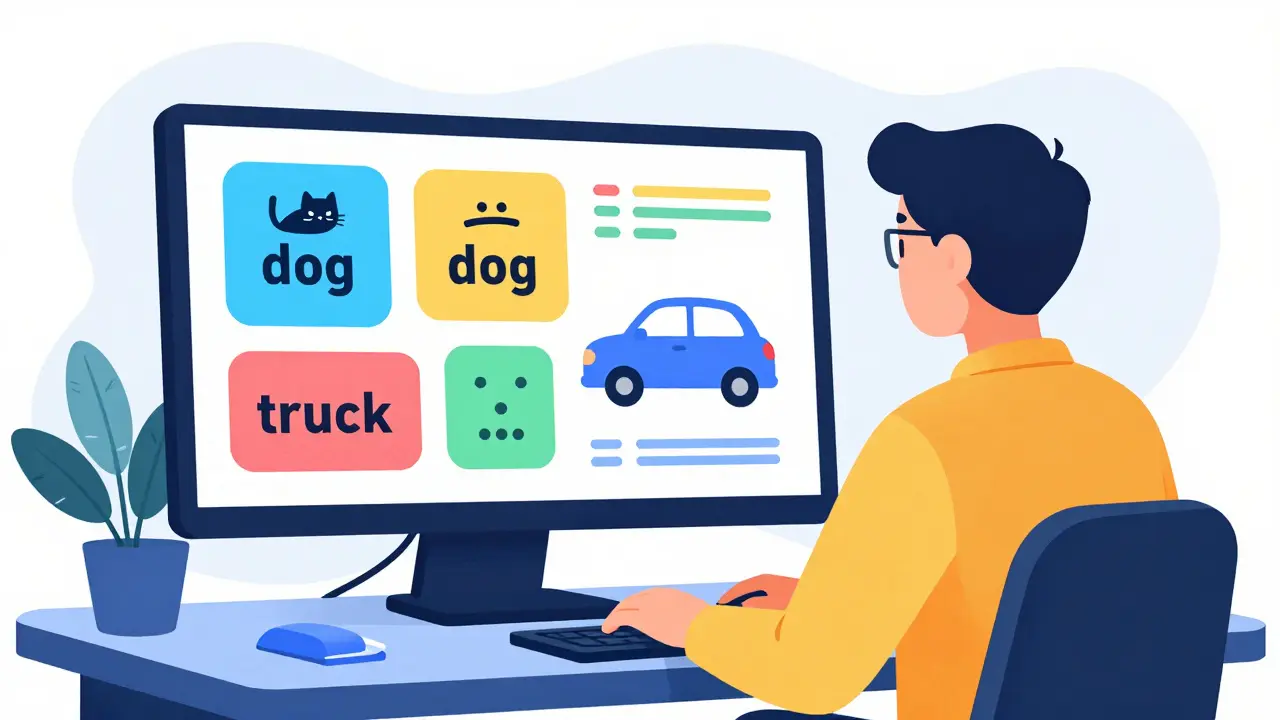
Imagine spending months training a machine learning model only to find out it’s failing because the data you fed it was wrong. This isn’t a rare glitch; it’s a common reality in AI development. Even high-quality datasets like ImageNet contain about 5.8% labeling errors. These mistakes-where the ground truth label doesn't match the actual content-can degrade your model's performance more severely than any architectural flaw. If you are working with annotated data, recognizing these errors and knowing how to ask for corrections is not just a best practice; it is essential for building reliable systems.
The Hidden Cost of Bad Labels
Labeling errors are inaccuracies in your dataset where the assigned tag or class is incorrect. In a medical imaging context, this might mean a tumor is labeled as healthy tissue. In autonomous driving, a pedestrian might be missed entirely. According to MIT's Data-Centric AI research from 2024, these errors create a fundamental ceiling on model performance. No amount of tweaking hyperparameters will fix a model that has learned from false premises.
Industry standards indicate that typical commercial datasets have error rates ranging from 3% to 15%. Computer vision datasets average around 8.2% errors. While those numbers sound small, they compound quickly. A study by Curtis Northcutt, creator of cleanlab, an open-source framework for finding label issues, showed that correcting just 5% of label errors in the CIFAR-10 dataset improved test accuracy by 1.8%. That is a significant gain for relatively little effort.
Common Patterns of Labeling Mistakes
To fix errors, you first need to know what they look like. They rarely appear as random noise; instead, they follow specific patterns. Understanding these patterns helps you spot them faster.
- Missing Labels: Objects or entities that should have been tagged are left blank. In object detection tasks, this accounts for 32% of all errors. For safety-critical apps like self-driving cars, missing a pedestrian label can have severe consequences.
- Incorrect Fit: The label is right, but the bounding box or segmentation mask is off. About 27% of errors fall into this category. A box that barely touches a car is still an error if it doesn't fully enclose it.
- Misclassified Types: The entity is found, but given the wrong class. For example, labeling a "sedan" as a "truck." In entity recognition tasks, 33% of errors involve misclassified types.
- Ambiguous Examples: Cases where multiple labels could reasonably apply, leading to inconsistent tagging across annotators. These make up about 10% of errors.
- Out-of-Distribution Data: Data points that don't belong to any defined class in your taxonomy. These account for roughly 15% of errors in text classification.
Often, these errors stem from unclear guidelines. TEKLYNX analyzed 500 industrial labeling projects and found that ambiguous instructions contributed to 68% of all labeling mistakes. If your team is struggling with consistency, check your documentation before blaming the annotators.
Technical Approaches to Spotting Errors
You cannot manually review every single data point in large datasets. You need systematic methods. There are three primary approaches to detecting these issues, each with its own strengths.
Algorithmic Detection
Tools like cleanlab use statistical methods called "confident learning" to estimate where errors likely exist. It works by comparing your model's predictions against the ground truth labels. If the model is highly confident that a sample is a "cat," but the label says "dog," the algorithm flags it as a potential error. Benchmarking shows this method can identify 78-92% of label errors with precision rates between 65-82%. The downside? It requires programming expertise. A 2023 usability study found that 72% of data analysts needed at least 8 hours of training to use it effectively.
Multi-Annotator Consensus
Human redundancy is a powerful tool. Having three annotators review the same sample reduces error rates by 63% compared to having just one. However, this comes at a cost: labeling expenses increase by approximately 200%. This method is ideal for high-stakes domains like healthcare or finance, where accuracy is non-negotiable, but it may be overkill for general-purpose applications.
Model-Assisted Validation
Platforms like Encord Active allow you to run a trained model on your annotated data to find discrepancies. Encord’s 2023 evaluation showed this approach identifies 85% of label errors by highlighting high-confidence false positives. This works best when your baseline model already has at least 75% accuracy. It’s a great way to leverage existing models to improve future ones.
Comparing Error Detection Tools
Choosing the right tool depends on your technical skills, budget, and data type. Here is how the major players stack up.
| Tool | Best For | Key Limitation | Adoption Rate |
|---|---|---|---|
| cleanlab | Statistical rigor, custom workflows | Steep learning curve, requires coding | 42% among ML engineers |
| Argilla | Hugging Face integration, web UI | Struggles with >20 multi-label classes | 29% in academic settings |
| Datasaur | Enterprise teams, tabular data | No support for object detection | 38% in enterprise annotation |
| Encord Active | Computer vision visualization | High resource usage (needs 16GB+ RAM) | Growing rapidly in CV sector |
If you are a solo developer or part of a small tech team, cleanlab offers the most flexibility. If you are managing a large annotation team without deep coding resources, Datasaur or Argilla provide more user-friendly interfaces. Remember, no tool is perfect. Dr. Rachel Thomas of the USF Center for Applied Data Ethics warns that over-reliance on algorithms without human oversight can create new error patterns, especially for minority classes.
How to Ask for Corrections Effectively
Finding the error is only half the battle. You need a workflow to fix it without breaking your pipeline. Here is a practical, four-step process based on industry best practices.
- Load and Prepare: Import your dataset into your chosen tool. This usually takes 1-2 hours. Ensure your data is in the correct format (e.g., COCO for object detection).
- Run Detection: Execute the error detection algorithm. Depending on dataset size, this can take anywhere from 5 minutes to 24 hours. For example, running cleanlab on a medium-sized text dataset might take 30 minutes.
- Review and Validate: Do not accept every flag automatically. Have human experts review the top candidates. Label Studio’s case studies show that adding two additional reviewers per flagged sample increases correction accuracy from 65% to 89%.
- Correct and Document: Update the labels in your source system. Crucially, maintain an audit trail. Record why a label was changed. This helps you refine your guidelines and prevent similar errors in the future.
A real-world example: A senior data scientist at a major e-commerce company used cleanlab to find 1,200 potential errors in their product categorization dataset. It took three full-time annotators two weeks to validate them. The result? False negatives dropped by 22%. The key was not just the tool, but the structured validation process.
Preventing Future Errors
Detection is reactive; prevention is proactive. How do you stop errors before they happen?
- Clarify Guidelines: Provide clear, example-rich instructions. TEKLYNX found that better guidelines reduced errors by 47%.
- Version Control: Use version control for your annotation taxonomies. "Midstream tag additions"-changing rules halfway through a project-cause 21% of errors. Versioning reduces this by 63%.
- Active Learning: Prioritize labeling examples that your model is unsure about. MIT’s Data-Centric AI Center is developing techniques that focus on examples most likely to contain errors, speeding up correction by 25%.
As the global data annotation market grows toward $8.34 billion by 2030, regulatory pressures are increasing. The FDA’s 2023 guidance for AI-based medical devices now requires rigorous validation of training data quality. Ignoring labeling errors is no longer an option. By integrating systematic detection and correction into your MLOps pipeline, you ensure your models are built on a solid foundation.
What is the average rate of labeling errors in commercial datasets?
According to industry reports from 2023, labeling error rates in typical commercial datasets range from 3% to 15%, with computer vision datasets averaging around 8.2% errors.
Which tool is best for non-technical users to find labeling errors?
For non-technical users, tools like Argilla or Datasaur are often better choices because they offer user-friendly web interfaces. Cleanlab is powerful but requires programming expertise and can have a steep learning curve.
How much does using multiple annotators reduce errors?
Having three annotators per sample can reduce error rates by approximately 63% compared to single-annotator workflows, though this typically increases labeling costs by around 200%.
Can fixing labeling errors really improve model accuracy?
Yes. Research shows that correcting just 5% of label errors in a dataset like CIFAR-10 can improve test accuracy by 1.8%. Label errors can degrade performance more severely than architectural limitations.
What are the most common types of labeling errors?
The most common errors include missing labels (32%), incorrect fit such as bad bounding boxes (27%), and midstream tag additions due to changing guidelines (21%). Misclassified types and ambiguous examples also contribute significantly.
Is it necessary to validate algorithmically detected errors with humans?
Yes. Experts warn that over-reliance on algorithms without human oversight can create new error patterns, particularly for minority classes. Human validation ensures corrections are accurate and contextually appropriate.

cleanlab is the only thing that actually works for this stuff, everyone else is just guessing
Oh please, don't be so reductive. While cleanlab has its merits for those who can code their way out of a paper bag, Argilla offers a far more sophisticated approach to collaborative annotation that simply cannot be dismissed with such pedestrian brevity. The nuance of multi-label handling in academic settings requires a tool that respects the complexity of human cognition, not just statistical shortcuts. One must consider the broader ecosystem of data curation where aesthetic presentation and user experience play pivotal roles in reducing annotator fatigue. It is quite amusing how often 'simplicity' is mistaken for 'efficacy' by those who have never managed a dataset larger than their own ego. Truly, we are witnessing a decline in intellectual rigor if we settle for tools that require no thought to operate.
I find it fascinating how these errors mirror our own cognitive biases, don't you think? Like when we see what we want to see rather than what is there. It's almost poetic in a tragic sort of way. The missing labels are like the blind spots in our peripheral vision, things we know are there but choose to ignore until they hit us full force. And the misclassified types? Oh, those are the misunderstandings in relationships, labeling someone as a friend when they're clearly a foe. We project our expectations onto the data, just as we do onto people. It makes me wonder if cleaning data is really about fixing numbers or if it's an exercise in humility, forcing us to confront our own assumptions about reality. Perhaps the model isn't failing because of bad data, but because we refuse to accept that our definitions are flawed. It's a beautiful mess, really, this whole endeavor of trying to teach machines to see the world as we claim to see it, when we can barely agree on what we see ourselves.
i totally get that perspective erin its really deep honestly i think we all project our biases into the models whether we mean to or not maybe thats why the guidelines need to be so strict to keep our human messiness from leaking into the machine learning process
Weak analysis. American companies dominate this space for a reason. They build the best tools. Foreign datasets are usually garbage anyway. Stick to US-made solutions like cleanlab if you want results. Don't waste time on fancy European interfaces.
Glenn, your comment is incredibly dismissive and lacks any constructive value. You are attacking the origin of the technology rather than addressing the technical merits discussed in the post. This kind of rhetoric shuts down meaningful dialogue and creates a hostile environment for everyone involved. I expect better from this community. Please refrain from making broad generalizations about entire countries or industries based on unfounded prejudices. We are here to discuss data quality, not engage in nationalist posturing. If you have specific technical criticisms of non-US tools, state them clearly and respectfully. Otherwise, please step back and allow others to contribute without fear of being belittled. Your aggression serves no one and degrades the quality of this discussion significantly.
I am personally struggling with the validation step right now because my team refuses to listen to me when I say the algorithmic flags are wrong. It is exhausting to constantly defend the ground truth against automated suggestions that seem so confident yet so incorrect. Why does everyone trust the machine more than the human eye? I feel like I am fighting a losing battle every single day. Do you ever feel like the tools are designed to make us look incompetent? I just want to do my job correctly but the pressure is immense and nobody seems to care about the nuance of individual cases anymore. It is truly draining to be the only one insisting on manual review for edge cases.
Cici, I hear you loud and clear. That frustration is completely valid and something many of us face. It is tough when the tech moves faster than the processes can adapt. Try framing the manual reviews as 'high-value expert insights' rather than just corrections. Sometimes changing the language helps management see the worth in human oversight. You are doing important work by catching those edge cases. Keep pushing for that balance between automation and human judgment. It is a marathon, not a sprint. Hang in there.