
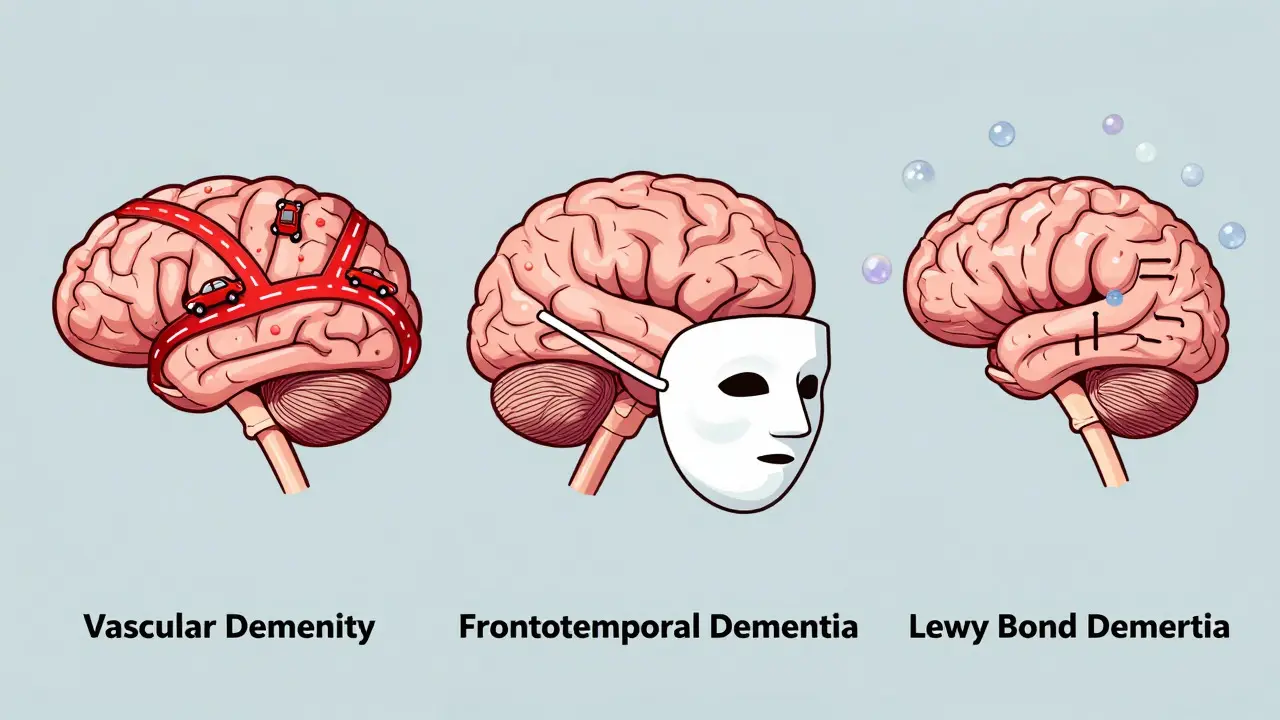
Most people think of dementia as just one thing: a slow fade into memory loss. But that picture is incomplete. In reality, dementia is an umbrella term for a group of conditions that damage the brain in very different ways. If you or a loved one are seeing changes in thinking, behavior, or movement, knowing which type of dementia is at play can change everything-from the medications prescribed to how you handle daily life.
We often hear about Alzheimer’s disease, which makes up 60-80% of cases. But what about the other 20-40%? Three specific types stand out because they have unique causes, distinct symptoms, and different care needs: Vascular dementia, caused by reduced blood flow to the brain, Frontotemporal dementia (FTD), which affects personality and language before memory, and Lewy body dementia (LBD), characterized by hallucinations and motor issues similar to Parkinson's. Misdiagnosing these can lead to dangerous medication errors or unnecessary stress. Let’s break down exactly what sets them apart.
Vascular Dementia: When Blood Flow Fails
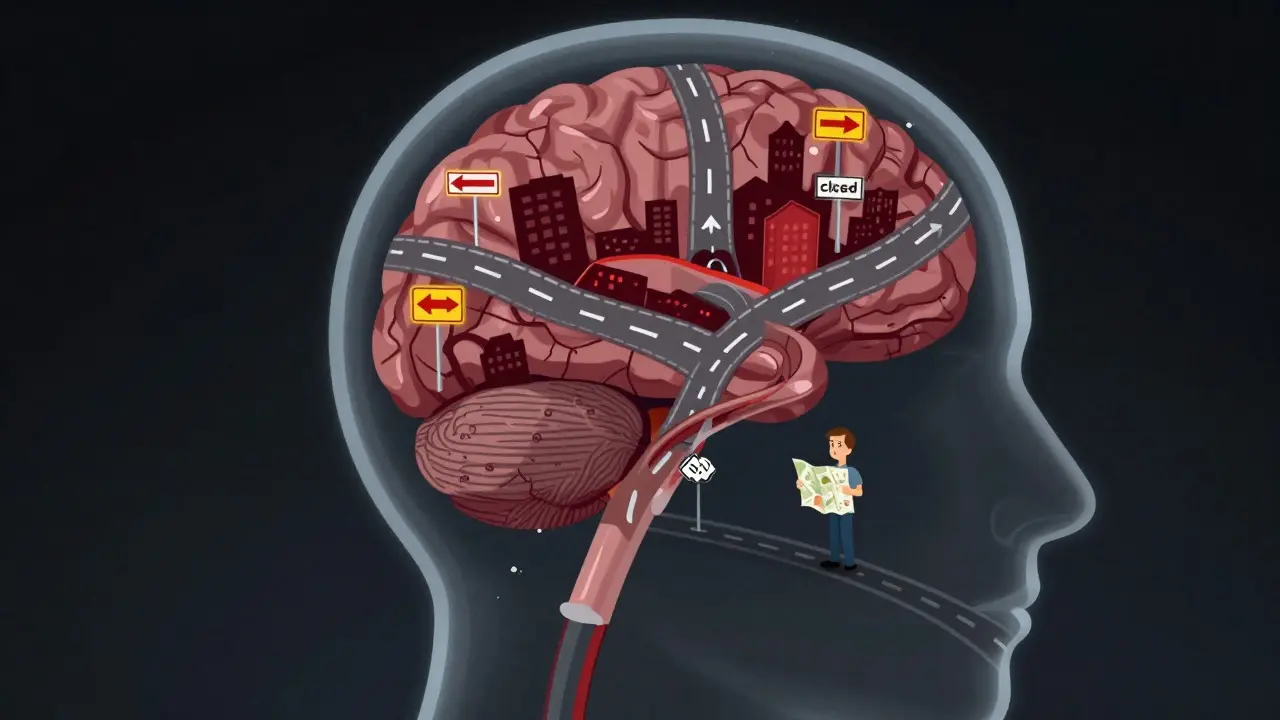
If your brain is like a city, vascular dementia happens when the roads get blocked. This condition results from impaired blood flow to the brain, often due to strokes, mini-strokes (transient ischemic attacks), or chronic conditions like high blood pressure and diabetes. It is the second most common type of dementia, accounting for about 10% of all cases.
The key difference here is the pattern of decline. Unlike the gradual slide seen in Alzheimer’s, vascular dementia often progresses in steps. A person might seem stable for months, then suddenly worsen after a small stroke or vascular event. You might notice:
- Sudden difficulty following instructions or planning tasks.
- Problems with judgment and decision-making.
- Movement issues, such as shuffling gait or balance problems, which appear earlier than in Alzheimer’s.
- Confusion or delusions, though less frequent than in LBD.
Diagnosis relies heavily on brain imaging. An MRI or CT scan will show evidence of past strokes or white matter damage. The good news? Prevention is part of the treatment. Managing blood pressure (aiming for under 130/80 mmHg), controlling diabetes, and taking antiplatelet medications like aspirin can slow progression. Research from the SPRINT-MIND trial suggests that intensive blood pressure control can reduce the risk of mild cognitive impairment by 19%.
Frontotemporal Dementia: The Personality Shift
Imagine someone you know well starts acting like a stranger. They become impulsive, lose social filters, or stop caring about hygiene. This isn’t necessarily “bad behavior”-it could be Frontotemporal dementia (FTD), also known as Pick's disease, affecting the frontal and temporal lobes.
FTD is unique because it strikes younger people, typically between ages 40 and 65. It is the most common form of dementia in people under 60. Pathologically, it involves the buildup of tau or TDP-43 proteins, leading to shrinkage in the parts of the brain responsible for personality, behavior, and language.
Here’s why FTD is so tricky: memory often stays intact in the early stages. Instead, you see dramatic changes in three main areas:
- Behavioral Changes: Apathy, loss of empathy, compulsive behaviors, or inappropriate social conduct. Up to 50% of FTD cases are initially misdiagnosed as depression, bipolar disorder, or schizophrenia.
- Language Problems: Difficulty finding words, understanding speech, or reading/writing. This variant is called primary progressive aphasia.
- Movement Issues: Some forms cause muscle stiffness, tremors, or balance problems, overlapping with motor neuron diseases.
There is no cure for FTD, and typical Alzheimer’s drugs don’t work. Treatment focuses on managing symptoms. Selective serotonin reuptake inhibitors (SSRIs) may help with behavioral issues, while speech therapy supports communication. Diagnosis requires an MRI showing frontal/temporal atrophy and neuropsychological testing that highlights executive function deficits rather than memory loss.
Lewy Body Dementia: The Fluctuating Mind
Lewy body dementia (LBD) is often mistaken for Alzheimer’s or Parkinson’s, but it is its own distinct condition. It accounts for 15-20% of dementia cases and affects about 1.4 million Americans. The hallmark of LBD is the presence of abnormal protein deposits called Lewy bodies, clumps of alpha-synuclein protein in the brain.
The defining feature of LBD is fluctuation. One day, a person might be sharp and engaged; the next, they are confused and drowsy. Beyond cognitive swings, LBD presents a specific cluster of core symptoms:
- Visual Hallucinations: Seeing people, animals, or objects that aren’t there. These are usually detailed and recurrent.
- Parkinsonism: Muscle rigidity, tremors, slowness, and reduced facial expression.
- REM Sleep Behavior Disorder: Acting out dreams during sleep, which can involve kicking or shouting.
- Severe Sensitivity to Medications: This is critical. About 50-75% of LBD patients have extreme reactions to antipsychotic drugs, potentially causing severe sedation or even life-threatening conditions like neuroleptic malignant syndrome.
Diagnosis follows the McKeith criteria, requiring two of the four core features mentioned above. A DaTscan (dopamine transporter imaging) can help distinguish LBD from Alzheimer’s, showing reduced dopamine levels in the brain. Treatment involves cholinesterase inhibitors like rivastigmine to help with cognition, but doctors must avoid typical antipsychotics. Proper diagnosis can reduce hospitalizations by 30% simply by avoiding harmful drug interactions.
Comparing the Three: What’s the Difference?
It’s easy to mix these up because they share some overlap. However, their underlying causes and early signs are distinct. Use this table to spot the differences:
| Feature | Vascular Dementia | Frontotemporal Dementia (FTD) | Lewy Body Dementia (LBD) |
|---|---|---|---|
| Primary Cause | Reduced blood flow/strokes | Protein buildup (tau/TDP-43) in frontal/temporal lobes | Lewy bodies (alpha-synuclein) in brainstem/cortex |
| Typical Onset Age | 65+ (varies) | 40-65 (youngest onset) | 50+ (average 65-75) |
| Early Symptoms | Step-wise decline, planning/judgment issues | Personality changes, language loss, apathy | Fluctuating attention, visual hallucinations, parkinsonism |
| Memory Loss | Present, but variable | Often preserved in early stages | Less prominent early on compared to Alzheimer’s |
| Key Diagnostic Tool | MRI/CT showing vascular damage | MRI showing frontal atrophy, PET scans | DaTscan, clinical criteria (McKeith) |
| Medication Caution | Manage blood pressure/diabetes meds | Alzheimer’s drugs usually ineffective | Avoid antipsychotics (severe sensitivity) |

Why Accurate Diagnosis Matters
You might wonder if it really matters which label gets attached. It does-big time. Misdiagnosis is rampant. Studies suggest up to 75% of LBD cases are initially diagnosed as Alzheimer’s. Why is this dangerous? Because the treatments clash.
If you give an antipsychotic to calm agitation in an LBD patient, you could trigger a severe neurological reaction. If you treat FTD with standard Alzheimer’s medication, you’ll likely see no benefit and possibly worse side effects. For vascular dementia, ignoring blood pressure control means missing a chance to prevent further brain damage.
Getting the right diagnosis involves more than just a memory test. It requires:
- Detailed medical history, including family history and past strokes.
- Brain imaging (MRI, CT, or PET scans).
- Neuropsychological testing to pinpoint which cognitive domains are affected.
- Review of medications and lifestyle factors.
If you suspect a misdiagnosis, seek a second opinion from a neurologist specializing in memory disorders. Specialists at centers like NYU Langone or UCSF emphasize that early, accurate identification allows for better care planning and access to targeted clinical trials.
Living with Dementia: Practical Next Steps
Once you know the type, you can tailor your approach. For vascular dementia, focus on heart health: walk regularly, eat a Mediterranean diet, and monitor blood pressure. For FTD, adapt your home environment for safety (remove hazards if impulsivity is high) and use simple communication strategies if language is affected. For LBD, manage the environment to reduce hallucination triggers (improve lighting, reduce clutter) and establish a consistent sleep routine to help with REM sleep behavior disorder.
Caregiver support is non-negotiable. Joining support groups specific to the dementia type can provide invaluable tips. The Lewy Body Dementia Association and the Association for Frontotemporal Degeneration offer resources tailored to these unique challenges. Remember, dementia is not just a medical issue-it’s a lifestyle adjustment for the whole family. Knowledge is your best tool for navigating it.
Can vascular dementia be reversed?
While existing brain damage cannot be fully reversed, progression can often be slowed or stabilized. By aggressively managing vascular risk factors like hypertension, diabetes, and high cholesterol, you can prevent further strokes and preserve remaining cognitive function. Early intervention is key.
Is frontotemporal dementia hereditary?
About 30-40% of FTD cases have a family history, suggesting a genetic link. Mutations in genes like C9orf72, MAPT, and GRN can cause familial FTD. If multiple relatives have been diagnosed, genetic counseling may be beneficial to understand risks and implications for future generations.
What is the biggest danger in treating Lewy body dementia?
The greatest risk is prescribing typical antipsychotic medications. People with LBD have an extreme sensitivity to these drugs, which can cause severe side effects including worsening parkinsonism, excessive sedation, confusion, and in rare cases, neuroleptic malignant syndrome-a life-threatening condition. Always inform doctors of an LBD diagnosis before starting new meds.
How do I tell the difference between normal aging and dementia?
Normal aging might include occasionally forgetting names but remembering them later. Dementia involves persistent memory loss that disrupts daily life, such as getting lost in familiar places, repeating questions constantly, or losing the ability to perform routine tasks like paying bills. If changes are sudden or step-wise (vascular) or involve personality shifts (FTD), seek medical evaluation immediately.
Are there any new treatments for these dementia types?
Research is ongoing. For LBD, clinical trials are testing monoclonal antibodies targeting alpha-synuclein (e.g., prasinezumab). For FTD, antisense oligonucleotides are being studied for genetic variants. While no cures exist yet, symptomatic treatments continue to improve, and biomarker advancements allow for earlier and more accurate diagnosis.