

Imagine a patient switching from an expensive brand-name HIV medication to a cheaper generic version. On paper, the pills look identical. In practice, the body might process them differently. This is where Therapeutic Drug Monitoring (TDM) steps in. It acts as a safety net, measuring exact drug levels in the blood to ensure the new generic is working just as well as the original. For many patients on complex regimens, this simple test can mean the difference between viral suppression and treatment failure.
What Is Therapeutic Drug Monitoring?
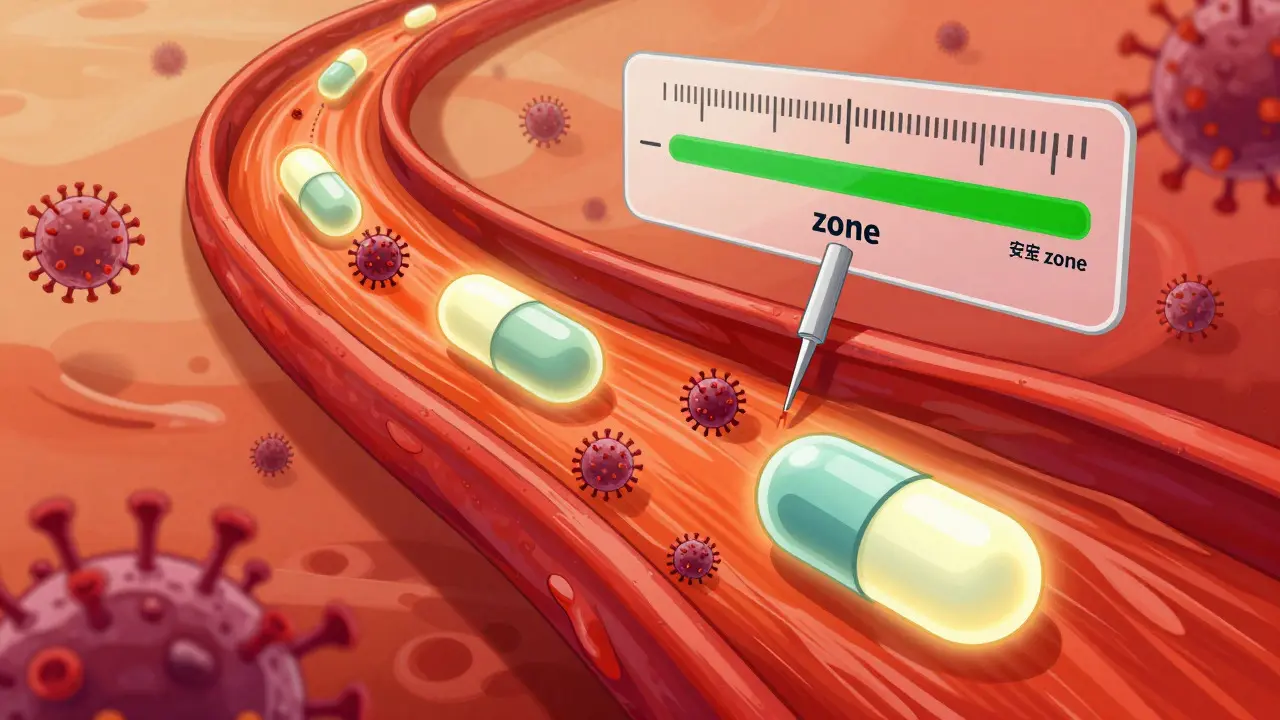
Therapeutic Drug Monitoring is a clinical strategy that guides dosing by measuring plasma drug concentrations and adjusting doses to keep levels within a target range. Think of it like checking the fuel gauge in a car. You don't just guess if you have enough gas; you check the meter. TDM checks the "meter" of your medication levels. If the level is too low, the virus might start multiplying again. If it's too high, you risk side effects or toxicity. The goal is to hit the sweet spot where the drug is effective but not harmful.
This process isn't about replacing standard care. It complements regular viral load tests. While a viral load test tells you if the virus is hiding, TDM tells you if the drug is actually present in the right amount to keep it hidden. This distinction is crucial when dealing with generic antiretroviral drugs, which must prove they are bioequivalent to their brand-name counterparts but can still vary slightly in how they are absorbed by different bodies.
The NRTI Exception: Why Not All Drugs Are Monitored
Here is a common point of confusion. You might think TDM applies to every pill in an HIV regimen. It doesn't. Specifically, Nucleoside Reverse Transcriptase Inhibitors (often called NRTIs or "nukes") are generally excluded from routine TDM. Why? Because these drugs are prodrugs. They need to be activated inside your cells before they work. Measuring them in the blood plasma doesn't accurately reflect what's happening inside the cell where the real action takes place.
TDM shines for other classes of drugs, particularly Protease Inhibitors and Non-Nucleoside Reverse Transcriptase Inhibitors. These drugs have a narrow therapeutic index, meaning there is a small window between being effective and causing harm. They also show high variability between patients. Some people metabolize them quickly, while others hold onto them longer. TDM helps navigate this variability, especially when a patient switches to a generic formulation that might have slight differences in absorption rates.
Why Generics Need Extra Care
Generic drugs are designed to be bioequivalent, meaning they deliver the same active ingredient at similar speeds. However, "similar" isn't always "identical." In most cases, this tiny difference doesn't matter. But for patients with tricky medical histories-like liver issues, kidney problems, or those taking multiple interacting medications-it can make a big impact. A generic that absorbs 5% slower might push a sensitive patient below the efficacy threshold.
This is where TDM becomes a protective tool. By measuring trough concentrations (the lowest level of the drug in your blood before the next dose), clinicians can verify that the generic is performing as expected. If the levels drop too low, the doctor can adjust the timing of the dose or switch back to the brand-name product if necessary. This proactive approach prevents silent treatment failures that might only become obvious months later through rising viral loads.
Real-World Scenarios Where TDM Helps
Let's look at specific situations where TDM proves its worth. One common scenario involves drug interactions. For example, if a patient is treated for tuberculosis using rifampicin or rifapentine, these drugs can significantly lower the levels of certain HIV medications like dolutegravir. Studies have shown exposure drops by up to 26%. Without TDM, a clinician might miss this dip until the viral load spikes. With TDM, the drop is caught early, allowing for a dose adjustment to maintain protection.
Another scenario is poor absorption. Imagine a patient experiencing severe diarrhea. Their gut might not be absorbing medication properly. A standard viral load test might remain normal for weeks due to the drug's long half-life, masking the problem. TDM reveals the low blood levels immediately. In one reported case, a clinician used TDM to adjust a protease inhibitor dose for a patient with severe diarrhea. Within eight weeks of the adjustment, the viral load became undetectable. That speed of correction is hard to achieve without direct concentration data.
Cost, Access, and Practical Limitations
TDM sounds ideal, but it comes with hurdles. The biggest is cost. In the UK NHS system, a single TDM test can cost between £250 and £350. In private US labs, urgent tests can run from $450 to $650. This makes it impractical for routine use in everyone. It is reserved for complex cases where the risk of failure outweighs the cost of testing.
Access is another barrier. Not every hospital has the lab equipment to run these specific assays. Often, samples must be sent to specialized reference laboratories. This introduces delays. Average turnaround times in public health systems are 10 to 14 days. For a patient already struggling with treatment, waiting two weeks for results can feel like an eternity. Some private labs offer expedited services with 2-3 day turnarounds, but that adds to the expense.
| Feature | Standard Viral Load Monitoring | Therapeutic Drug Monitoring (TDM) |
|---|---|---|
| What it measures | Virus copies in blood | Drug concentration in blood |
| Best for | Routine adherence checks | Complex interactions, special populations |
| Turnaround time | 1-2 weeks | 10-14 days (public), 2-3 days (private urgent) |
| Cost (approx.) | Covered by insurance/routine care | £250-£350 (UK) / $450-$650 (US private) |
| Applicability to NRTIs | Yes | No (due to intracellular activation) |

Expert Opinions and Current Guidelines
Experts are divided on how widely TDM should be used. Dr. Peter G. Gulick, a prominent researcher in this field, describes TDM as a useful tool to increase virologic efficacy and safety. He believes it provides valuable insights that standard tests miss. On the other hand, some guidelines, including those from the US Department of Health and Human Services, do not recommend routine TDM for all patients. They view it as an experimental or specialized tool rather than a standard of care.
The European AIDS Clinical Society (EACS) takes a middle path. They recommend TDM for specific situations: checking drug interactions, managing patients with pre-existing liver or kidney damage, addressing poor absorption, and adjusting pediatric doses. This targeted approach balances the benefits of TDM against its costs and logistical challenges. It acknowledges that while TDM is powerful, it is not a magic bullet for every patient.
Future Directions and Emerging Trends
As newer antiretroviral combinations enter the market, the role of TDM may evolve. Newer integrase inhibitors, for instance, interact with strong CYP3A4 inducers in ways that were less common with older drugs. The UK's 2025 guideline update expanded TDM recommendations to include these scenarios. This suggests that as treatments become more complex, the need for precise monitoring will grow.
In resource-limited settings, TDM is gaining attention for a different reason: safeguarding the use of generic drugs. Pilot programs in South Africa showed a 22% reduction in treatment failure among patients receiving TDM-guided therapy compared to standard care. This indicates that even in areas with fewer resources, TDM can be a critical tool for ensuring that affordable generics deliver reliable results. As global health systems strive to expand access to HIV treatment, TDM could play a vital role in maintaining quality control over generic supply chains.
Frequently Asked Questions
Does TDM apply to all HIV medications?
No. TDM is primarily useful for Protease Inhibitors and Non-Nucleoside Reverse Transcriptase Inhibitors. It is generally not applicable to Nucleoside Reverse Transcriptase Inhibitors (NRTIs) because these drugs require intracellular metabolism to become active, making plasma measurements less reflective of their actual effect.
How often should I get TDM tests done?
There is no fixed schedule for routine use. TDM is typically ordered during specific events: when starting a new drug combination, after a switch to a generic, when significant drug interactions occur, or if unexplained treatment failure happens. Your doctor will determine the frequency based on your individual clinical picture.
Is TDM expensive?
Yes, relative to standard tests. In the UK, it costs around £250-£350 per test. In the US, private urgent tests can range from $450 to $650. Insurance coverage varies, so it is often reserved for complex cases where the benefit clearly outweighs the cost.
Can TDM replace viral load testing?
No. They serve different purposes. Viral load testing confirms whether the virus is suppressed. TDM confirms whether the drug levels are adequate. Best practices suggest using them together, especially in complex cases, rather than relying on one alone.
How long does it take to get TDM results?
In public health systems, the average turnaround time is 10 to 14 days. Private laboratories may offer expedited services with results in 2 to 3 days for urgent cases. This delay is one of the main criticisms of TDM, as it can lag behind rapid changes in a patient's condition.