
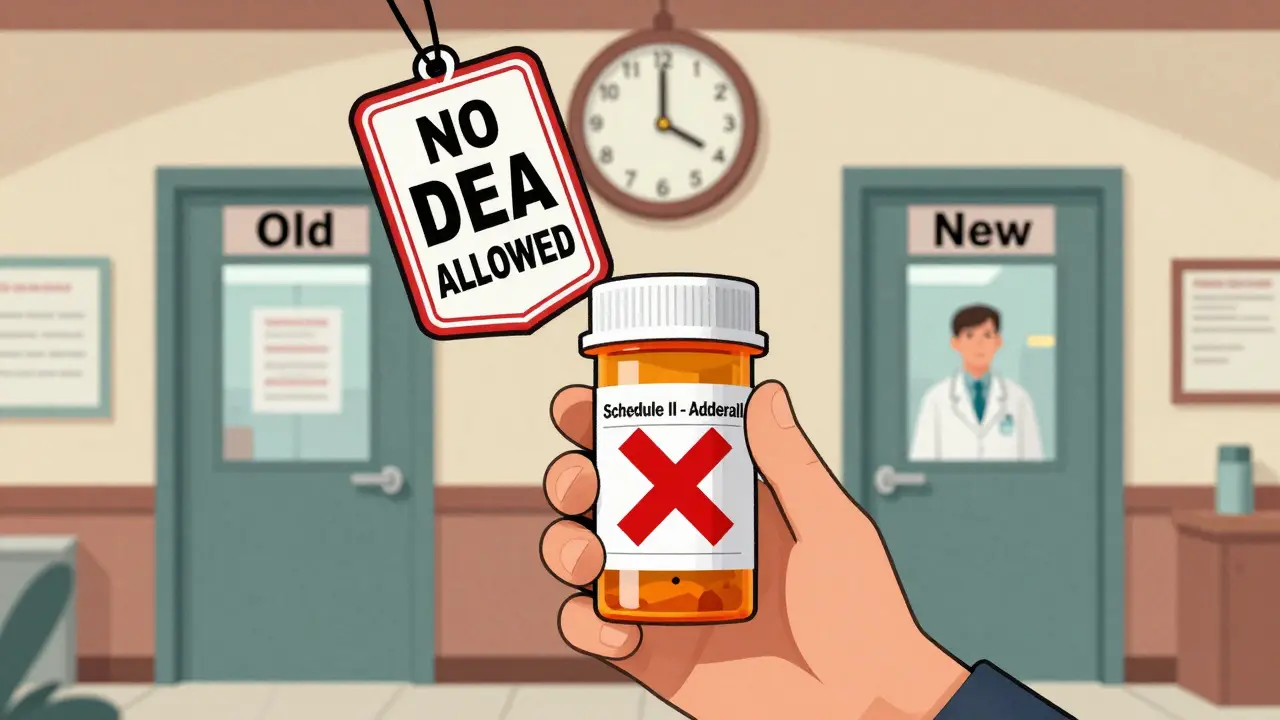
Changing pharmacies sounds simple-just walk in, hand over your scripts, and you’re done. But if you’re taking any controlled medications, it’s not that easy. The rules changed in August 2023, and now what you need to give your new pharmacy depends heavily on what kind of drugs you’re on. Get it wrong, and your prescription won’t transfer. You could be left without your medicine for days. Here’s exactly what to bring, what to ask, and what to watch out for.
Know Your Medication’s Schedule
The first thing you need to figure out is whether your medicine is a controlled substance, and if so, which schedule it’s in. The DEA classifies these into five groups, and only Schedules III, IV, and V can be transferred at all. Schedule II drugs-like oxycodone, Adderall, or fentanyl patches-cannot be transferred under any circumstances. If you’re on one of these, you must get a new prescription from your doctor. No exceptions.For Schedule III-V drugs-think gabapentin, tramadol, or certain ADHD meds-you can transfer them once. That’s it. Even if you have three refills left, you can’t move that same prescription to another pharmacy later. Once it’s transferred, the original is voided. This rule applies even if both pharmacies are owned by the same company, like CVS to CVS. It’s not about location-it’s about the prescription itself.
What Information to Give the New Pharmacy
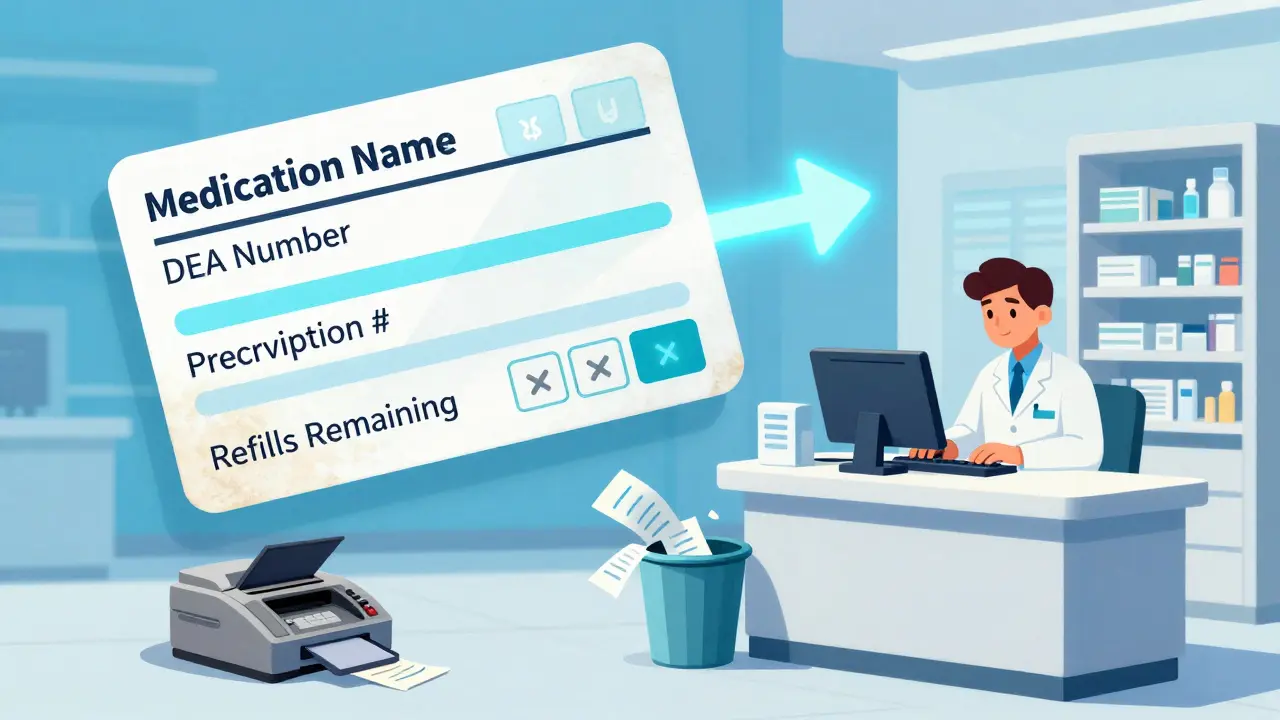
For any prescription transfer, you’ll need to give your new pharmacy your full legal name, date of birth, and current address. That’s standard. But for controlled substances, they’ll need more. Specifically:- The exact name of the medication and dosage
- The prescriber’s name and DEA number
- The original prescription number
- The date the prescription was written
- The original number of refills allowed and how many remain
- The last date it was filled
Don’t assume your old pharmacy will send all this automatically. Even though the transfer is electronic, the receiving pharmacy needs every detail to log it correctly. If they’re missing one piece, they’ll call you. And if you’re not available, the transfer stalls.
Controlled vs. Non-Controlled: Big Differences
If you’re only switching for non-controlled meds-like blood pressure pills, statins, or thyroid meds-you’re in the easy lane. You can transfer these as many times as you want, as long as refills are left. The process is faster, and pharmacies usually handle it without much back-and-forth. Most digital systems auto-send the info once you give your details.But for controlled substances, things get tight. The DEA requires that the transfer happen electronically between two licensed pharmacists. No paper copies. No screenshots. No forwarding emails. The prescription must move directly from one pharmacy’s secure system to another. And both pharmacies have to document everything:
- The transferring pharmacy must mark the original as “VOID” and record the date, the receiving pharmacy’s name, address, and DEA number, and the name of the pharmacist who sent it.
- The receiving pharmacy must add “TRANSFER” to the prescription record, note the original pharmacy’s info, and log their own name and the transfer date.
All records must be kept for at least two years. If a pharmacy can’t prove they followed these steps, they risk fines or losing their DEA license. That’s why some pharmacists are extra cautious-sometimes too cautious.
Why Your Transfer Might Get Stuck
You’d think this system would be smooth by now. But it’s not. Here’s why transfers fail:- State laws override federal rules. Some states, like California and New York, have stricter rules. They might require a signed form or limit transfers to in-state pharmacies only. If you’re moving across state lines, expect delays.
- Old systems still exist. About 13% of independent pharmacies hadn’t updated their software by the end of 2023. If your old pharmacy is small or rural, they might still be using fax or phone to send data-which isn’t allowed for controlled substances anymore.
- Missing DEA numbers. A common mistake? The new pharmacy asks for your prescriber’s DEA number, but you don’t have it. That number is on your prescription label. If you can’t find it, call your doctor’s office. They’ll give it to you in seconds.
- Prescription is out of refills. No refill left? No transfer. You need a new prescription, even if it’s a Schedule III drug. The DEA doesn’t allow partial refills to be transferred.
According to a 2023 Consumer Reports survey, 68% of people who tried to transfer a prescription ran into problems. Over 40% of those issues were because of controlled substance rules. Don’t be one of them.
How to Make the Transfer Go Smoothly
Here’s how to avoid the hassle:- Call your new pharmacy first. Ask: “Do you accept electronic transfers of Schedule III-V controlled substances?” Not all do, especially if they’re new or in a rural area.
- Have your old prescription label handy. Write down the medication name, dosage, prescriber, DEA number, prescription number, and refill count.
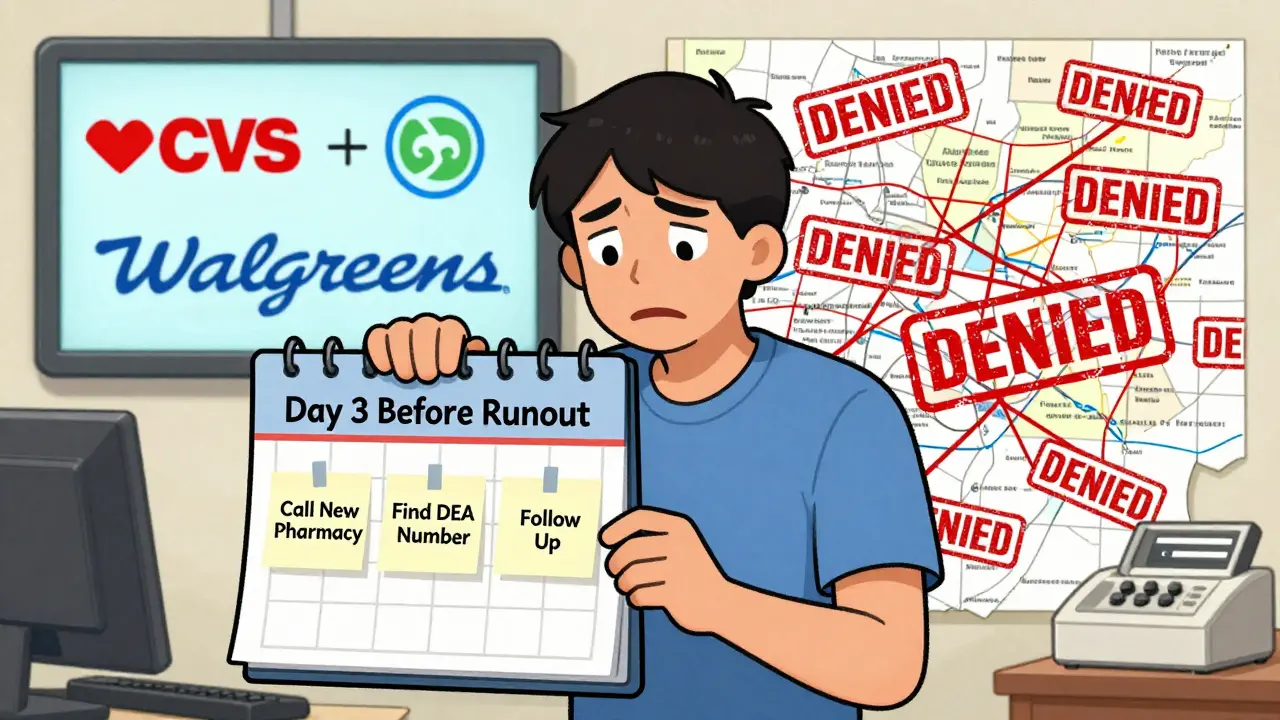
- Don’t wait until your last refill. Start the transfer at least 3 days before you run out. Transfers take 24-48 hours. Controlled substances often take longer because of extra checks.
- Ask your new pharmacy to call your old one directly. You don’t have to go back and forth. Most pharmacies will do this for you if you give them the info.
- Follow up. If you haven’t heard back in 48 hours, call the new pharmacy. Ask if they’ve received the prescription and if they need anything else.
What to Do If It’s Denied
If your transfer is refused, don’t just accept it. Ask for the reason in writing. Pharmacies are required to give you a valid reason under federal law. Common excuses like “we don’t do that” or “our system won’t let us” aren’t enough. If they say it’s because of state law, ask them to show you the specific regulation.Some pharmacies deny transfers because they’re unsure of the rules. That’s not your problem. If they’re wrong, you can report them to your state pharmacy board. Most boards have online complaint forms. Keep a record of your calls and emails.
What’s Coming Next
The DEA’s 2023 rule was the first big change to prescription transfers in over 15 years. They’re collecting data now to see how it’s working. By mid-2024, they’ll release an interim report. Industry experts believe they may allow multiple transfers for controlled substances by 2026-especially for chronic conditions like pain or ADHD. But for now, the one-time rule stands.Meanwhile, most major chains-CVS, Walgreens, Rite Aid-have fully updated their systems. Independent pharmacies are catching up, but slower. If you’re switching to a big chain, your odds of a smooth transfer are much higher.
Bottom Line
Switching pharmacies doesn’t have to be a nightmare. But if you’re on controlled meds, you need to be prepared. Know your drug’s schedule. Gather every detail from your prescription label. Call ahead. Follow up. And don’t assume anything will happen automatically. The system is better than it was, but it still demands attention. Get it right, and you’ll have your medicine without interruption. Get it wrong, and you’ll be stuck waiting-or worse, going without.Can I transfer a Schedule II prescription like Adderall to a new pharmacy?
No. Schedule II controlled substances-including Adderall, oxycodone, and fentanyl-cannot be transferred between pharmacies under any circumstances. You must get a new prescription from your prescriber. Even if you have refills left, the DEA does not allow these prescriptions to be moved. Plan ahead and contact your doctor before your current prescription runs out.
How many times can I transfer a Schedule III prescription?
Only once. The DEA’s 2023 rule allows a single electronic transfer for Schedule III, IV, and V controlled substances. After that, the original prescription is voided. Even if you have three refills remaining, you can’t transfer it again to another pharmacy later. If you need to switch again, you’ll need a new prescription from your doctor.
Do I need my prescriber’s DEA number to transfer a prescription?
Yes, for controlled substances. The DEA requires the receiving pharmacy to record the prescriber’s DEA number as part of the transfer documentation. You’ll find this number on your prescription label next to your doctor’s name. If you don’t have the label, call your doctor’s office-they’ll give you the number over the phone. Without it, the transfer cannot be completed.
Can I transfer prescriptions across state lines?
It depends. Federal rules allow interstate transfers of electronic prescriptions for controlled substances, but individual states can impose stricter rules. Some states require additional forms or prohibit transfers from out-of-state pharmacies entirely. Before switching, call your new pharmacy and ask if they accept transfers from your current state. If you’re moving permanently, it’s safer to get a new prescription from a provider in your new state.
What if my prescription has no refills left?
You cannot transfer a prescription that has used all its refills-whether it’s controlled or not. The DEA and state laws require an active refill to initiate a transfer. If you’re out of refills, contact your prescriber for a new prescription. Don’t wait until the last day. It can take several days to get a new script, especially if your doctor needs to schedule a follow-up visit.
How long does a pharmacy transfer take?
For non-controlled medications, transfers usually take 24 hours. For controlled substances, expect 24 to 48 hours, sometimes longer if the pharmacies are in different states or use different systems. The process is slower because pharmacists must verify DEA numbers, confirm transfer rules, and manually document each step. Plan ahead-don’t wait until your medicine runs out to start the transfer.
Can I transfer prescriptions if I’m using mail-order pharmacy?
Yes, but only if the mail-order pharmacy is DEA-registered and uses an electronic system that meets federal transfer standards. Most major mail-order services like Express Scripts or CVS Caremark can receive transfers. However, they typically only accept transfers from retail pharmacies, not from other mail-order providers. Check with your mail-order pharmacy directly before initiating the transfer.

Yo, if you're on Adderall and think you can just switch pharmacies like it's a gym membership, you're gonna be screwed. Schedule II? No transfers. Period. Get a new script or go cold turkey. No one's gonna help you if you wait till the last minute.
Thanks for breaking this down so clearly. I had no idea Schedule III-V prescriptions could only be transferred once. I just assumed it was like any other med. This saved me from a potential gap in my treatment. Always double-check the DEA schedule first!
Wow. So after all this drama, the only thing that changed is that now pharmacies have to type a little more in their system? And we’re supposed to be impressed? I’ve been transferring my gabapentin for 5 years. No one ever asked for my prescriber’s DEA number until now. Classic bureaucratic overreach.
The structural asymmetry in pharmaceutical logistics reveals a deeper epistemological crisis in how we institutionalize bioavailability as a right. The DEA’s one-time transfer paradigm enforces a performative compliance regime that prioritizes audit trails over patient continuity - a neoliberal technocracy disguised as regulatory prudence. The real failure isn’t the pharmacy’s software, it’s the ontological reduction of therapeutic necessity to transactional data points.
Meanwhile, the patient is left holding a half-empty bottle and a stack of unprocessed paperwork, wondering if their suffering is just a field in a database that hasn’t been synced.
Y’all are stressing over this way too much. I’ve switched pharmacies 3 times in the last year and never had an issue. Just call the new place first, have your label ready, and don’t panic. They’re not trying to make your life hard - they’re just following rules that are actually there to protect you. Seriously, take a breath, write down the info, and send it over. You got this.
One thing people forget: if you’re on a controlled med, your pharmacy isn’t just being annoying - they’re legally responsible for every single transfer. One typo in the DEA number and they could lose their license. So yeah, they’re gonna ask for the same info 5 times. Be patient. They’re not the enemy. The system is.
Okay but why are we pretending this isn’t just a way for big pharmacy chains to lock people in? CVS to CVS is still a transfer? That’s not a rule, that’s a monopoly tactic. You can’t switch to a cheaper pharmacy if you’re on gabapentin? What kind of dystopia are we living in? And don’t even get me started on how they make you wait 48 hours when you’re already out of pills. This isn’t safety - it’s profit control disguised as bureaucracy.
And don’t tell me it’s for ‘patient safety.’ If it was, they’d let you transfer multiple times. They’d let you use mail-order. They’d make it digital. But they don’t. Because they want you to stay put.
I’ve been on oxycodone for 7 years. I moved states. I called 12 pharmacies. 11 said no. The 12th said ‘we don’t do controlled substances.’ I had to drive 90 miles to a clinic that would see me the next day. I went 36 hours without pain meds. This system is a nightmare. And now you want me to be ‘patient’? No. This needs to burn down.
Prescription transfers for controlled substances require strict adherence to federal guidelines under 21 CFR 1306.25. The receiving pharmacy must verify the prescriber’s DEA registration status and confirm the authenticity of the prescription data. Failure to comply constitutes a violation of the Controlled Substances Act. Patients are advised to provide complete documentation to facilitate timely processing. State laws may impose additional requirements.
Just want to say I’ve been helping my mom transfer her tramadol since she can’t use phones well. The hardest part was finding the DEA number on the label. Took me 20 minutes. If you’re helping someone older, write down all the info ahead of time. Don’t make them dig through old bottles. It’s stressful enough already.
Thank you for this. In Nigeria we don’t have this kind of system. But I can see how important it is for people here. I hope more pharmacies learn this. Maybe one day we can have something like this where I’m from. Safety first, always.
Excellent guide. I’ve worked in pharmacy for over a decade and this is one of the most accurate summaries I’ve seen. For anyone reading this: if you’re switching to a mail-order pharmacy, confirm they accept transfers from retail locations. Many don’t. Also, keep a printed copy of your prescription label - even if you don’t think you need it. You’ll thank yourself later.
😭😭😭 This is why I hate America. You can’t even move your meds without a 12-page form, a notary, and a blood oath. I’m moving to Canada. At least there they don’t treat you like a criminal for needing pain relief. 🇨🇦
Why do they even make you write down all that stuff? Can’t the computer just talk to the other computer? This is 2024. I can order a pizza in 2 mins. But I gotta wait 3 days to get my ADHD med? This is dumb.
Look, I know this feels like a maze. But think of it this way - every time you give the pharmacy that DEA number, you’re helping them keep your meds safe from people who shouldn’t have them. This isn’t about making your life harder. It’s about making sure the next person who needs this med can actually get it. You’re part of the system now. Be the person who does it right - not the one who complains when it works.
And if you’re stuck? Call your doctor. Call your new pharmacy. Call again. Don’t give up. You’re worth the effort.