

You pick up your medication from the pharmacy, get home, and look at the bottle only to find a string of letters like "1 tab BID" or "PRN." It feels like you need a secret decoder ring just to figure out when to take your own medicine. This confusion isn't just annoying; it's a real safety risk. Many people mistake "TID" for "three days" or think "BID" means "before and after dinner," which can lead to missing doses or taking too much.
The goal of this guide is to strip away the medical jargon and give you a clear, plain-English translation of the most common prescription label directions. Whether you are managing your own health or helping a parent, knowing these codes ensures your treatment actually works. If you're unsure about a dose, remember: it is always better to call your pharmacist than to guess.
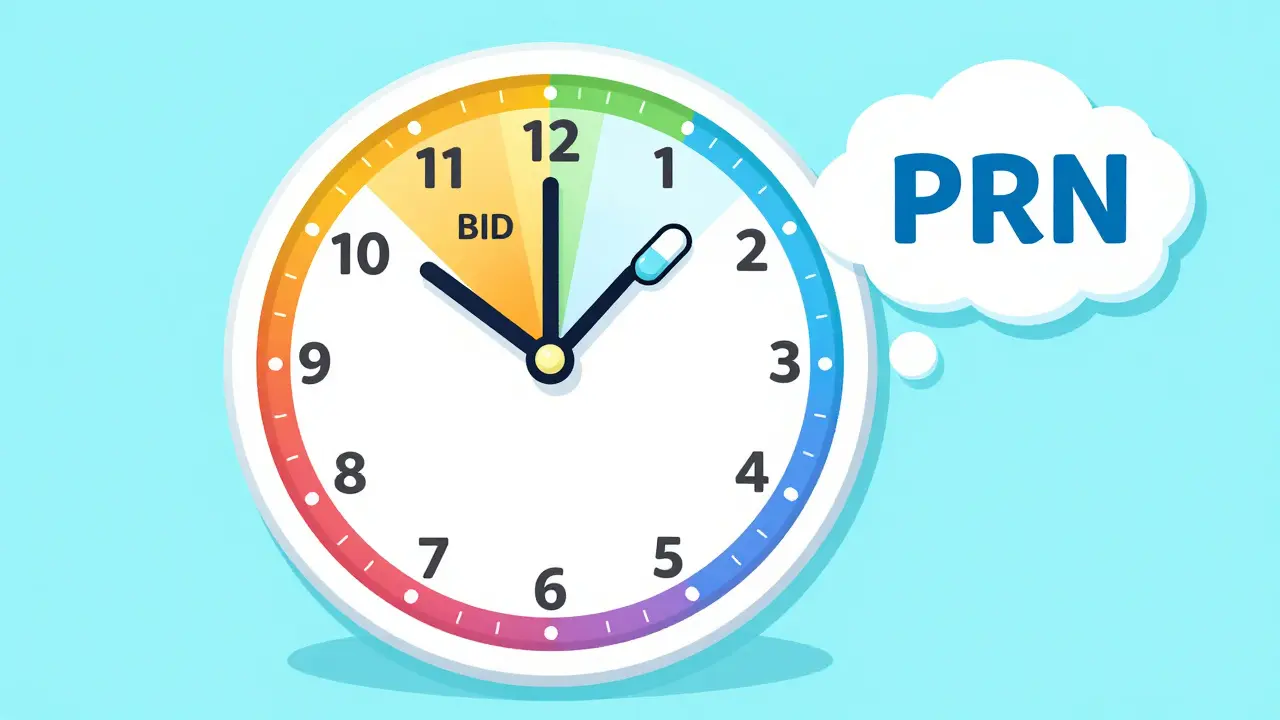
- BID means twice a day (roughly every 12 hours).
- TID means three times a day (roughly every 8 hours).
- PRN means "as needed"-not on a fixed schedule.
- QID means four times a day (roughly every 6 hours).
- Consistency is key: varying your dosing intervals can significantly lower drug efficacy.
The Most Common Timing Abbreviations
Most pharmacy shortcuts come from Latin, a practice that started over a century ago to save space on handwritten pads. While we use computers now, these codes stuck around. Here are the ones you'll see most often:
- BID is short for bis in die. It means you should take the medication twice daily. For the best results, space these out 12 hours apart-like 8:00 AM and 8:00 PM.
- TID stands for ter in die, meaning three times a day. To keep a steady level of medicine in your bloodstream, aim for 8-hour intervals (e.g., 6:00 AM, 2:00 PM, and 10:00 PM). A study from Johns Hopkins showed that taking TID antibiotics at inconsistent 10-hour intervals instead of 8-hour spacing dropped treatment efficacy by 27%.
- QID comes from quater in die, which means four times daily. Usually, this implies a dose every 6 hours.
- QD stands for quaque die, or once daily. Try to take this at the same time every day to maintain a routine.
Understanding "As Needed" and Special Instructions
Not every pill follows a strict clock. Some medications are only for when symptoms flare up. That's where PRN (pro re nata) comes in. It literally means "as the occasion arises."
When you see PRN, the label should also give you a limit. For example, "Ibuprofen 400mg PRN for pain, max 3 doses in 24 hours." If it doesn't have a limit, ask your pharmacist. The FDA has noted that PRN medications are responsible for about 31% of all dosing errors because patients often misunderstand the boundaries of "as needed."
You might also see instructions regarding food or sleep:
- AC (ante cibum): Take this before meals, usually 30 to 60 minutes before you eat.
- PC (post cibum): Take this after meals, typically within 30 minutes of finishing.
- HS (hora somni): Take this at bedtime.
- PO (per os): This just means the medicine is taken by mouth.
| Abbreviation | Latin Term | Plain English Meaning | Ideal Interval |
|---|---|---|---|
| BID | Bis in die | Twice a day | Every 12 hours |
| TID | Ter in die | Three times a day | Every 8 hours |
| QID | Quater in die | Four times a day | Every 6 hours |
| PRN | Pro re nata | As needed | Based on symptoms |
| QD | Quaque die | Once a day | Every 24 hours |
Why Timing Actually Matters
It might seem like taking a pill "sometime in the morning" and "sometime in the evening" is close enough for BID dosing, but precision counts. The 2023 American College of Clinical Pharmacy guidelines suggest that the acceptable variation for a dose is only about ±15% of the interval. For a TID schedule, that means your window is roughly 6.8 to 9.2 hours.
Why be so strict? Certain drugs, especially antibiotics and blood thinners, require a consistent concentration in your blood to work. If the gap between doses gets too long, the drug level drops, and the bacteria or condition you're fighting can bounce back. Mayo Clinic research found a 38% drop in drug efficacy when intervals varied by more than two hours from the prescribed schedule.
Avoiding Dangerous Mistakes
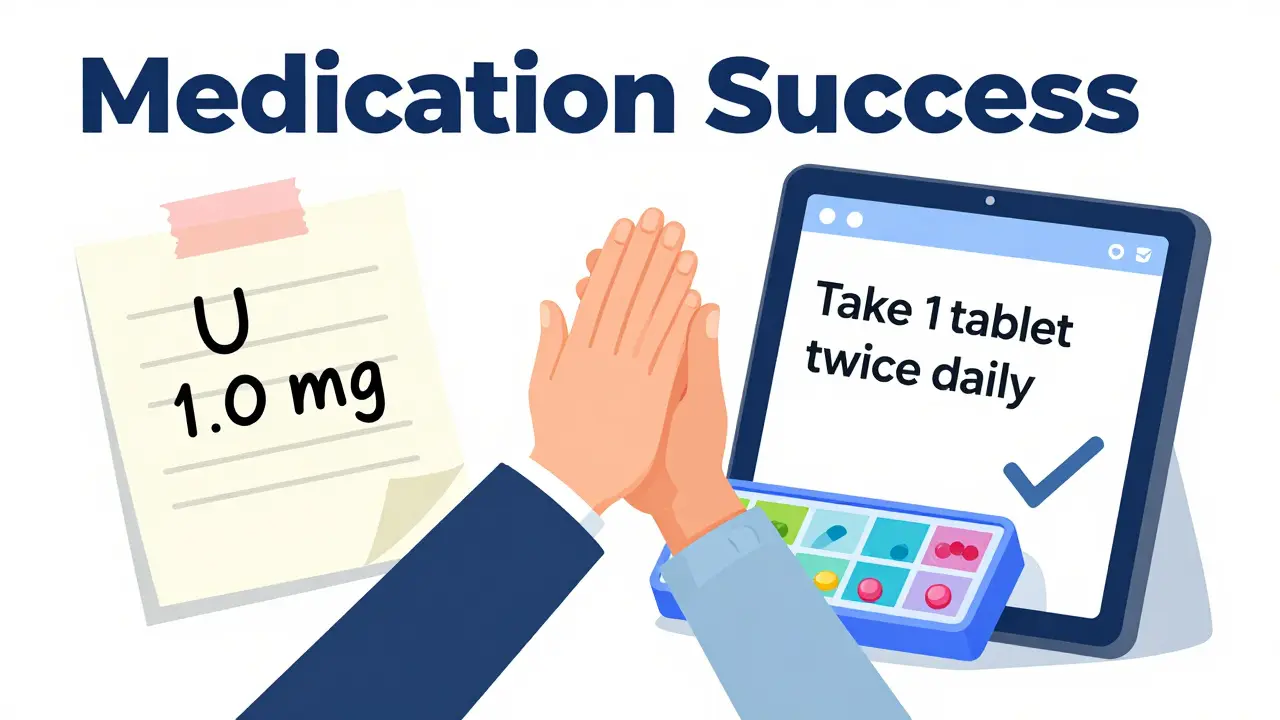
Some abbreviations are so confusing that medical authorities have tried to ban them. The Joint Commission created a "Do Not Use" list to prevent fatal errors. One of the biggest culprits was the letter "U" for Units. In many cases, a handwritten "U" looks like a zero. There have been documented instances where a patient was supposed to get 10 units of insulin, but the "U" was read as "0," leading to a massive 10-fold overdose.
Another risk is the "trailing zero." Writing "1.0 mg" instead of "1 mg" can be dangerous if the decimal point is missed, making it look like "10 mg." If you see anything on your label that looks like a decimal or a strange single letter, don't assume you know what it means. Double-check it immediately.
Pro Tips for Staying on Track
If you're juggling multiple medications with different schedules, relying on memory is a recipe for disaster. Here are a few concrete ways to ensure you get the dosing right:
- The Teach-Back Method: When the pharmacist explains the label, repeat it back to them in your own words. For example, "So, I take one pill at 8 AM and one at 8 PM, and only take the other one if I have a headache, but no more than three times a day?" This simple step can reduce misunderstandings from 38% down to 9%.
- Pill Organizers: Use a weekly pill box with morning, afternoon, and evening slots. According to a study in the Annals of Internal Medicine, this improves adherence by 52%.
- Digital Reminders: Apps like Medisafe can convert these confusing abbreviations into plain-English alarms on your phone, so you don't have to remember if "QID" means four times or every four hours.
- The Brown Bag Review: Every few months, put all your current medications in a bag and take them to your doctor. They can verify that the directions on the labels match the current treatment plan and check for conflicting schedules.
The Future of Pharmacy Labels
The good news is that these Latin codes are slowly dying. The United States Pharmacopeia (USP) has issued standards to eliminate Latin abbreviations in favor of plain English. In fact, some major pharmacy chains like Walmart and CVS have already moved toward plain-English labeling for the majority of their prescriptions.
Electronic prescribing is also a huge win. When a doctor sends a prescription digitally via systems like Epic or Cerner, the risk of a pharmacist misreading a handwritten "BID" as something else drops significantly. Experts predict that by 2030, these old-school abbreviations will be almost entirely gone from clinical practice, replaced by clear instructions like "Take twice daily."
What is the difference between BID and TID?
BID means you take the medication twice a day, typically every 12 hours. TID means you take it three times a day, ideally every 8 hours. The main difference is the frequency and the resulting interval between doses to keep the medicine effective in your system.
What does PRN mean and how do I use it?
PRN stands for "as needed." Unlike BID or TID, you don't take PRN meds on a fixed schedule. Instead, you take them only when you feel a specific symptom (like pain or nausea). Always check the label for the maximum number of doses allowed in 24 hours to avoid overdose.
Is it okay if I'm an hour or two late for my dose?
A small window of variation (about 15% of the interval) is generally acceptable. However, if you are consistently off by more than two hours, the efficacy of the drug can drop significantly, especially for antibiotics. If you miss a dose, check your patient information leaflet or call your pharmacist before doubling up.
Why do pharmacies still use Latin abbreviations?
These abbreviations were developed in the early 20th century to save space and time for doctors writing prescriptions by hand. While electronic prescribing is now common, many healthcare providers were trained using these terms, and they remain embedded in legacy medical systems.
What should I do if the label is confusing or handwritten?
Never guess. Call your pharmacy or speak with the pharmacist in person. They are the final check in the medication process and expect patients to ask for clarification. You can also use the "teach-back" method to confirm you've understood the timing correctly.
Next Steps for Different Needs
If you are a primary caregiver: Start a medication log. Instead of writing "BID," write "8:00 AM / 8:00 PM" next to the drug name. This prevents confusion when multiple people are helping with care.
If you are managing chronic illness: Set up a digital health app or a smart speaker reminder. These tools can bridge the gap between a confusing label and the actual time you need to swallow the pill.
If you are traveling: Be aware that different countries use different codes. For example, in the UK, "BD" is used for twice daily, whereas in the US, "BID" is the standard. Always verify the dosing with a local pharmacist if you're filling prescriptions abroad.

Standard stuff here, but definitely a lifesaver for people who get overwhelmed at the pharmacy counter. I always tell my patients to just snap a photo of the label and use a reminder app because memory fails even the best of us.
It is truly fascinating how we cling to the vestiges of Latin in a digital age. One might argue that the persistence of these abbreviations is less about efficiency and more about maintaining a curated barrier of professional exclusivity. The cognitive load placed upon the layperson is an unnecessary burden, yet it persists as a relic of a bygone era where the physician was the sole arbiter of knowledge.
pill boxes are the way to go
Oh wow, look at us spending our precious time discussing Latin codes for pills. I'm sure the pharmacists love it when you spend twenty minutes "teaching back" your basic understanding of a bottle. Maybe just try reading the English part of the label that says "twice a day" instead of treating it like a PhD program.
Apps are just a crutch.
The lack of emphasis on pediatric dosing in this guide is... concerning!!! Imagine a parent missing a decimal point on a child's liquid med... absolute nightmare!!! This needs a massive disclaimer about weight-based dosing!!!
India has way better pharmacy systems than the US anyway 🇮🇳. Why use Latin when simple English works? This whole "decoder ring" thing is just a failure of Western medical bureaucracy 🙄.
Imagine living in a country where you can't even read your own meds. Truly a tragedy of the modern age 🙄💅. Only in America do we need a whole guide for "twice a day"!
It is interesting to see the difference in terminology across borders. In many parts of Asia, we are quite used to these shorthand notes, but having a standardized guide is helpful for everyone regardless of where they are from.
I absolutely love the idea of the brown bag review because it allows the doctor to see everything in one place and it's just so much more efficient than trying to list every single supplement and prescription from memory while you are sitting in a tiny exam room with a ticking clock!
Get those pill organizers right now! Seriously, stop gambling with your health and get organized! If you can't remember a pill, you can't recover! Let's get this adherence rate up to 100%!
I must insist that every individual utilizes the teach-back method without exception! It is an absolute necessity for patient safety! Failure to confirm your understanding is a dereliction of your own health responsibilities!
Everyone must follow these guidelines strictly to ensure the best outcomes! There is no excuse for dosing errors in a modern medical facility! Be proactive and demand clear labels from your pharmacy immediately!
Absolute gold. I love how we've reached the peak of civilization and we're still using dog-latin so some guy in a white coat can feel like a wizard. It's a real masterpiece of inefficiency. Honestly, if you can't handle a three-letter code, maybe just stick to vitamins and prayers because the real world is a cruel, confusing place for the mediocre 🇺🇸.