
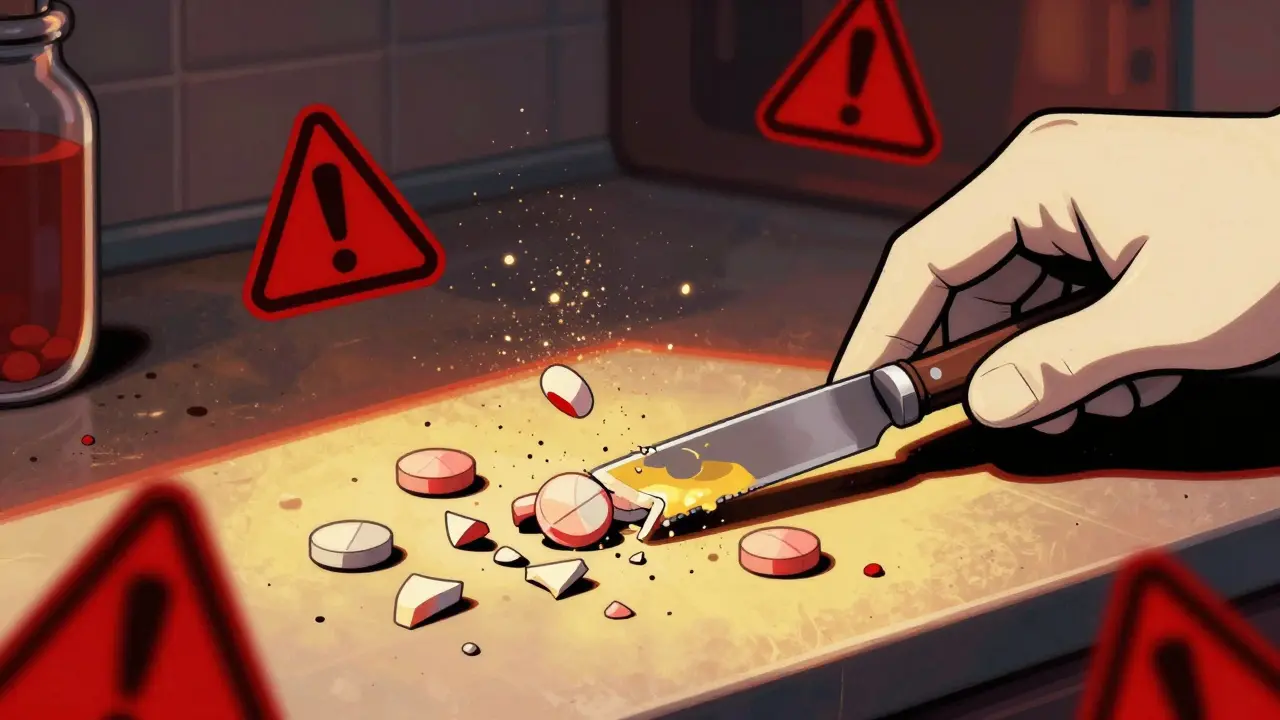
Splitting a pill seems simple enough. You take a tablet, put it in a cutter, press down, and you’re done. But if you’ve ever seen the dusty residue left on your counter or noticed how easily powder sticks to your fingers, you know it’s messier than it looks. That mess is more than just annoying-it’s a health risk. Improper handling can lead to cross-contamination, inaccurate doses, and even exposure to hazardous drugs.
In care homes and hospitals, this isn’t just a household chore; it’s a regulated medical procedure. The Institute for Safe Medication Practices (ISMP) has issued strict guidelines because errors here are common. In fact, improper splitting contributes to over 8% of medication errors in institutional settings. For caregivers at home, the stakes are just as high. Getting the technique right protects you from inhaling dangerous particles and ensures the person taking the medicine gets exactly what they need.
Know Which Pills Can Be Split
Before you even touch a pill splitter, you need to know if the medication allows it. Not every tablet is built to be divided. About 40% of medications cannot be safely split due to their formulation. If you force them apart, you might destroy the drug’s effectiveness or release toxic chemicals.
Look for a score line-a shallow groove pressed into the center of the tablet. This is the manufacturer’s signal that the pill is designed to be split. However, a score line doesn’t guarantee safety for all types. You must avoid splitting these specific categories:
- Enteric-coated tablets: These have a special coating that prevents stomach acid from breaking them down too early. Splitting exposes the core, causing irritation or destroying the drug before it works.
- Sustained-release or extended-release formulations: These are engineered to release medication slowly over hours. Breaking them dumps the entire dose at once, which can cause overdose or severe side effects.
- Hazardous drugs (HDs): Certain chemotherapy agents and other potent medications are classified as hazardous. Crushing or splitting them without specialized closed-system equipment can aerosolize cytotoxic agents, posing serious health risks to anyone nearby.
If the label says "DO NOT CRUSH OR SPLIT," respect it. According to FDA documentation, nearly 98% of enteric-coated, sustained-release, or hazardous drugs fall into this restricted category. When in doubt, ask your pharmacist. They can check if a generic alternative with a lower strength is available, which is often safer and cheaper than splitting.
Use the Right Tools for the Job
Using a butter knife, scissors, or your fingernails to break a pill is a recipe for disaster. Studies show that improvised methods achieve only about 64% dose accuracy, whereas using a dedicated pill splitter boosts accuracy to over 92%. More importantly, proper tools contain the debris.
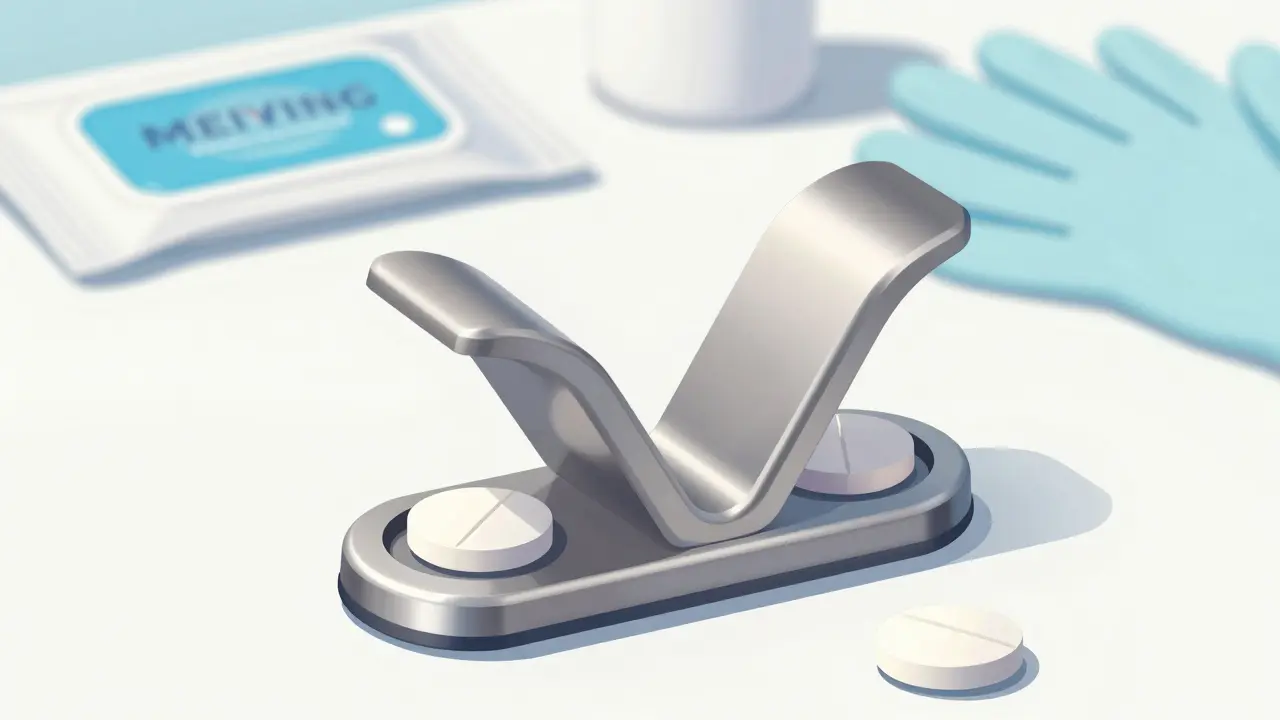
A good pill splitter features a V-shaped holder to keep the tablet steady and stainless steel blades with tight tolerances (around 0.05mm) for clean cuts. For crushing, especially for patients who can’t swallow pills, open mortars and pestles create airborne dust. Instead, use a sealed crusher like the Silent Knight model. These devices contain crushed medication within a closed container, preventing residue from spreading across countertops or being inhaled. Research indicates that closed-system crushers reduce hazardous drug exposure by nearly 90% compared to open techniques.
| Method | Dose Accuracy | Contamination Risk | Best Use Case |
|---|---|---|---|
| Dedicated Pill Splitter | 92-95% | Low (if cleaned) | Scored immediate-release tablets |
| Scissors/Knife | ~64% | High (uneven cuts, residue) | Not recommended |
| Closed-System Crusher | N/A (Powder) | Very Low (Sealed) | Powdering for feeding tubes/hazardous drugs |
| Mortar and Pestle | N/A (Powder) | High (Airborne dust) | Only for non-hazardous drugs with ventilation |
Master the Hygiene Protocol
Even with the best tool, contamination happens if you skip hygiene steps. Cross-contamination occurs when residue from one medication mixes with another, or when environmental bacteria get into the dose. Here is the step-by-step protocol recommended by safety experts:
- Prepare the area: Work on a hard, flat surface that is easy to wipe down. Clear away clutter. Ensure good lighting so you can see the score line clearly.
- Sanitize hands and tools: Wash your hands thoroughly with soap and water. Put on disposable gloves if you are handling multiple medications or hazardous drugs. Wipe the pill splitter’s blade and tray with 70% isopropyl alcohol wipes between uses. Let it air dry completely.
- Align carefully: Place the tablet in the splitter’s holder. Align the score line precisely with the blade. Don’t rush this step. Misalignment causes crumbling, which increases waste and mess.
- Press firmly: Apply steady, downward pressure. Do not twist or rock the blade, as this can crush the pill rather than slice it.
- Adminimize immediately: Once split, give the medication right away. Storing split halves exposes them to moisture and air, which can degrade the drug. The Joint Commission mandates documentation of administration within 15 minutes for split meds in clinical settings to ensure potency.
- Clean up: Dispose of any crumbs or dust immediately. Wipe the splitter again with alcohol. Remove gloves and wash hands.
A critical rule: Never share splitters between different patients or different medications without cleaning them first. Surveys show that while most staff wash their hands, fewer than 35% clean the splitter between different drugs. This is a major source of cross-contamination, especially with sensitive medications like warfarin, where even tiny amounts of extra dosage can be dangerous.
Storage and Disposal Best Practices
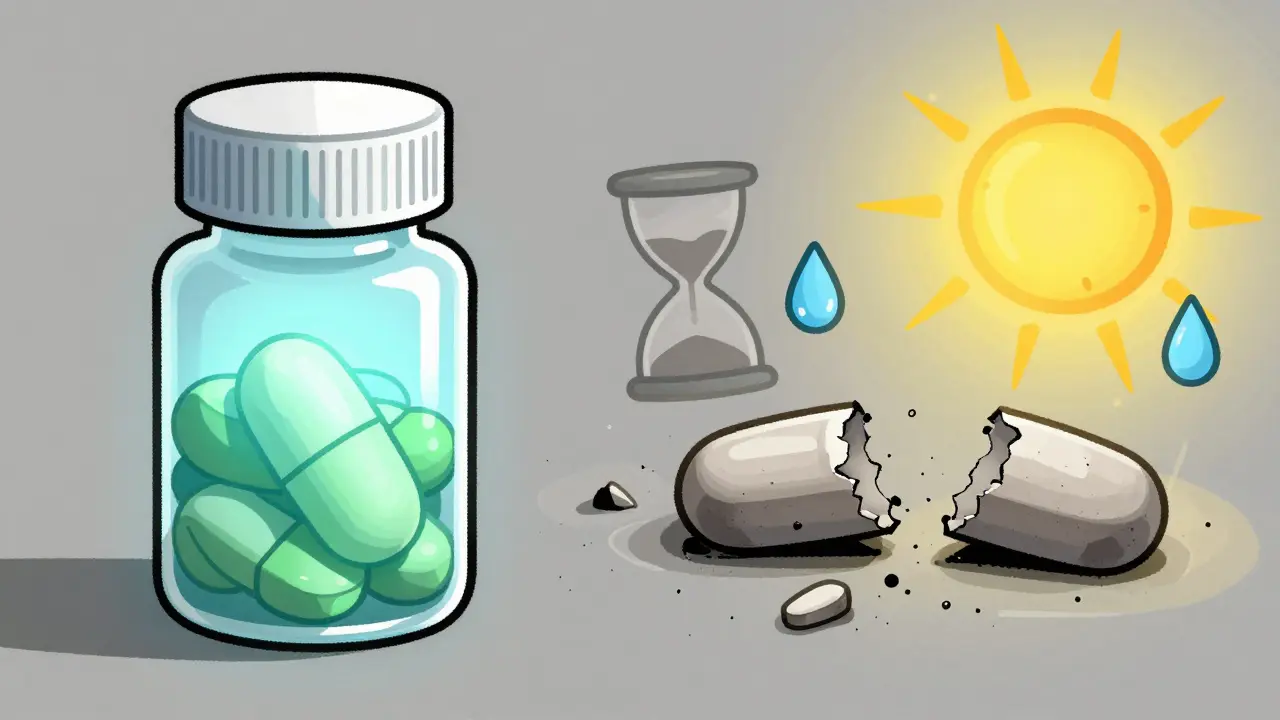
You might think saving time by splitting an entire bottle of pills at once is efficient. It’s not. The FDA explicitly advises against pre-splitting medications for storage. Once a tablet is broken, its protective coating is gone. Exposure to humidity, oxygen, and light accelerates chemical degradation. A study on drug stability showed that split tablets lose potency faster than intact ones, sometimes within days depending on the environment.
Store split halves only if absolutely necessary, and then only in airtight, opaque containers. Label them clearly with the date and medication name. Discard any unused portion after a week unless your pharmacist confirms longer stability. For disposal, do not flush most medications down the toilet. Instead, mix unwanted crushed or split pills with unpalatable substances like coffee grounds or cat litter in a sealed bag, and throw them in the trash. Many pharmacies also offer take-back programs for safe disposal.
When to Call the Pharmacist
Pharmacist-led education has been shown to reduce splitting errors by nearly 60%. If you are unsure about a medication, don’t guess. Ask your pharmacist three questions:
- Is this tablet scored and approved for splitting?
- Are there lower-strength versions available that would eliminate the need to split?
- Does this medication require special handling due to being hazardous or unstable?
In many cases, switching to a generic version with the exact dose needed costs less than splitting a higher-dose brand-name drug. Plus, it eliminates the risk of dosing errors entirely.
Can I split my pills if they don't have a score line?
Generally, no. A score line indicates the manufacturer tested the tablet for even splitting. Without it, the dose may be uneven, leading to under- or overdosing. Additionally, unscored tablets are often coated or formulated for slow release, which splitting can disrupt.
How do I clean a pill splitter properly?
After each use, disassemble the splitter if possible. Wipe all surfaces, especially the blade and holding tray, with 70% isopropyl alcohol wipes. Allow it to air dry completely before reassembling. Do not wash metal blades in dishwashers as this can dull the edge and promote rust.
Is it safe to store split pills for later use?
It is not recommended. Split pills are exposed to air and moisture, which can degrade the medication quickly. If you must store them, keep them in an airtight, dark container and use them within a few days. Always check with your pharmacist for specific stability guidelines.
What should I do if a pill crumbles instead of splitting cleanly?
If the pill crumbles, discard the pieces. You cannot accurately measure the dose from crumbs, and you risk giving too little or too much medication. Try again with a new tablet, ensuring better alignment in the splitter. If it keeps happening, the tablet may not be suitable for splitting.
Why are some pills labeled as hazardous?
Hazardous drugs, such as certain cancer treatments, can be harmful to people handling them. Crushing or splitting these pills can release toxic dust into the air or onto surfaces. They require special closed-system equipment and protective gear to prevent occupational exposure and contamination.